

Quick Answer
Yes, many Border Collies, often shortened to BCs, like to cuddle after their exercise and mental needs are met. Cuddle preference still varies by personality, age, socialization, and experience; the AKC Border Collie profile describes the breed as affectionate and able to settle for cuddle time after activity.
Signs your Border Collie enjoys cuddling
- Leans into you: Your dog presses a shoulder, hip, or side against your body and stays relaxed.
- Chooses closeness: Your Border Collie settles beside you without being called or restrained.
- Stays soft: Their eyes, jaw, ears, and body remain loose while you touch them.
- Returns for more: They move back toward your hand after you briefly stop petting.
- Settles after activity: Cuddling often feels easier after a walk, training session, or play period.
Best rule
- Let your Border Collie choose contact. Affection is more meaningful when your dog can approach, stay, or leave freely.
Border Collies are famous for intense focus, quick learning, and seemingly endless energy. What surprises many new owners is how affectionate a Border Collie, or BC, can become once the day slows down.
I have found that the question is less about whether the breed cuddles and more about how each dog prefers closeness. Some want to lie across your feet, while others would happily climb into your lap.
In This Guide
- Do Border Collies actually enjoy cuddling?
- Why do some Border Collies cuddle more than others?
- How do Border Collies show affection besides cuddling?
- When do Border Collies become more cuddly?
- How can I tell if my Border Collie wants a cuddle?
- How can I encourage calm affection without forcing it?
- Is a suddenly clingy Border Collie a concern?
- Border Collie vs Australian Shepherd: which is more cuddly?
- Frequently asked questions
Do Border Collies actually enjoy cuddling?
Many Border Collies enjoy cuddling, but they often want affection on their own terms. A well-exercised dog may become much more interested in quiet contact once the need to move, think, and work has eased.
As of 2026, the practical answer remains simple: breed tendencies matter, but individual preference matters more. One dog may sleep against your legs, while another prefers a nearby bed.
Definition: A Border Collie’s cuddle preference is the amount and type of close physical contact the individual dog voluntarily seeks from trusted people.
The breed’s herding heritage helps explain the pattern. Border Collies were developed to stay highly aware of movement, distance, livestock, and handler cues, so closeness may look more alert than sleepy.
I do not judge affection by lap time alone. A dog that follows me, checks in during chores, then sleeps nearby can still be deeply bonded.
- Common cuddler: lies against your side, rests a head on you, or asks for chest rubs.
- Contact-light dog: stays nearby but dislikes being hugged or held tightly.
- Activity-first dog: seeks affection mainly after exercise, training, or work.
- Selective cuddler: wants physical contact with one or two trusted people.
Section Takeaway: Most Border Collies are capable of strong affection, but cuddling is only one expression of attachment. Look for voluntary closeness rather than forcing a classic lap-dog style.
Why do some Border Collies cuddle more than others?
Cuddle preference comes from a mix of genetics, early handling, learned experiences, age, routine, and personality. Even littermates raised together can develop different comfort levels with touch.
Temperament makes a big difference
Border Collies are responsive dogs, and many notice small changes in human movement or mood. That sensitivity can produce a dog that seeks contact often or one that values a little personal space.
A puppy that repeatedly gets calm, pleasant handling may learn that touch predicts comfort. A dog that has been grabbed, restrained, or startled during handling may become more cautious.
- Early socialization: gentle, positive exposure to people can make physical contact feel familiar.
- Past experience: rescue dogs or poorly handled dogs may need more time before choosing close contact.
- Household rhythm: dogs often become cuddlier when the home has predictable periods for activity and rest.
- Temperature: some dogs seek more body contact in cool weather and less during heat.
- Coat and comfort: a dense double coat can make long, warm cuddles less appealing.
Exercise can change the answer
A restless Border Collie may struggle to lie still even when they adore you. These dogs often need meaningful physical activity plus mental work before they can switch into rest mode.
I see the clearest difference after balanced activity, not endless ball throwing. A short training session, a sniff-rich walk, and controlled play often produce a calmer dog.
Section Takeaway: A Border Collie’s cuddle style reflects both who the dog is and how safe, satisfied, and settled they feel. Meeting exercise and mental needs often makes affection easier to enjoy.
How do Border Collies show affection besides cuddling?
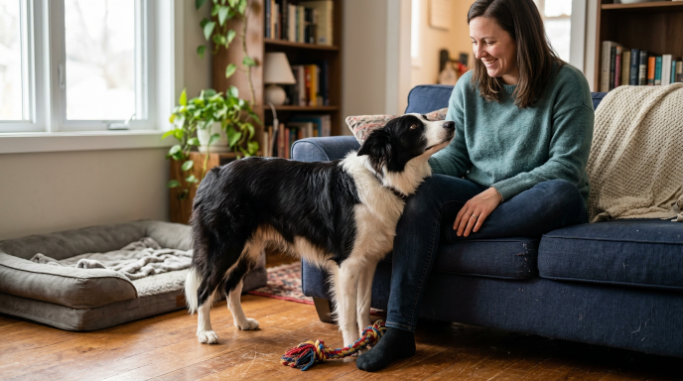
Border Collies often show love through proximity, attention, cooperation, and shared activity. A dog does not need to sit in your lap to have a strong bond with you.
Some of the most affectionate Border Collies I have known were “shadow dogs.” They followed quietly and chose the same room without demanding touch.
- Following you: your dog regularly chooses to stay near you around the home.
- Checking in: they look back at you during walks or return between bursts of play.
- Bringing toys: they invite you into games instead of entertaining themselves alone.
- Leaning: they press gently against your leg or side while remaining relaxed.
- Resting nearby: they sleep close enough to monitor you without needing full-body contact.
- Responsive training: they seem eager to work with you and enjoy your praise.
Watch the whole dog, not one signal
A wagging tail alone does not prove a dog wants to be touched. Read posture, eyes, mouth, ears, movement, and whether the dog is choosing to stay.
The PetMD guide to dog body language is a useful visual reference for relaxed, stressed, fearful, and alert signals.
For me, the strongest affection signal is choice. If I stop touching a Border Collie and the dog moves closer again, that is a much clearer invitation than simply tolerating my hands.
When do Border Collies become more cuddly?
Many Border Collies become more settled and physically affectionate as they mature, but there is no guaranteed age. Puppies and adolescents often value exploration, motion, and play more than prolonged contact.
Puppies under about six months
Young puppies may cuddle when sleepy, then suddenly wake and bite a sleeve, chase a toy, or investigate the room. Keep handling short, gentle, and easy to escape.
Adolescents from roughly six to eighteen months
Adolescence can bring more energy, independence, and environmental focus. Some dogs temporarily seem less cuddly because everything outside their body is more interesting.
Adults from roughly eighteen months onward
Adult Border Collies often develop clearer routines and better off-switches. Once exercise and training are predictable, many begin seeking quiet evening contact more consistently.
Senior Border Collies
Older dogs may enjoy longer resting periods and more companionship, but increased closeness can also reflect discomfort or insecurity. Pay attention when the change is sudden rather than gradual.
Vet note: If an older Border Collie suddenly becomes clingy, avoids normal movement, seems painful, or changes sleep and appetite patterns, contact your veterinarian rather than assuming the dog simply became more affectionate.
How can I tell if my Border Collie wants a cuddle?
A Border Collie that wants contact usually approaches voluntarily and stays physically loose. The safest cuddle is one your dog can end whenever they choose.
| What you see | Likely meaning | Best response |
|---|---|---|
| Loose body, soft eyes, leaning in | Comfortable with contact | Continue gently, then pause |
| Moves closer after you stop | Actively asking for more | Resume calm petting |
| Turns head away, licks lips, yawns | Possible discomfort or conflict | Give space and reassess |
| Stiff body, hard stare, freezing | Strong warning that contact is unwanted | Stop touching and create distance |
| Walks away and stays away | Cuddle session is finished | Respect the choice |
A simple consent test works well: pet for three to five seconds, then stop. If your dog leans back in, paws softly, nudges, or moves closer, you can continue.
If your dog turns away or leaves, let the interaction end. This small habit builds trust because your Border Collie learns that closeness never means being trapped.
The ASPCA dog bite prevention guidance also stresses understanding anxious, fearful, or threatened body language and respecting a dog’s signals.
How can I encourage calm affection without forcing it?
You can make cuddling more likely by pairing physical closeness with safety, predictability, and choice. Do not hold a reluctant Border Collie in place or repeatedly pull them back toward you.
- Meet daily needs first. Give age-appropriate exercise, sniffing, training, play, food enrichment, and rest.
- Pick a calm time. Try after the evening walk or when your dog is already lying down.
- Invite rather than grab. Sit nearby and let the dog close the distance.
- Start with preferred areas. Many dogs accept chest, shoulder, or side contact more easily than hugs over the head.
- Use short sessions. Stop after a few seconds and see whether the dog asks for more.
- Reward calmness naturally. Soft praise, gentle contact, or simply staying together can be enough.
Teach an off-switch, not exhaustion
Border Collies can become conditioned to expect nonstop action. If every restless moment starts a game of fetch, your dog may never learn that quiet time is part of the routine.
I like a simple evening pattern: activity, water, a short training reset, then a mat or sofa cue. The goal is not obedience for its own sake; it is helping the dog recognize that nothing else needs doing.
Keep training positive and clear. Border Collies are quick to notice pressure, so calm repetition usually works better than corrections when you are building relaxed household behavior.
Is a suddenly clingy Border Collie a concern?
Sudden clinginess deserves attention when it is a clear change from your dog’s normal behavior. It can happen after a routine change, frightening event, pain, illness, aging, or increased stress.
Do not diagnose the cause from cuddling alone. Look at the full pattern and ask what changed at the same time.
- Physical changes: limping, reluctance to jump, panting at rest, appetite change, or unusual sleep.
- Stress signs: pacing, trembling, hiding, excessive licking, or difficulty settling.
- Separation distress: panic, vocalizing, destruction, or toileting when left alone.
- Environmental change: moving home, a new pet, visitors, schedule changes, storms, or construction noise.
For sudden or persistent behavior changes, your veterinarian should be the first stop. The American Veterinary Medical Association is also a reliable starting point for general veterinary information.
Vet note: New clinginess paired with pain, appetite loss, weakness, confusion, breathing changes, or other physical symptoms needs veterinary assessment. Behavior can change when a dog feels unwell.
Border Collie vs Australian Shepherd: which is more cuddly?
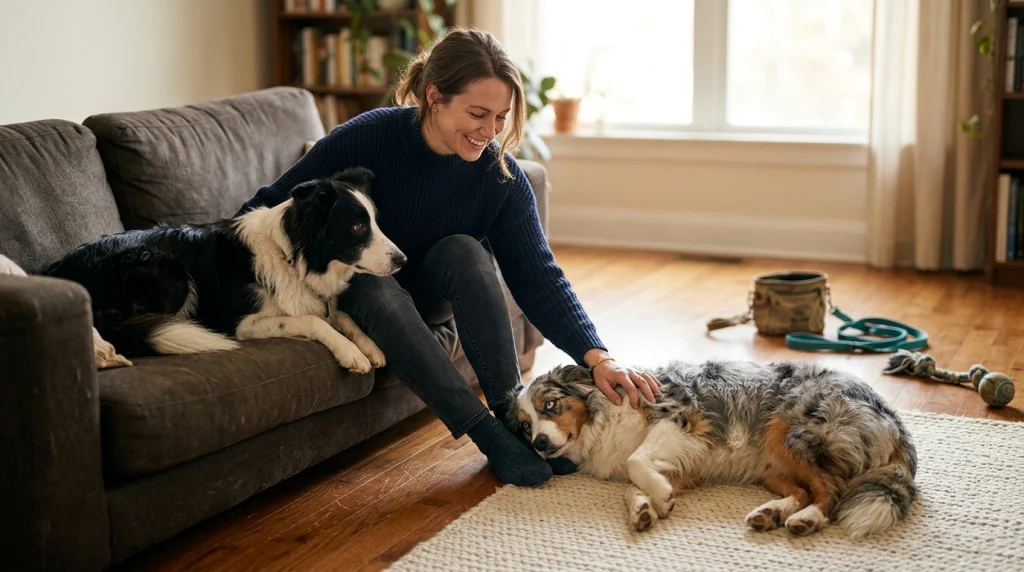
Neither breed guarantees a more cuddly individual. Border Collies and Australian Shepherds are both intelligent herding dogs, but family affection still varies from dog to dog.
The useful comparison is temperament plus lifestyle. Both breeds need activity and engagement, so an under-stimulated dog may look restless rather than affectionate.
| Trait | Border Collie | Australian Shepherd |
|---|---|---|
| Typical adult height | 18-22 inches | 18-23 inches |
| Typical adult weight | 30-55 pounds | 40-65 pounds |
| Working style | Intense handler focus and livestock control | Work-driven ranch herder with guarding instinct |
| Family affection | Often loving and loyal, sometimes selective | Often devoted, but not always highly demonstrative |
| Best cuddle predictor | Individual temperament and ability to settle | Individual temperament and ability to settle |
AKC lists Border Collies as medium dogs around 18 to 22 inches and 30 to 55 pounds. Its Australian Shepherd overview gives roughly 18 to 23 inches and 40 to 65 pounds for Aussies.
Size does not determine affection, but it changes how cuddling feels in daily life. A 50-pound dog across your lap is a different experience from a dog resting neatly beside your leg.
Frequently asked questions
Why does my Border Collie always want to be near me?
Border Collies often form strong working and social bonds with their people, so staying nearby can mean affection, interest, habit, or anticipation of activity. If closeness becomes frantic and your dog cannot cope with normal separation, discuss the pattern with a veterinarian or qualified behavior professional.
Why does my Border Collie not like hugs?
Many dogs dislike being restrained around the neck or shoulders, even when they enjoy petting; your Border Collie may prefer leaning, lying beside you, chest rubs, or brief contact. Respecting that preference usually builds more trust than repeatedly trying to teach tolerance for hugs.
Do male or female Border Collies cuddle more?
Sex alone is not a reliable predictor of cuddliness because individual temperament, socialization, routine, reproductive status, and life experience usually tell you more. When choosing a dog, observe the individual and ask the breeder, foster, or rescue about that dog’s normal social behavior.
Do Border Collies sleep with their owners?
Some Border Collies happily sleep on the bed, while others prefer the floor, crate, or a nearby dog bed; sleeping location is a household choice. Make sure your dog can rest comfortably, leave freely, and settle without guarding the bed or disturbing everyone’s sleep.
Why does my Border Collie cuddle only at night?
Nighttime often follows exercise, meals, training, and household activity, so your dog may finally be ready to rest; cooler temperatures can also make body contact more comfortable. A Border Collie that ignores cuddles all day but seeks you at night can still be highly affectionate.
Can I make my Border Collie more affectionate?
You can encourage trust and calm contact, but you cannot guarantee a certain cuddle style; use positive handling, predictable routines, consent-based petting, appropriate exercise, and quiet time together. Let affection develop instead of measuring your bond by how long your dog stays in your lap.
Are Border Collies good family dogs if they are not cuddly?
Yes, provided the household fits the breed’s activity, training, and management needs; a less-cuddly Border Collie can still be loyal, responsive, playful, and deeply attached to the family. Affection should be judged by the dog’s whole relationship with people, not physical contact alone.
So, do Border Collies like to cuddle? Many do, especially when they feel safe, trust their people, and have had enough physical and mental activity to relax.
Your dog may prefer a lap, a shoulder lean, or simply sleeping within arm’s reach. Respect that choice, and closeness can grow naturally.
If you are learning your Border Collie’s affection style, start with one simple habit tonight: offer a few seconds of gentle contact, pause, and let your dog decide what happens next.
