

Quick Answer
Yes, Border Collies can be clingy because they were bred to work closely with people and pay constant attention to their handler. Many healthy Border Collies naturally follow their favorite person from room to room, although individual temperament varies. The Border Collie’s working temperament helps explain that intense human focus.
Signs of normal Border Collie clinginess
- Room-to-room following: Your dog quietly moves with you around the house.
- Constant watching: Your Border Collie keeps an eye on your movements and waits for cues.
- Close resting: Your dog chooses the floor, couch, or bed near you.
- Frequent interaction: Your dog brings toys or checks whether you’re ready to do something.
- Handler preference: Some Border Collies form an especially strong bond with one household member.
What should you verify?
- Watch what happens after you leave. Calm resting is different from panic, nonstop barking, destructive escape attempts, or severe distress.
If your Border Collie follows you into the kitchen, bathroom, bedroom, and back again, you’re not imagining it. This breed can be remarkably people-focused.
The important question isn’t simply whether your dog is clingy. It’s whether that closeness is normal Border Collie attachment, unmet needs, or genuine separation distress.
In This Guide
- Are Border Collies naturally clingy?
- Why does my Border Collie follow me everywhere?
- Is clinginess the same as separation anxiety?
- How much attention does a Border Collie need?
- How can I teach my Border Collie to be more independent?
- Can exercise reduce clingy behavior?
- Are puppies more clingy than adult Border Collies?
- When should clinginess concern you?
- Frequently asked questions
- Final takeaway
Are Border Collies Naturally Clingy?
Border Collies often appear clingier than more independent breeds. Their working heritage encouraged intense awareness of a handler’s position, voice, movement, and instructions.
A Border Collie’s handler focus is its tendency to watch and respond closely to the person directing its work. That quality can look like clinginess inside a modern home.
- They notice movement: Standing up may instantly get your dog’s attention.
- They expect interaction: Daily life can become another opportunity for training, play, or work.
- They form strong bonds: Many prefer staying close to familiar people.
- They are sensitive: Small changes in your routine or body language may matter to them.
The American Kennel Club describes Border Collies as intelligent, intense workers that are affectionate with family. It also notes that temperament differs between individual dogs.
You can read more about how breed and individual temperament interact when evaluating your own dog’s behavior.
Clinginess by itself isn’t necessarily a problem. A dog that follows you but can relax independently may simply be behaving like a social, handler-oriented Border Collie.
Why Does My Border Collie Follow Me Everywhere?
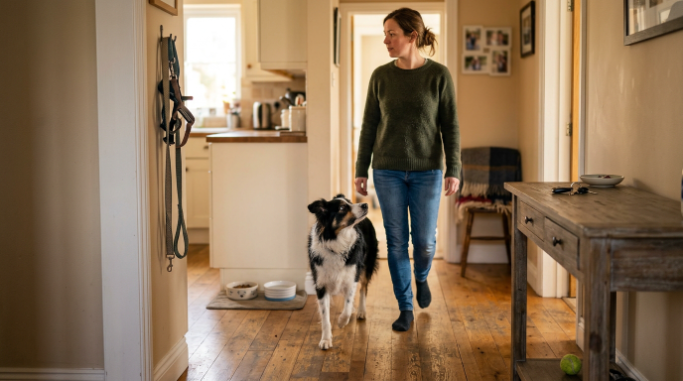
Your Border Collie may follow you because being near you has become rewarding and predictable. Breed tendencies can strengthen that pattern.
They were bred to watch handlers closely
Traditional sheep work requires communication between the dog and handler. Border Collies also use intense visual focus, often called eye, while controlling livestock.
That attentiveness doesn’t disappear when the dog enters a family home. Your movements can become meaningful signals even when you aren’t deliberately giving commands.
You are the source of interesting things
Think about what happens during an ordinary day. Most valuable events start with a person.
- Meals come from you.
- Doors open because of you.
- Walks begin when you pick up equipment.
- Toys appear during interaction.
- Training rewards arrive through you.
- Car rides and outdoor adventures usually involve you.
A clever Border Collie quickly learns these patterns. Following you becomes an effective way to avoid missing something.
Your routine may accidentally reward following
If you pet, talk to, feed, or play with your dog every time it approaches, following becomes productive. That’s ordinary learning rather than manipulation.
I use a simple check here: watch what the dog does when following earns nothing. A relaxed dog often lies down nearby after realizing that no activity is starting.
Is Border Collie Clinginess the Same as Separation Anxiety?
No. A dog can be extremely attached to you without having separation anxiety.
Separation anxiety involves significant distress connected with being separated from an attachment figure. The behavior after departure matters more than how closely your dog follows you while you’re home.
| What you observe | Normal attachment | Under-stimulation | Possible separation distress |
|---|---|---|---|
| While you’re home | Follows you, watches you, then settles | Pesters for activity, steals objects, struggles to settle | May shadow you constantly and react to departure cues |
| When you prepare to leave | Usually remains fairly calm | May look disappointed or restless | May pant, pace, whine, tremble, or become agitated |
| After departure | Can rest, chew, eat, or sleep | May become destructive from boredom | May bark, howl, pace, eliminate, destroy exits, or attempt escape |
| Best next step | Keep healthy routines and independence skills | Improve exercise, enrichment, training, and rest balance | Discuss the behavior with a veterinarian or qualified behavior professional |
Use a camera instead of guessing
Record your Border Collie after you leave home. Pay particular attention to the first 30 minutes and note whether your dog settles or becomes increasingly distressed.
The ASPCA’s separation-anxiety guidance explains that affected dogs may bark, howl, eliminate, chew, dig, or attempt to escape when separated.
Vet note: Sudden behavior changes can sometimes have medical contributors. Contact your veterinarian if new clinginess appears suddenly or comes with appetite, sleep, mobility, pain, or other health changes.
How Much Attention Does a Border Collie Need?
Border Collies need meaningful daily engagement, but they shouldn’t require your attention every waking minute. Healthy companionship includes both interaction and independent rest.
The goal is quality rather than constant entertainment. A predictable routine usually works better than responding to every request for attention.
A practical daily rhythm
For a healthy adult dog, a sample day might divide engagement into several purposeful blocks. Adjust intensity for age, fitness, weather, temperament, and veterinary advice.
- Morning: 30–45 minutes of walking, sniffing, structured play, or appropriate running.
- Training: Two or three focused sessions of about 3–10 minutes.
- Enrichment: Food puzzles, scent searches, shredding activities, or problem-solving games.
- Later activity: Another purposeful walk, play session, sport, or training outing.
- Quiet time: Scheduled periods when nothing exciting happens and the dog simply rests.
More exercise isn’t always the complete answer. A Border Collie also needs practice switching off.
That balance matters because an owner who supplies nonstop stimulation can accidentally create a dog that constantly expects stimulation.
How Can I Teach My Border Collie to Be More Independent?
Build independence gradually while your dog is calm. Don’t suddenly isolate a dog that has never learned how to relax away from you.
1. Reward calm behavior away from you
Notice when your Border Collie chooses a bed, mat, crate, or another comfortable spot. Quietly reinforce that choice without turning it into an exciting event.
2. Create a predictable resting place
Teach a mat or bed cue using positive reinforcement. Start only a few feet away before adding distance.
A useful progression looks like this:
- Reward the dog for stepping onto the mat.
- Reward sitting or lying down.
- Increase relaxed time from a few seconds to several minutes.
- Take one or two steps away and return.
- Move briefly around the room.
- Practice short periods when you’re out of sight.
3. Stop rewarding every demand
Your dog doesn’t need a response each time it nudges your hand or drops a ball on your lap. Wait for calm behavior before starting some interactions.
4. Make tiny separations ordinary
Walk into another room for a few seconds while your dog has something safe to do. Return before mild uncertainty turns into distress.
Increase difficulty slowly. Independence training should feel boring and safe, not like a test your dog keeps failing.
5. Avoid punishment
Never punish a dog for anxiety-related behavior. Fear and distress aren’t corrected by scolding.
PetMD’s overview of separation anxiety in dogs describes clinginess as one possible sign when it occurs alongside distress related to separation.
Can Exercise Reduce Clingy Border Collie Behavior?
Exercise and mental work can reduce attention-seeking caused by boredom. They won’t cure true separation anxiety by themselves.
Border Collies were developed for demanding work. A slow neighborhood walk may not provide enough variety for every adult dog.
Mix physical and mental activity
Good outlets depend on the individual dog. Rotate activities instead of relying on endless repetitive ball throwing.
- Sniffing walks in different environments
- Recall practice
- Hide-and-seek with toys
- Food-search games
- Trick training
- Obedience exercises
- Agility foundations
- Appropriate herding activities
- Tug with clear start-and-stop cues
The breed’s herding background also means many Border Collies enjoy tasks requiring concentration. Thinking can be as important as running.
Don’t create a canine endurance athlete by accident
Trying to physically exhaust a young, healthy Border Collie every day can simply improve its fitness. You may eventually own a dog that needs even more activity to feel tired.
Teach settling as deliberately as you teach recall or loose-leash walking. Calm behavior is a skill.
Are Border Collie Puppies More Clingy Than Adults?
Puppies can be especially dependent because everything is new. They rely on familiar people for safety, routine, food, learning, and access to the environment.
Adolescents may also become intense followers. Their impulse control is still developing while energy and curiosity rise.
Adult personalities vary
Some adult Border Collies remain classic “Velcro dogs.” Others enjoy affection but regularly choose another room or resting place.
Several factors influence the final pattern:
- Genetics: Working lines and individual family lines can differ in intensity and sensitivity.
- Early experience: Puppies that learn calm separation gradually may cope better with everyday independence.
- Household routine: Constant access to one person can strengthen shadowing habits.
- Exercise and enrichment: Bored dogs often seek more interaction.
- Personality: Breed tendencies never make every Border Collie identical.
- Life changes: Moving, schedule changes, household changes, or aging can alter behavior.
As of 2026, the best way to interpret clinginess is still to evaluate the individual dog rather than assuming one behavior applies to the whole breed.
When Should Border Collie Clinginess Concern You?
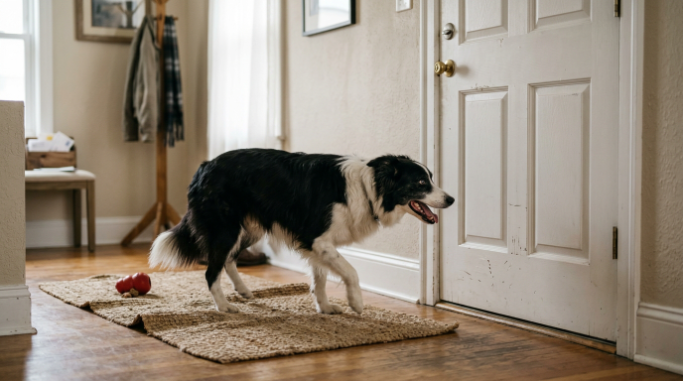
Closeness becomes concerning when your dog cannot cope with ordinary separation or when behavior changes suddenly. Look at intensity, frequency, and the dog’s emotional state.
Watch for these warning signs
- Frantic barking or howling soon after you leave
- Heavy panting or drooling without an obvious physical cause
- Pacing that continues instead of settling
- Scratching or chewing doors and windows
- Escape attempts that risk injury
- Indoor urination or defecation linked specifically to being alone
- Refusing high-value food when left
- Trembling or obvious panic around departure cues
- Sudden new clinginess in a previously independent dog
When these behaviors occur, avoid simply leaving the dog for progressively longer periods and hoping it “gets used to it.” Repeated panic can make the situation harder.
The goal of separation-anxiety treatment is usually gradual, controlled exposure that keeps the dog below its panic threshold. Severe cases may require help from a veterinarian or veterinary behavior professional.
The ASPCA and PetMD both emphasize behavior modification rather than punishment for separation-related distress. Medical support may also be appropriate in some diagnosed cases.
Vet note: Contact your veterinarian before treating severe anxiety on your own, especially when a dog risks self-injury, shows major behavior changes, or cannot tolerate even brief separation.
Frequently Asked Questions
Do Border Collies usually bond with one person?
Some Border Collies develop a noticeable preference for one person, especially the person who trains, exercises, feeds, or works with them most often. Others bond closely with several household members, so one-person attachment isn’t guaranteed.
Why does my Border Collie stare at me all the time?
Border Collies are highly observant dogs with a strong working history. Your dog may stare because it’s watching for a cue, predicting your next action, asking for interaction, or simply monitoring the person it trusts.
Why does my Border Collie follow me into the bathroom?
The bathroom isn’t special to your dog. If your Border Collie habitually follows you through the house, a closed bathroom door simply interrupts an established pattern of staying near you.
Can a Border Collie be left alone?
Many properly prepared adult Border Collies can learn to spend reasonable periods alone. Their success depends on age, temperament, training, exercise, enrichment, routine, and whether they have separation-related anxiety.
Will getting another dog make my Border Collie less clingy?
Not necessarily. Another dog can provide companionship, but it doesn’t automatically replace a Border Collie’s attachment to people or treat separation anxiety involving a specific person.
Should I ignore my Border Collie when it follows me?
You don’t need to ignore normal affectionate behavior completely. Instead, reward calm independent choices and avoid making every approach, stare, nudge, or toy delivery produce immediate attention.
Do Border Collies become less clingy as they get older?
Some become more settled as maturity and training improve. Others remain close followers throughout life because strong handler focus is part of their individual temperament.
Final Takeaway: Clingy Doesn’t Always Mean Anxious
Yes, Border Collies can be remarkably clingy. Their intelligence, sensitivity, working heritage, and strong interest in people make close following common.
The key is whether your dog can still relax without constant contact. Quietly following you and then settling is different from panicking when you disappear.
- Give your Border Collie enough physical activity.
- Provide daily problem-solving and training.
- Reward calm independent behavior.
- Practice short, comfortable separations.
- Use a camera to see what happens when you’re gone.
- Seek professional help if separation causes genuine distress.
A well-balanced Border Collie doesn’t need to stop loving your company. The goal is a dog that enjoys being with you and also feels safe when you’re temporarily apart.
