

Quick Answer
The best undercoat rake for a Border Collie has rounded metal teeth long enough to reach loose undercoat without scraping the skin or aggressively cutting the guard coat. For most Border Collies, I prefer a rotating-pin or rounded double-row rake, especially during seasonal shedding; this matches the coat-care needs described in the AKC Border Collie grooming guidance.
What I Look For
- Rounded teeth: Smooth tips reduce scratching when the pins reach through the dense coat.
- Proper pin length: The teeth need enough reach for your dog’s rough or smooth double coat.
- Gentle action: Rotating or well-spaced teeth can reduce pulling through loose undercoat.
- Good control: A non-slip handle makes light, controlled strokes easier.
- No aggressive cutting: Routine undercoat removal should preserve healthy outer guard hairs.
My 2026 Shortlist
- Best overall: FURminator Grooming Rake with rotating metal teeth.
- Best fixed-tooth option: JW GripSoft Double Row Undercoat Rake.
- Best dual-sided option: Maxpower Planet Original Pet Grooming Rake.
Finding the best undercoat rake for a Border Collie can be confusing because these dogs don’t have a simple single-layer coat. Both rough-coated and smooth-coated Border Collies carry a dense double coat, so the tool must reach loose fluff underneath without being harsh on the outer hair.
I focus less on flashy claims and more on tooth shape, depth, control, and how the rake moves through the coat. Those details matter when you’re grooming a dog that may have thick feathering around the chest, rear legs, and tail.
In This Guide
- What Is the Best Undercoat Rake for a Border Collie?
- Why Does a Border Collie Need an Undercoat Rake?
- How Do You Choose the Right Undercoat Rake?
- Best Border Collie Undercoat Rakes Compared
- How Do You Use an Undercoat Rake Safely?
- What Undercoat Rake Mistakes Should You Avoid?
- How Often Should You Rake a Border Collie’s Coat?
- Frequently Asked Questions
- Final Takeaway
What Is the Best Undercoat Rake for a Border Collie?
For most Border Collies, my first choice is a rounded rotating-pin grooming rake. It reaches into dense undercoat while allowing the teeth to move as they encounter resistance.
The FURminator Grooming Rake is a strong example. Its current design uses rotating metal teeth and a non-slip handle, and the manufacturer positions it specifically for thick fur and dense double coats.
Best overall: FURminator Grooming Rake
I like this style most for routine undercoat work because the rotating teeth can move through loose coat with less dragging than rigid pins. That’s useful around thick areas where a Border Collie’s soft undercoat can collect.
- Tooth design: Rotating metal teeth.
- Best for: Routine loose-undercoat removal and mild tangles.
- Coat match: Rough and smooth Border Collie double coats.
- Control: Ergonomic non-slip handle.
- Main caution: Repeated strokes over one spot can still irritate skin.
Best fixed-tooth rake: JW GripSoft Double Row
The JW GripSoft uses two rows of round-tipped teeth. Its teeth are also positioned parallel to the skin rather than pointing aggressively into it.
I would consider this one when you want a simple rake with no rotating mechanism. The double row can collect loose coat efficiently while the rounded ends make careful grooming easier.
Best dual-sided rake: Maxpower Planet
The Maxpower Planet Original Pet Grooming Rake uses two different sides. One side has nine teeth for knots and denser sections, while the 17-tooth side is intended for thinning loose undercoat.
That flexibility suits rough-coated Border Collies with heavier feathering. I would use the wider-spaced side only when needed rather than repeatedly working healthy coat.
Definition: An undercoat rake is a grooming tool with longer metal teeth designed to pass through the outer coat and collect loose hair from the softer layer underneath.
Why Does a Border Collie Need an Undercoat Rake?
A Border Collie has a weather-resistant double coat. The outer layer is coarser, while the undercoat is softer, shorter, and denser.
The American Kennel Club recognizes both rough and smooth coat varieties. Both still have an undercoat, so short-looking Border Collies aren’t automatically low-shedding dogs.
The undercoat is different from the topcoat
The topcoat contains protective guard hairs. Beneath those hairs sits the softer insulating undercoat that sheds more heavily as coat cycles change.
- Topcoat: Coarser protective hair that helps repel moisture and debris.
- Undercoat: Soft, dense hair that provides insulation.
- Loose coat: Dead undercoat that can remain trapped until brushed or shed naturally.
The AKC’s double-coat grooming guidance lists the Border Collie among medium double-coated breeds. Regular combing helps remove loose undercoat and prevent coat problems.
One detail I watch closely is the hair around the rear thighs and ruff. A dog’s back can look tidy while packed undercoat remains hidden in those thicker zones.
An undercoat rake doesn’t replace every brush
I don’t treat a rake as the only grooming tool a Border Collie needs. A slicker or pin brush is better for surface hair, light tangles, and finishing.
The ASPCA’s dog grooming advice also emphasizes choosing brushes according to coat type. Regular brushing removes dirt, loose hair, and tangles while giving you a chance to inspect the skin.
How Do You Choose the Right Undercoat Rake?
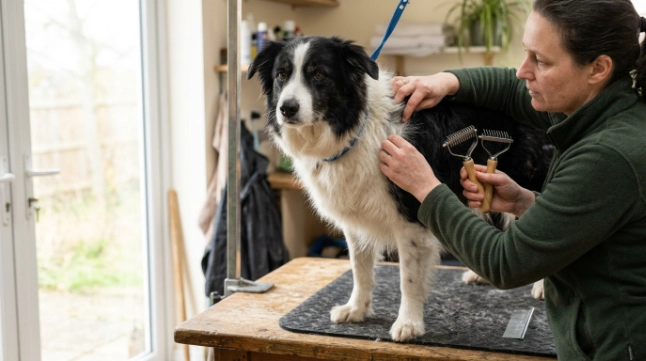
Choose the rake according to your individual Border Collie’s coat density, not just the breed name. A heavily feathered rough coat may need more tooth depth than a shorter smooth coat.
1. Look for rounded tooth tips
Rounded tips are my first requirement. They give you more margin for error when the rake reaches close to the skin.
Sharp-looking blades can be useful for severe mat removal, but that’s a different job. For routine Border Collie deshedding, gentler teeth are easier to control.
2. Match tooth length to the coat
The pins must reach through the outer coat. Teeth that only skim the surface won’t remove much undercoat.
- Smooth coat: Moderate-length rounded teeth are usually enough.
- Average rough coat: Longer pins can reach beneath the feathering more effectively.
- Heavy rough coat: Wider spacing or rotating teeth may move through dense areas with less pulling.
3. Prefer control over aggressive cutting
A comfortable handle matters more than it seems. Better grip control helps you keep pressure light and recognize resistance before pulling.
I also separate a grooming rake from a cutting-style dematting tool. If your goal is routine shedding control, you usually don’t need aggressive blades cutting through healthy coat.
4. Consider how your dog reacts
A technically excellent rake is useless if your Border Collie hates every stroke. Start gently and watch for skin twitching, turning toward the tool, avoidance, or sudden restlessness.
Comfort matters. Grooming should become predictable rather than a wrestling match.
Best Border Collie Undercoat Rakes Compared
As of 2026, these three designs stand out because they solve slightly different grooming problems. I would choose based on coat density and how much detangling you need.
| Rake | Tooth Design | Best Use | Best Border Collie Fit | Main Limitation |
|---|---|---|---|---|
| FURminator Grooming Rake | Rotating metal teeth | Routine undercoat removal and tangles | Most rough or smooth coats | Not intended for forceful mat cutting |
| JW GripSoft Double Row | Two rows of round-tipped fixed teeth | Lifting loose shedding hair | Dense coats needing simple maintenance | Fixed teeth don’t rotate through resistance |
| Maxpower Planet Original Rake | 9-tooth and 17-tooth sides | Tangles plus undercoat thinning | Heavy rough coats and feathering | Requires more care around delicate areas |
If I wanted one straightforward tool for an average Border Collie, I’d start with the rotating-pin FURminator rake. The JW is appealing if you prefer fixed rounded teeth, while Maxpower gives you more options for heavier tangles.
Don’t choose by the amount of hair a tool removes in one dramatic session. A safe rake should remove hair that’s ready to release without making the healthy topcoat noticeably thinner.
How Do You Use an Undercoat Rake Safely?
Use light pressure and rake in the natural direction of hair growth. Short, controlled sessions are safer than repeatedly scraping the same area.
The PetMD grooming guidance also recommends working through small sections and brushing in the direction of the coat. This approach helps reduce unnecessary skin contact.
My simple raking routine
- Check the skin first. Look for redness, sores, ticks, tender areas, or unusual hair loss.
- Remove obvious tangles. Don’t force the rake through a tight mat.
- Start at the shoulders. Use a light stroke in the direction of hair growth.
- Work in small sections. Move across the body instead of repeating one patch.
- Use extra care on feathering. Slow down around the chest, rear legs, belly, and tail.
- Finish with a brush or comb. Check whether the coat separates cleanly down toward the skin.
For a first session, five minutes can be enough. The manufacturer of the FURminator Grooming Rake suggests roughly five to ten minutes per session, adjusted for coat condition and thickness.
Don’t pull against resistance
If the rake suddenly stops, I stop too. I don’t use extra force to drag it through.
Resistance may mean you’ve reached a knot, dense packed coat, or sensitive area. Separate the hair with your fingers and decide whether a comb, slicker, or professional groomer is the safer choice.
What Undercoat Rake Mistakes Should You Avoid?
The biggest mistake is assuming more pressure removes more useful hair. Heavy raking can irritate the skin and may unnecessarily damage coat.
- Pressing into the skin: Let the teeth travel through hair instead of scraping underneath it.
- Raking one area repeatedly: Move around the coat rather than chasing every last loose hair.
- Using a rake on tight mats: Severe matting can pull painfully on skin.
- Ignoring skin problems: Don’t groom over sores, inflamed patches, or unexplained hair loss.
- Using only one tool: Pair the rake with a slicker, pin brush, or comb when needed.
- Trying to remove healthy coat: The goal is loose undercoat, not maximum hair removal.
Should you shave a Border Collie instead?
Routine shaving isn’t a substitute for removing loose undercoat. A Border Collie’s outer coat and undercoat perform different protective functions.
I prefer regular coat maintenance rather than removing the double coat for convenience. Grooming should preserve healthy coat structure whenever possible.
Vet note: If you find persistent redness, sores, bald patches, strong odor, painful skin, or sudden abnormal shedding, stop grooming the affected area and ask your veterinarian for advice.
How Often Should You Rake a Border Collie’s Coat?
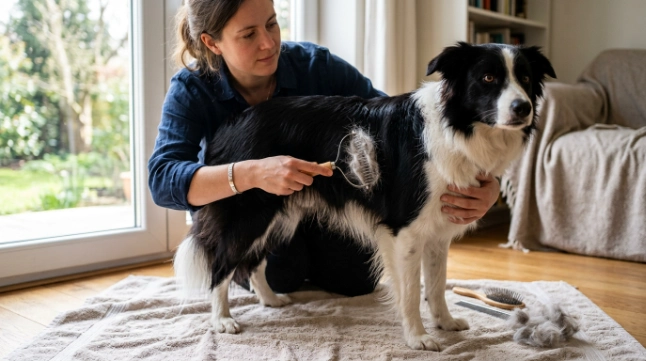
There isn’t one schedule for every Border Collie. Coat type, climate, indoor living, season, and individual shedding patterns all change how often the undercoat needs attention.
AKC guidance recommends regular brushing for Border Collies and more frequent grooming during periods of heavier shedding. I use the coat itself as my guide rather than forcing a fixed daily schedule.
A practical grooming schedule
| Coat Situation | Rake Approach | Other Grooming |
|---|---|---|
| Normal light shedding | Short session as needed | Brush once or twice weekly |
| Heavy seasonal shedding | More frequent short sessions | Check and brush daily if needed |
| After outdoor debris | Use only where loose coat has collected | Remove burrs and tangles first |
| Tight mats or painful tangles | Stop routine raking | Seek professional grooming help |
I know a session is productive when soft, loose undercoat comes away easily and the rake begins passing through with less resistance. I don’t keep going just because a few more hairs appear on each stroke.
That restraint matters. Border Collies need coat maintenance, not endless deshedding.
Frequently Asked Questions
What type of undercoat rake is best for a Border Collie?
A rounded rotating-pin or rounded double-row rake works well for many Border Collies. Choose enough tooth length to reach the soft undercoat while avoiding sharp tips that scrape the skin or aggressively cut healthy outer hair.
Can I use an undercoat rake on a smooth-coated Border Collie?
Yes. Smooth-coated Border Collies still have a dense double coat, although their outer hair is shorter. Use moderate-length rounded teeth and light pressure because you may not need the same depth required for a heavily feathered rough coat.
Is a slicker brush or undercoat rake better for a Border Collie?
They perform different jobs. An undercoat rake reaches deeper loose undercoat, while a slicker brush helps with surface hair and tangles. I prefer keeping both rather than expecting one tool to handle every part of the coat.
Can I use an undercoat rake every day?
You can groom more frequently during heavy shedding, but daily raking isn’t automatically necessary. Watch the amount of loose coat, your dog’s skin, and how easily the tool moves. Stop if you see irritation or increasing sensitivity.
Does an undercoat rake cut a Border Collie’s hair?
A basic rounded-pin rake is primarily designed to separate coat and remove loose undercoat rather than cut healthy hair. Some dual-sided dematting tools have sharper edges, so check the design carefully before using one as a routine rake.
How do I know when I’ve removed enough undercoat?
Stop when the rake begins moving smoothly and the amount of loose fluff drops noticeably. You don’t need to achieve a hair-free tool on every pass. Trying to remove every strand can lead to unnecessary over-grooming.
What if my Border Collie hates the undercoat rake?
Start with short sessions and gentle strokes, then reward calm behavior. If your dog reacts to one body area, check for tangles, tenderness, or skin irritation rather than forcing the rake through it.
Final Takeaway
The best undercoat rake for a Border Collie should reach the loose inner coat while giving you enough control to protect the skin and outer guard hairs. For most dogs, I favor rounded rotating teeth or a gentle double-row design.
The FURminator Grooming Rake is my best overall style match, the JW GripSoft Double Row is a strong fixed-tooth alternative, and the Maxpower Planet dual-sided rake offers extra flexibility for thick rough coats.
- Choose rounded teeth.
- Match tooth depth to your Border Collie’s coat.
- Use light pressure.
- Work in the direction of hair growth.
- Stop when you meet firm resistance.
- Use a slicker or comb alongside the rake.
- Increase grooming during heavy shedding rather than over-raking one session.
Most importantly, judge the result by your Border Collie’s comfort and coat condition. A good rake leaves the coat lighter and easier to brush without leaving the skin sore or the protective topcoat thin.
