
How to Know If a Border Collie Is Bored: 12 Clear Signs

Quick Answer
You can usually tell a Border Collie is bored when normal energy turns into repeated pacing, barking, destructive chewing, digging, demanding attention, or inventing unwanted jobs. Because this working breed needs both movement and thinking, adding purposeful exercise and mental enrichment often changes the behavior. The Border Collie care guidance from PetMD also stresses the breed’s strong need for physical and mental activity.
Common signs of Border Collie boredom
- Destructive chewing: Furniture, cushions, paper, shoes, or household objects become self-made entertainment.
- Constant attention-seeking: Your dog repeatedly paws, nudges, stares, or drops toys in your lap.
- Restless pacing: Your Collie moves around the house and struggles to relax.
- Excessive barking: Small sounds, windows, passing people, or nothing obvious trigger repeated barking.
- Invented jobs: Herding family members, stalking pets, or chasing shadows can become an outlet.
- Sudden mischief: A normally cooperative dog starts searching for anything interesting to do.
A simple way to check
Border Collies can make boredom look dramatic. These intelligent herding dogs often find their own work when we don’t give them enough useful work.
I’ve found the key is watching for a change in pattern, not judging one behavior alone. This guide explains what boredom looks like, what causes it, and what you can do about it in 2026.
In This Guide
- What does boredom look like in a Border Collie?
- What are the signs a Border Collie is bored?
- Is my Border Collie bored or just high-energy?
- Why do Border Collies get bored so easily?
- How much activity does a Border Collie need?
- How do you fix Border Collie boredom?
- When is it more than boredom?
- Frequently asked questions
- Final takeaway
What Does Boredom Look Like in a Border Collie?
Border Collie boredom is a lack of satisfying physical, mental, or social activity. The dog still has energy and working drive, but no appropriate place to direct it.
Definition: A Border Collie’s boredom is a state where the dog’s need to move, think, explore, interact, or perform purposeful tasks is not being met.
This matters because Border Collies were developed to notice movement, respond to handlers, solve problems, and control livestock. Those traits don’t disappear when the dog lives in a suburban home.
A bored Collie therefore may not simply lie around looking unhappy. Many create activities that owners see as bad behavior.
Boredom often looks like excess energy
You may see a dog walking from room to room, watching windows, following you constantly, or bringing the same toy repeatedly. Some dogs become noisy.
Others become destructive. Chewing, shredding, digging, stealing objects, and emptying bins can all provide stimulation.
- Physical boredom: The dog hasn’t had enough suitable movement.
- Mental boredom: The body exercised, but the brain had little to solve.
- Social boredom: The dog has had too little meaningful interaction.
- Routine boredom: Every walk, game, and training session feels identical.
This is why a two-hour routine can still leave one Border Collie unsatisfied. Quality and variety matter alongside duration.
What Are the Signs a Border Collie Is Bored?
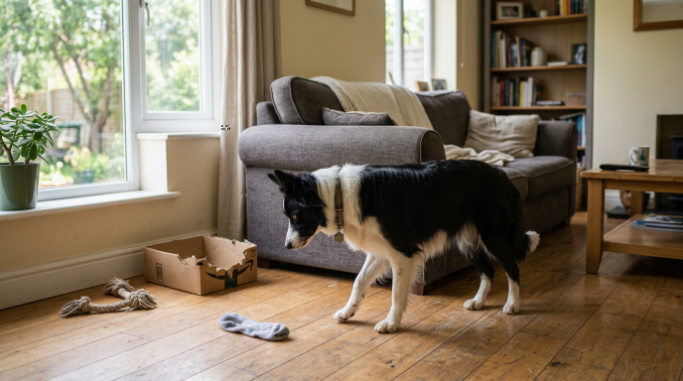
The clearest clue is repeated behavior that appears when your dog has little to do. It often improves after meaningful activity.
Watch the whole pattern. One chewed shoe doesn’t prove boredom.
1. Destructive chewing
A bored Border Collie may chew furniture legs, cushions, cardboard, shoes, or anything within reach. Chewing gives the dog an immediate activity.
2. Restless pacing
Your dog may walk between rooms, circle furniture, or repeatedly check doors and windows. They seem unable to switch off.
3. Excessive barking
Bored Collies sometimes bark at passing cars, neighbors, birds, tiny noises, or empty spaces. Barking becomes something to do.
4. Constant attention-seeking
Your dog may paw you, push toys against you, stare intensely, whine, or nudge your hands. The requests often return seconds after you stop interacting.
5. Digging
Some Border Collies dig gardens, bedding, carpets, or sofas. The behavior creates movement, scent, texture, and immediate feedback.
6. Stealing household objects
A bored dog quickly learns that grabbing a sock starts a chase. Your reaction can accidentally turn stealing into a rewarding game.
7. Herding people or other pets
Border Collies have a strong herding background. Without suitable outlets, some begin stalking, circling, blocking, or chasing family members.
Nipping at moving ankles can also appear. Don’t encourage it as entertainment.
8. Chasing lights, shadows, or reflections
Repeated fixation on moving light deserves attention. It can begin as stimulation-seeking but become difficult to interrupt.
Avoid deliberately creating laser-light games. Give the dog predictable activities with a clear beginning and ending instead.
9. Repetitive fence running
A Border Collie may patrol the same fence whenever people, dogs, bicycles, or vehicles pass. The repeated chase becomes a self-created job.
10. Getting into bins or cupboards
Food smells provide a rewarding puzzle. Clever Collies can become skilled at opening doors or investigating containers.
11. Losing interest in ordinary toys
A pile of toys doesn’t guarantee enrichment. Toys that never move, change, or involve you can lose their value.
12. Creating strange little routines
This is one of the signs I watch most closely. An under-stimulated Collie may begin monitoring a hallway, stalking a vacuum, or waiting obsessively for a particular sound.
The dog has effectively assigned itself a job. Your goal is to replace it with a healthier one.
Section Takeaway: Several boredom signs appearing together are more meaningful than one isolated behavior. Look for patterns that improve after structured exercise, training, sniffing, and problem-solving.
Is My Border Collie Bored or Just High-Energy?
A high-energy Border Collie wants activity. A bored Border Collie has energy but lacks a satisfying outlet for it.
The difference becomes clearer when you look at timing, triggers, and what helps the dog settle.
| Pattern | What you may notice | What often helps |
|---|---|---|
| Boredom | Pacing, stealing, chewing, barking, pestering, invented jobs | 10-minute training, scent work, varied walks, puzzles, purposeful play |
| Normal high energy | Eager movement and play, followed by normal settling | Age-appropriate daily exercise and predictable rest |
| Anxiety | Distress linked to separation, noises, triggers, or specific situations | Trigger management and professional behavioral guidance |
| Possible discomfort | Sudden restlessness, sleep changes, reluctance to move, appetite changes | Veterinary assessment rather than extra exercise |
Try the activity-and-settle test
Give your dog an appropriate walk with time to sniff. Later, add five to ten minutes of focused training.
Then provide water and a calm resting period. A bored dog often becomes easier to settle after its needs are met.
If the dog remains distressed, frantic, painful, or unable to relax despite a sensible routine, don’t assume boredom. Something else may be happening.
Why Do Border Collies Get Bored So Easily?
Border Collies combine high physical capacity with unusually strong interest in work and interaction. That combination can make repetitive home life feel unstimulating.
The American Kennel Club’s Border Collie profile describes the breed as energetic and highly work-focused. That background helps explain why purposeful activity matters.
They were bred to work with people
A working Collie doesn’t only run. The dog watches livestock, reads movement, listens for cues, changes direction, and makes decisions.
That mixture is hard to replace with repetitive ball throwing alone.
They notice small changes
Many Border Collies quickly learn household routines. They know when shoes mean a walk and when a cupboard contains their training treats.
If nothing interesting happens, that awareness can turn toward windows, shadows, other pets, or household objects.
Repetition stops being challenging
A puzzle solved twenty times may no longer be much of a puzzle. The same five-minute fetch routine can also become predictable.
- Change walking routes.
- Rotate puzzle toys instead of leaving all of them available.
- Teach one small new skill each week.
- Use sniffing and searching games.
- Practice known cues in different safe locations.
Novelty doesn’t need to be expensive. A cardboard-box search game can sometimes engage a dog better than another new toy.
How Much Activity Does a Border Collie Need?
Many healthy adult Border Collies need substantial daily activity, often around one to two hours of physical exercise. Individual needs still vary with age, health, fitness, temperament, and activity type.
More exercise isn’t always better. The goal is a dog that can work, think, and also relax.
Balance movement with brain work
Instead of trying to exhaust your Collie through running, split the day into different forms of activity. Short mental sessions can be surprisingly satisfying.
- Physical activity: Walks, hiking, appropriate running, fetch, swimming, or dog sports.
- Mental work: Training, food puzzles, scent searches, toy-name games, or problem-solving.
- Natural behavior: Sniffing, exploring, chewing suitable items, and searching for food.
- Social time: Calm interaction, cooperative training, and suitable play.
- Rest: Quiet periods without constant entertainment.
A practical adult routine
For a healthy adult, I prefer several smaller blocks rather than one huge exercise session. This also prevents the entire day from becoming a countdown to one intense activity.
- Morning: 30 to 45 minutes of walking with sniffing and several training cues.
- Midday: 5 to 10 minutes of food searching, tricks, or a puzzle.
- Afternoon: A short toilet and sniff break with calm interaction.
- Evening: 30 to 60 minutes of varied activity based on the individual dog.
- Before bed: Quiet chewing, settling, and relaxation.
Puppies, older dogs, injured dogs, and dogs with medical conditions need different routines. Avoid applying an adult athlete’s schedule to every Border Collie.
How Do You Fix Border Collie Boredom?
Fix boredom by adding purpose, variety, and predictable rest. Don’t simply keep increasing high-speed exercise.
A successful plan gives your Collie things to solve. It also teaches that doing nothing is sometimes part of the day.
Use short training sessions
Five to ten focused minutes can work well. Stop while the dog is still engaged.
- Practice stays with gradually increasing difficulty.
- Teach left and right direction cues.
- Practice targeting your hand.
- Teach names for two or three toys.
- Build impulse control around doors or food.
Turn meals into enrichment
Food can become a simple daily activity instead of disappearing from a bowl in 30 seconds. Scatter part of the meal safely or use a suitable food toy.
The ASPCA pet-care resources also emphasize enrichment that allows dogs to use normal behaviors such as sniffing and chewing.
Let your Border Collie sniff
A walk doesn’t have to be fast to be useful. Ten minutes investigating an unfamiliar grassy area may provide more mental information than ten minutes marching beside your leg.
Give the dog a job
The job doesn’t need sheep. It needs clear rules and a goal.
- Find a hidden toy.
- Carry a safe lightweight item.
- Search several boxes for food.
- Complete an obedience sequence.
- Work through beginner agility foundations.
- Retrieve named toys into a basket.
Rotate activities
Keep several options out of sight and rotate them. Familiar activities often regain value after a short break.
I also avoid making fetch the answer to every restless moment. Constant sprinting can build fitness without teaching a dog how to settle.
Reward calm behavior too
This part is easy to miss. Owners often interact when the dog becomes demanding but ignore the dog when it’s resting quietly.
Notice calm behavior. Quietly reinforce your Collie for lying down, relaxing, or watching the world without reacting.
Section Takeaway: The best boredom plan combines movement, thinking, sniffing, social interaction, and rest. A Border Collie needs meaningful engagement, not nonstop entertainment.
When Is It More Than Boredom?
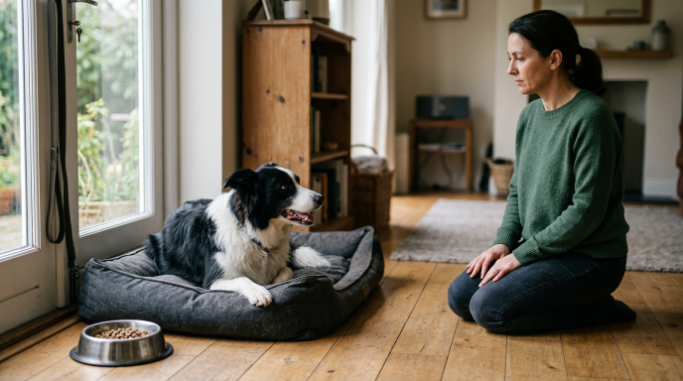
Not every restless Border Collie is bored. Sudden or severe behavior changes can reflect fear, anxiety, pain, illness, or another medical problem.
Pay special attention when the behavior appears abruptly. Boredom usually connects more clearly to routine and lack of activity.
Watch for warning signs
- Sudden loss of appetite
- Vomiting or diarrhea
- Limping or reluctance to move
- Persistent panting without an obvious reason
- Shaking or hiding
- Extreme distress when left alone
- Repeated self-injury
- New aggression or unusual sensitivity
- Sudden inability to settle at night
If you’re uncertain, a veterinary check is safer than trying to exercise the problem away. The AVMA’s pet-owner resources are also a useful starting point for responsible veterinary guidance.
Vet note: If your Border Collie’s behavior changes suddenly, seems painful, becomes compulsive, or doesn’t improve with a balanced routine, contact your veterinarian. A professional can help rule out medical causes before you treat the behavior as simple boredom.
What about separation anxiety?
Separation-related distress is different from ordinary boredom. It occurs around being left alone or losing access to a particular person.
Signs can include frantic escape attempts, prolonged vocalizing, destruction near exits, drooling, or severe distress. Those cases may need a veterinarian or qualified behavior professional.
Frequently Asked Questions
Can a Border Collie get bored even after a long walk?
Yes. A long walk may satisfy physical needs without providing enough mental challenge. Add sniffing, short training sessions, scent games, food puzzles, or simple problem-solving tasks rather than assuming your Border Collie always needs a longer walk.
Does chewing mean my Border Collie is bored?
Chewing can be a sign of boredom, especially when it appears during long inactive periods. However, puppies also chew while developing, and dogs may chew from stress or other causes. Look at when the behavior happens and what other signs appear.
Why does my Border Collie keep bringing me toys?
Your dog may simply enjoy playing with you. If toy-dropping becomes constant and your Collie cannot settle after appropriate activity, attention-seeking may be linked to boredom or a learned habit that has been repeatedly rewarded.
Are puzzle toys enough to stop boredom?
No single activity is enough for most Border Collies. Puzzle toys can provide useful mental stimulation, but dogs also need appropriate physical exercise, social interaction, training, opportunities to sniff and explore, and enough quiet time to rest.
Can boredom make a Border Collie destructive?
Yes. An under-stimulated Border Collie may discover that chewing, digging, stealing, or investigating household objects provides instant entertainment. Prevent access to unsafe items while giving your dog appropriate activities that meet the same need for movement or problem-solving.
How quickly should boredom behavior improve?
Minor restlessness may improve within several days after you build a better routine. Long-standing habits can take longer because the behavior itself has become rewarding. Consistency, management, training, and calm reinforcement matter more than one unusually active day.
Should I tire my Border Collie out every day?
A Border Collie needs appropriate exercise, but trying to physically exhaust the dog every day can be counterproductive. Balance physical activity with mental work and teach relaxation. The goal is a satisfied dog that can settle, not an increasingly conditioned athlete.
How Can You Tell If Your Border Collie Needs More to Do?
Look for patterns. Repeated pacing, barking, chewing, digging, stealing, attention-seeking, herding, and invented jobs are strong clues when they appear during under-stimulated periods.
Then test the pattern with a better routine. Add appropriate movement, sniffing, short training, problem-solving, social time, and planned rest.
If your Border Collie settles more easily, you’ve learned something useful about their needs. Keep adjusting the routine as your dog’s age, health, and interests change.
If the behavior stays intense or changes suddenly, involve your veterinarian. Boredom is common in this clever working breed, but it shouldn’t become the automatic explanation for every behavior problem.
