
Border Collie Puppy Feeding Schedule at 8 Weeks: A Practical Guide for New Owners

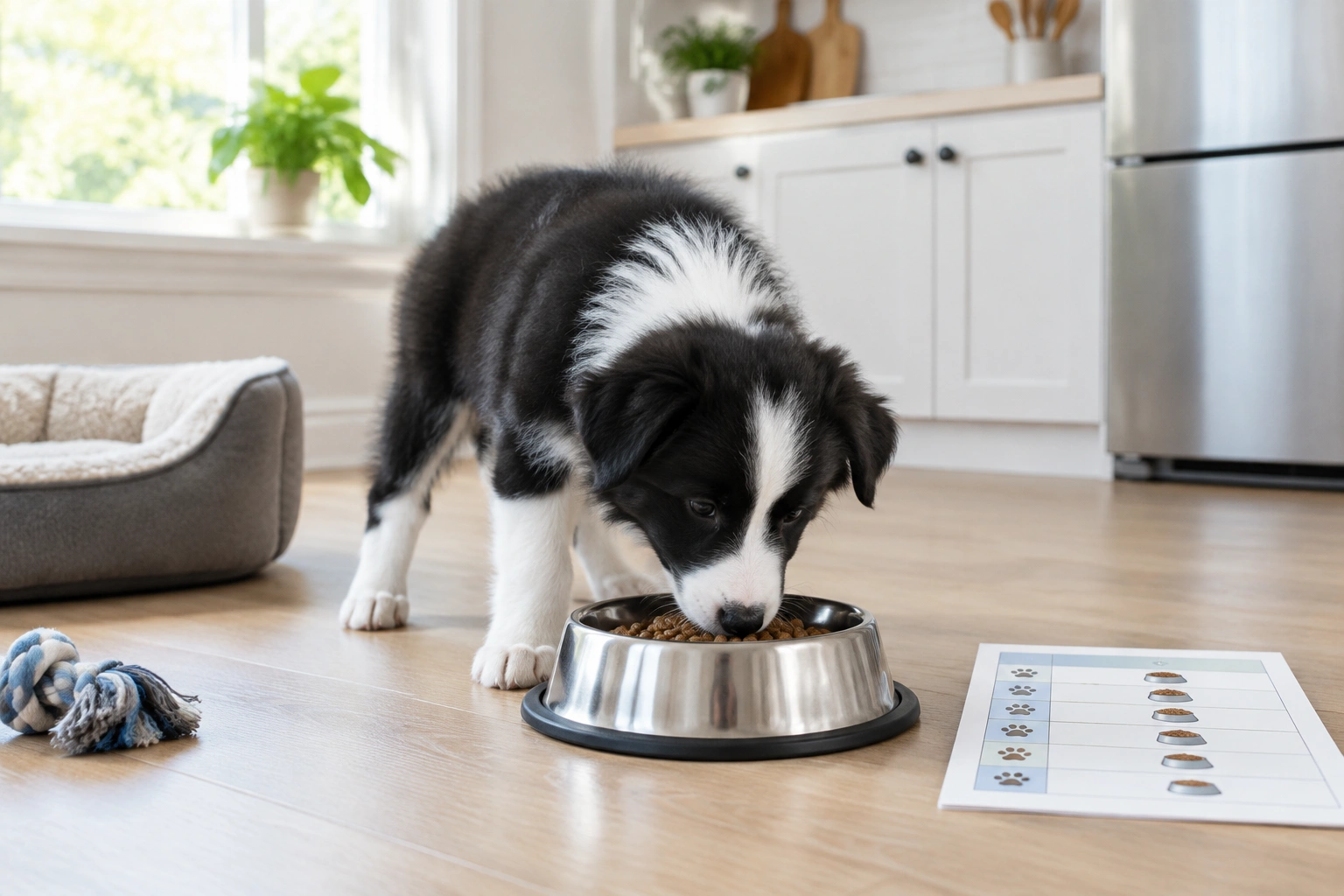
An 8-week-old Border Collie puppy usually needs small, scheduled meals spread across the day, not one or two big servings. In practice, that often means 3 to 4 meals daily, with some puppies doing better on 4 smaller meals if they’re very young, still settling into a new home, or have a sensitive stomach. The food should be a complete and balanced puppy formula or another growth-appropriate diet that your veterinarian approves.
A useful starting point: keep the breeder’s food, amount, and meal timing for the first few days if your puppy is eating well, then adjust slowly if needed. That approach is usually easier on digestion than making three changes at once.
If you want the simplest rule for the first week home, use this:
– feed on a schedule
– measure every meal
– watch stool quality
– weigh your puppy weekly
– adjust only one variable at a time
For most Border Collie puppies, the goal at 8 weeks is not to “feed until full.” It is to create a routine that supports steady growth without upsetting the stomach or accidentally overfeeding a puppy that looks hungrier than it truly is.
How Often to Feed an 8-Week-Old Border Collie Puppy
At 8 weeks, 3 to 4 meals per day is a practical target for most Border Collie puppies. Some guides and veterinary advice lean toward 4 small meals at this age, especially for very young puppies, while others say 3 meals can work if the puppy is thriving and tolerating them well.
Here is the practical way to choose:
Choose 4 meals if:
- your puppy is newly weaned or just home from the breeder
- meals are very small
- your puppy gets shaky, frantic, or overly hungry between meals
- stool gets soft when meals are too large
- you need a gentler schedule for a sensitive stomach
Choose 3 meals if:
- your puppy is eating well
- stool is normal
- the puppy is settling in and not acting ravenous between meals
- your schedule makes 4 feedings unrealistic
A Border Collie puppy is active, but activity does not automatically mean it needs huge meals. Puppies can look like little athletes and still have small stomachs. That is why scheduled meals beat free-feeding at this age. Scheduled meals make it easier to notice appetite changes, track intake, and avoid grazing all day.
For a young puppy, a simple feeding rhythm works well:
– breakfast
– midday meal
– late afternoon or early evening meal
– optional small bedtime meal if needed
If your puppy is going 6 to 8 hours between meals and doing fine, that is usually more useful than trying to force a rigid clock. The bigger issue is consistency.
How Much to Feed Per Meal and Per Day
The safest way to portion an 8-week-old Border Collie puppy is to use the food label plus your puppy’s current body weight, then adjust based on body condition and stool.
That is better than guessing by breed alone, because Border Collie puppies vary a lot in size. An 8-week-old puppy that weighs 6 kg will need less than one that weighs 8 kg, even if both are the same age.
A practical starting point is to use the feeding chart on the bag and then compare it with your puppy’s weight and the food’s calorie density. For example, if a puppy food provides about 380 to 420 kcal per cup, a small 8-week-old Border Collie puppy may start somewhere around 1 to 1.5 cups per day, while a larger puppy may need closer to 1.5 to 2 cups per day. That daily amount is usually split into 3 to 4 meals.
Here is a simple starting-range example by puppy weight and food calorie density:
| Puppy weight | Lower-calorie puppy food (about 320 kcal/cup) | Mid-calorie puppy food (about 380 kcal/cup) | Higher-calorie puppy food (about 420 kcal/cup) |
|---|---|---|---|
| 4 kg (9 lb) | about 1.0 to 1.25 cups/day | about 0.75 to 1.0 cups/day | about 0.75 to 1.0 cups/day |
| 5 kg (11 lb) | about 1.25 to 1.5 cups/day | about 1.0 to 1.25 cups/day | about 1.0 to 1.25 cups/day |
| 6 kg (13 lb) | about 1.5 to 1.75 cups/day | about 1.25 to 1.5 cups/day | about 1.25 to 1.5 cups/day |
| 7 kg (15 lb) | about 1.75 to 2.0 cups/day | about 1.5 to 1.75 cups/day | about 1.25 to 1.75 cups/day |
These are only starting estimates, not exact targets. The best amount is the one that keeps your puppy lean, growing steadily, and producing normal stool.
One breed feeding guide notes that puppies at around 8 weeks may need roughly 8–10% of body weight per day, with that amount gradually decreasing as they grow. That kind of percentage can be a rough starting point, but it is not a substitute for the feeding instructions on the actual food bag, because calorie density varies widely between brands and formulas.
For a practical decision framework, use this order:
1) Check the bag first
Look for a food labeled complete and balanced for growth or for puppies. Then use the manufacturer’s feeding chart based on current weight.
2) Divide the daily amount into 3 to 4 meals
If the daily amount is, for example, 1.5 cups, you might split it into:
– 4 meals of about 3/8 cup each, or
– 3 meals of about 1/2 cup each
The exact cup amount depends on the calorie density of the food. A cup of one kibble may contain far more calories than a cup of another.
3) Adjust by body condition, not appetite alone
A puppy that finishes every meal quickly is not automatically underfed. Border Collies are often enthusiastic eaters. Before increasing food, check:
– ribs: should be easy to feel, not sharply visible
– waist: should be visible from above
– belly tuck: should rise slightly behind the ribs
If ribs are clearly visible or the puppy seems thin and is not gaining weight, increase food gradually. If the puppy is getting rounder, losing the waist, or leaving food behind, reduce slightly.
4) Recheck weekly
Puppies change fast. What worked last week may be too much or too little this week.
Best Food Type for an 8-Week-Old Border Collie Puppy
The best default choice for most puppies is a complete and balanced puppy formula or another growth diet that is specifically appropriate for puppies. For an 8-week-old Border Collie, that is usually the clearest, safest starting point.
A good puppy formula should:
– be labeled for growth or puppies
– have a clear nutritional statement showing it is complete and balanced
– provide appropriate calcium and phosphorus levels for growth
– be easy for your puppy to digest
If you are comparing food types, here is the practical trade-off:
| Food type | Pros | Cons | Best use case |
|---|---|---|---|
| Dry kibble | Easy to measure, store, and use in training | Less palatable for some puppies | Most homes, especially for routine feeding |
| Wet food | Often more appetizing, easier to eat | Messier, pricier, harder to store once opened | Picky eaters or puppies needing extra palatability |
| Mixed feeding | Can improve acceptance and texture variety | Harder to track calories and portions | Owners who want flexibility and can measure carefully |
For many Border Collie puppies, dry kibble is the easiest daily base because it is simple to portion and track. Wet food can be useful if your puppy is hesitant to eat after moving homes or if you need to encourage intake briefly. Mixed feeding can work, but only if you are careful with total calories.
If your puppy is not enthusiastic about dry food, a little wet food mixed in can make sense. If your puppy is doing well, though, there is no need to complicate the diet. For most readers, the simplest answer is: start with a puppy-specific complete and balanced kibble, then add wet food only if you need better palatability or easier eating.
If you want a general nutrition standard to check against, AAFCO’s pet food labeling guidance is a useful place to understand what “complete and balanced” is supposed to mean.
Should You Keep the Breeder’s Food or Switch?
In most cases, keep the breeder’s food for at least the first several days if your puppy is eating it well. That reduces the number of changes your puppy’s digestive system has to handle at once.
Keeping the breeder’s food is usually the safer choice when:
– your puppy is eating normally
– stools are firm
– you know the food brand and formula
– you do not have a medical reason to change immediately
Switching sooner may make sense if:
– the breeder food is unavailable
– your veterinarian recommends a different formula
– the puppy is having ongoing loose stools or poor tolerance
– you want to move to a different food for practical reasons, but can transition slowly
The main trade-off is simple: staying on the breeder’s food is gentler, while switching may be more convenient long term. If the puppy is already stressed from a new environment, there is no prize for changing food fast.
How to Switch Foods Without Upsetting Your Puppy’s Stomach
A gradual transition is the safest route for most puppies. A sudden switch can lead to soft stool, gas, vomiting, or a puppy that suddenly refuses meals.
A straightforward transition plan looks like this:
- Days 1–2: 75% old food, 25% new food
- Days 3–4: 50% old food, 50% new food
- Days 5–6: 25% old food, 75% new food
- Day 7: 100% new food
If your puppy has a sensitive stomach, stretch that process longer. There is no need to rush if the puppy is doing well on the old food.
A few practical rules help:
– keep meal times the same
– keep treats minimal during the switch
– do not add multiple new foods at once
– if stool softens, pause at the current mix for a few extra days
If vomiting starts, or diarrhea is more than mild and brief, stop the switch and call your veterinarian.
Sample Daily Feeding Routine for Busy Owners
A schedule only works if you can actually follow it. This example is realistic for a household with a normal workday:
- 7:00 a.m. breakfast
- 12:00 p.m. lunch
- 5:30 p.m. dinner
- 9:00 p.m. optional small snack or final meal if your puppy needs 4 meals
If you can only manage 3 meals, use:
– morning
– mid-afternoon
– evening
The point is consistency. Border Collie puppies usually do better when meal times are predictable, especially during the first weeks in a new home.
As your puppy matures, you can usually move from 4 meals to 3 meals once it is eating reliably, handling larger portions well, and no longer seems to need that extra small feeding. Many puppies can later move from 3 meals to 2 meals as they get older, but that is a later-stage change, not usually a first-week decision.
Treats, Water, and Training Rewards
Treats are useful, but they can quietly throw off the daily calorie total. For an 8-week-old puppy, keep treats small and counted as part of the day’s intake. Training rewards should be tiny enough that they do not replace a meaningful amount of balanced food.
A practical way to manage treats:
– use pieces of the puppy’s kibble for easy training
– reserve higher-value treats for difficult moments, not constant snacking
– reduce meal portions slightly if training rewards are frequent
Water should always be available unless your veterinarian has given different instructions. Young puppies need easy access to fresh water, especially after play, training, and warm weather. If your puppy is drinking very little, that matters more than whether it polished off every meal.
For a puppy in the middle of house training, water access should stay normal. Limiting water is not a feeding strategy; it is usually a mistake.
How to Tell If You’re Feeding Too Much or Too Little
The best signals are body condition, stool quality, and weekly weight trend.
Signs you may be feeding too much
- rounder body with little waist
- stools that are loose or bulky
- frequent leftover food plus extra treats
- rapid weight gain that seems out of proportion
Signs you may be feeding too little
- ribs and spine are too visible
- puppy seems persistently hungry and loses weight
- poor growth or no visible change over time
- low energy that is not explained by normal puppy sleep
Signs the food may not agree with your puppy
- repeated soft stool
- vomiting after meals
- excessive gas
- refusal to eat a food that was previously accepted
Normal stool for an 8-week-old puppy is usually formed, moist, and easy to pick up, with the puppy passing it without strain. Very small changes can happen during a food transition, but stool that is persistently watery, very pale, bloody, or accompanied by vomiting is not normal.
A simple weekly adjustment rule helps:
– if your puppy is too thin, not gaining weight, or still seems hungry and stool is normal, increase the daily amount by about 5 to 10%
– if your puppy is getting round, losing the waist, or stools are getting bulky or loose, decrease the daily amount by about 5 to 10%
– if the puppy is doing well, keep the portion the same for another week
One important caution: a puppy that leaves food behind is not always “self-regulating.” It may simply be getting too much at that meal, not enough at the next, or it may be distracted, stressed, or mildly nauseated. Look at the pattern over several days before making a big change.
Common Feeding Problems and What They Mean
My puppy seems hungry all the time
Border Collie puppies often act hungry, especially after play. That does not automatically mean the portion is wrong. Check body condition and weigh the puppy before increasing food. If weight gain is too fast, the issue may be too many treats, not too little kibble.
My puppy won’t finish meals
This can happen during the first days in a new home, after a food change, or when meals are too large. Try a calmer feeding spot and smaller portions. If refusal continues, call your veterinarian.
My puppy has loose stools
Loose stool often points to a diet change that was too fast, too many treats, or a food that does not suit the puppy. If the puppy is otherwise bright and eating, slow the transition and simplify the diet. If diarrhea is frequent, bloody, or paired with vomiting, get veterinary advice promptly.
My puppy gobbles food too fast
Fast eating is common in young puppies. Smaller, more frequent meals can help. A slow feeder can also help, but only if it does not frustrate the puppy so much that it stops eating.
When to Ask Your Veterinarian
Ask your veterinarian if your 8-week-old Border Collie puppy:
– is not eating for more than one meal and seems unwell
– has repeated vomiting or diarrhea
– is losing weight
– seems weak, dehydrated, or unusually lethargic
– has stool problems that do not improve after a careful transition
– has a feeding history you cannot verify from the breeder
If your puppy is healthy but you are unsure about the food choice, your veterinarian can help you confirm whether the formula is appropriate for growth and whether the portion matches your puppy’s current size.
For a broader age-based reference, you may also find our Border Collie feeding chart and our guide on how much to feed a Border Collie puppy helpful as your puppy grows.
FAQs
Can an 8-week-old Border Collie puppy eat only two meals a day?
Usually not as a first choice. Most puppies this age do better with 3 to 4 meals because their stomachs are small and they need steadier energy through the day.
How much should I feed per meal?
Divide the total daily amount from the food label into 3 or 4 meals. The exact amount depends on your puppy’s current weight and the calorie content of the food.
Is puppy food better than all-life-stages food?
Puppy food is usually the safer default because it is designed for growth. Some all-life-stages foods may also be appropriate if they are complete and balanced for growth, but the label matters.
Can I feed wet food only?
Yes, if it is complete and balanced for growth and you can measure portions accurately. The downside is cost and mess, not nutrition by itself.
What if my puppy is still hungry after eating?
Check body condition, not just appetite. If the puppy is growing well and looks lean but not thin, the hunger may be normal. If the puppy is losing weight or seems too thin, increase food gradually and ask your vet if you are unsure.
How soon should I switch from 4 meals to 3?
Often somewhere between 8 weeks and a few months, depending on appetite, stool quality, and how well the puppy handles the current schedule. There is no single exact day that fits every puppy.
Should I measure food with a cup?
Yes, but use the same measuring tool every time. For better accuracy, a kitchen scale is even better if the food label gives grams.
How much should my puppy drink?
There is no useful single number for every puppy. Fresh water should be available at all times, and drinking should be steady without dramatic changes.
What if my puppy has soft stool after changing food?
Slow the transition, reduce treats, and keep the diet simple. If the stool is very loose, bloody, or accompanied by vomiting, call your veterinarian.
The best feeding schedule for an 8-week-old Border Collie puppy is the one you can keep consistent while watching the puppy’s body condition, stool, and growth. Get those three things right, and the rest becomes much easier.