
How Many Treats Can a Border Collie Have Per Day? A Practical Feeding Guide

Border Collies can have treats every day, but the safe amount is usually much smaller than owners expect. The most useful rule is the familiar 10% guideline: treats should make up no more than about 10% of your dog’s daily calories. That keeps rewards useful for training without crowding out the balanced food that covers the nutrients your dog actually needs.
For a Border Collie, that does not mean a fixed number of biscuits. A small, less active dog and a hard-working agility dog will have very different treat budgets because their daily calorie needs are different. The right answer is always: count the treats inside the dog’s total daily calorie allowance, then adjust meals if needed.
If you want the practical version in one line: most Border Collies do best with a few small treats per day, not a handful of large ones. The exact number depends on the treat’s calories, your dog’s size, and how much reward-based training you’re doing.
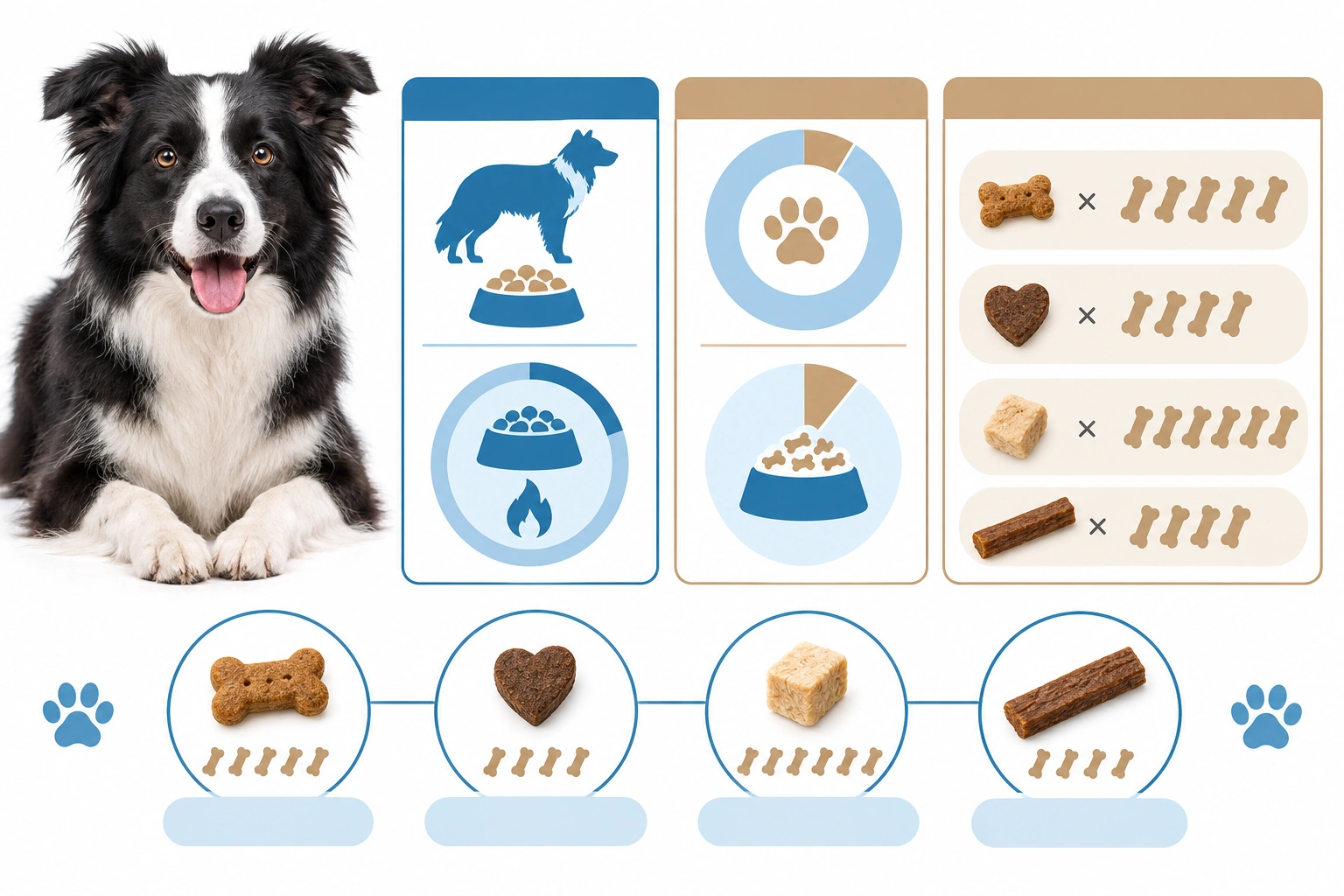
Here’s the quick takeaway: for many Border Collies, the daily treat cap is roughly 5 to 10 tiny training treats, about 3 to 6 small biscuits, or around 1 to 3 higher-calorie treats, depending on calories and size. A low-activity Border Collie may need to stay near the low end, while a heavily trained dog may fit more rewards into the budget. Treat calories vary a lot by brand and treat size, so always check the label.
How to Calculate a Safe Daily Treat Limit
Treats are easiest to manage when you think in calories instead of pieces. That gives you a budget.
The simple formula
- Find your Border Collie’s estimated daily calories.
- Take 10% of that number for treats.
- Divide that treat budget by the calories in each treat.
Formula:
Daily treat calories = daily calories × 0.10
So if your dog needs 1,100 calories per day, treats should total about 110 calories or less.
That matches the general guidance that dog treats should make up no more than 10% of daily calories, with the bulk of calories coming from regular food designed to meet nutritional needs. You can read the same principle in Pedigree’s treat guidance.
A worked example
Say your adult Border Collie needs about 1,200 calories per day.
Ten percent of that is 120 calories for treats.
Now look at the treat label:
- A small training treat might be 2 calories
- A medium biscuit might be 20 calories
- A larger crunchy treat might be 40 calories
That means your daily treat budget could look like this:
- 60 tiny 2-calorie treats
- 6 twenty-calorie treats
- 3 forty-calorie treats
Those are very different feeding patterns, even though the calorie total is the same. For most Border Collies, the tiny-treat approach is much easier to manage because it supports training without blowing through the budget in a few bites.
Quick treat-budget table for Border Collies
| Border Collie type | Example daily calories | 10% treat budget | What that means in practice |
|---|---|---|---|
| Less active adult | 900 calories | 90 calories | About 45 tiny 2-calorie treats, or 4 small 20-calorie treats |
| Moderately active adult | 1,100–1,300 calories | 110–130 calories | Roughly 55–65 tiny 2-calorie treats, or 5–6 small 20-calorie treats |
| Highly active working dog | 1,400+ calories | 140+ calories | More room for rewards, but still not unlimited |
| Puppy | Varies by age and growth stage | Usually still keep treats small | Use treats sparingly and count them carefully |
These are examples, not exact feeding instructions. Your dog’s body condition, age, and food brand matter too.
What Counts as a Treat, Training Reward, or Chew?
This is where owners accidentally overfeed.
A treat is not just a biscuit from the bag. If it contains calories, it belongs in the daily budget.
Count these as treats
- Training treats
- Crunchy biscuits
- Freeze-dried meat pieces
- Cheese or sausage used for training
- Table scraps
- Dental chews
- Bully sticks and other edible chews
- Bits of kibble used as rewards if they are extra beyond the meal
That last one surprises people. If you use your dog’s regular kibble during training and simply pull it from the meal bowl, that is not extra treat calories. If you add it on top of the meal, it is.
Why this matters
A Border Collie can look lean and still be getting too many calories from “little extras.” A few cheese cubes, a chew, and a handful of training treats can add up fast. The problem is not just weight gain. Too many rich snacks can also lead to softer stools or a dog that starts ignoring meals because the rewards are more exciting than dinner.
How Age, Activity Level, and Training Frequency Change the Limit
Border Collies are an active breed, but activity does not erase calorie math. A dog can burn more energy and still gain weight if treats are oversized or constant.
Puppies
Border Collie puppies usually need frequent small meals, and in the early months some may eat 4 to 6 meals per day. That does not mean they should get lots of treats on top of that.
For puppies, keep treats:
- very small
- soft enough to chew quickly
- low in calories
- tied to training, not boredom
Puppies are growing, so you want room in the diet for a complete and balanced puppy food rather than filling them up with snacks. If you are using treats heavily for training, use tiny pieces and reduce meal portions only if the treat amount becomes meaningful.
Adult pet Border Collies
Most adult Border Collies do well with a regular calorie budget and a treat allowance that stays near the 10% mark. If your dog is mostly a companion dog with moderate exercise, treat calories need tighter control than people expect.
A good example: if your adult dog gets two daily meals and a few training sessions, you may be better off using very small treats and reserving larger snacks for occasional use.
Highly active or working Border Collies
A Border Collie that works, competes, or trains hard may have more room for rewards because its daily calorie needs are higher. That said, “more room” is not the same as “unlimited.”
Working dogs still need:
- a calorie budget
- stool monitoring
- body condition checks
- meals adjusted when treat use rises
A dog doing a lot of activity can tolerate more treat calories than a couch-potato pet, but the budget still matters. If you want the dog to stay lean and perform well, treat calories should still come from the day’s total.
Seniors
Older Border Collies often need fewer calories than younger adults because activity usually drops. That means the treat allowance often shrinks too.
Seniors are also the group where owners most often miss gradual weight gain. A few extra snacks per day can become a real issue over months, even if the dog still seems eager and energetic.
Best Low-Calorie Treat Choices for Border Collies
For frequent training, the best treat is usually the one that is small, easy to swallow, and low in calories.
Better choices for everyday training
- Tiny soft training treats
- Pieces of plain cooked chicken, cut very small
- Freeze-dried meat broken into crumbs
- A portion of the dog’s regular kibble
- Low-calorie commercial training treats
A practical target is to look for treats that are roughly 1 to 3 calories per piece for everyday training, or small enough that you can give several without using up the day’s budget. For longer sessions, a lower-calorie option that adds up to under about 20 to 30 calories per training round is often easier to manage.
The goal is not to make every reward exciting. The goal is to make the reward repeatable. A tiny treat you can give 20 times in a session is often more useful than a large, high-value snack that burns the whole budget in five repetitions.
High-value treats: useful, but easy to overdo
High-value treats have a place. They can help with recall, reactivity work, or difficult training moments. The trade-off is simple: the more rewarding the treat is, the more carefully you need to portion it.
A useful strategy is to reserve richer treats for short, important training moments and use lower-calorie options for routine reinforcement.
Store-bought vs homemade
Store-bought treats are convenient because calories are often listed on the package. Homemade treats can be fine, but they are harder to budget unless you know the ingredients and portion size. A homemade piece of chicken is easy to estimate; a mixed recipe with cheese, flour, and oil is not.
If you want the easiest path to calorie control, use treats with a clear calorie label and keep the pieces small.
Should You Reduce Meals When You Give Treats?
Yes, if treats are regular rather than occasional.
This is the part many owners skip. If you give treats every day and never adjust meals, your Border Collie is eating more than you think.
Use this decision rule
- Occasional treat day: no meal change needed
- Daily training treats: reduce meal portions if treat calories are meaningful
- Heavy training day: subtract treat calories from the day’s food budget
If your dog gets 100 calories of treats and the treat budget is 120 calories, that is fine. But if you keep the full meal portion and add those treats on top, the dog is now eating 100 extra calories beyond the plan.
That may not sound like much, but over time it matters.
A practical way to adjust meals
If your dog’s regular food is calorie-dense, even a small reduction in kibble can offset a lot of treats. For example, if your kibble label says 400 calories per cup, then 1/4 cup equals about 100 calories. If your Border Collie gets about 100 calories of treats during training, you can reduce the meal by roughly that amount on the same day.
The exact amount depends on the food label, which is why calorie counting works better than guessing by volume.
If you have not already worked out your dog’s daily food baseline, this pairs well with how much a Border Collie should eat each day and how many calories a Border Collie needs per day.
Signs Your Border Collie Is Getting Too Many Treats
The first clue is usually not dramatic weight gain. It is a slow change.
Watch for these signs
- Waist becomes less obvious
- Ribs are harder to feel under a light layer of fat
- Your dog finishes meals less eagerly
- Stool gets soft or inconsistent
- Begging increases around snack times
- Weight creeps up over several weeks
A Border Collie should generally stay lean enough that you can feel the ribs without pressing hard, and the waist should still be visible from above. If the body shape is changing, treat calories are one of the first things to check.
The body condition score test
Body condition score is one of the most practical tools owners have. If your dog is moving from lean to “a little padded,” the fix is usually not a dramatic diet overhaul. Often it is just a tighter treat budget and a more honest look at extras like chews and table scraps.
If you notice your Border Collie’s waist is fading or the ribs are getting harder to feel, cut treat calories by about 25% for 2 weeks and recheck. For example, if your dog was getting about 120 calories of treats per day, drop that to around 90 calories and watch the body shape, stool, and appetite.
When to Ask Your Veterinarian
Some dogs need a more personalized plan than the 10% rule can provide.
Ask your veterinarian if your Border Collie:
- is overweight or gaining weight despite “normal” portions
- has a sensitive stomach or frequent loose stools
- is a puppy with a lot of training treats in the routine
- has a medical condition that affects feeding
- is on a therapeutic or prescription diet
- needs a weight-loss plan
A vet can help you set a treat budget that fits the dog’s condition, not just the breed. If your dog’s weight or digestion is changing, that is worth addressing early rather than waiting until the problem is obvious.
For general nutrition standards, it also helps to remember that complete and balanced foods should meet the dog’s main nutritional needs; the Association of American Feed Control Officials explains the framework behind pet food labeling and nutrient adequacy at AAFCO.
The Bottom Line for Border Collie Treats
If you want a simple rule you can use today, use this: keep treats to about 10% or less of your Border Collie’s daily calories, count every edible reward, and reduce meals if treats become a regular part of the day.
That approach gives you enough flexibility for training without letting snacks quietly take over the diet. For a Border Collie, the best treat plan is usually not the most generous one. It is the one you can keep consistent while keeping the dog lean, energetic, and eager to work.
FAQ
How many treats per day is too many for a Border Collie?
If treats start pushing past about 10% of daily calories, that is usually too many. In practical terms, that might mean more than 5 to 10 tiny treats, several medium biscuits, or a frequent stream of chews and table scraps, depending on the treat size and calories.
Can I use my Border Collie’s kibble as training treats?
Yes. Kibble is often one of the easiest low-calorie training rewards, especially if you take it from the meal portion instead of adding it on top.
Do chews count as treats?
Yes. Edible chews like bully sticks, dental chews, and similar snacks can add a lot of calories over time. For budgeting, they should count as part of the daily treat total.
What is the best low-calorie treat for training?
Usually the best choice is a tiny, soft treat that is about 1 to 3 calories per piece or a small piece of the dog’s regular kibble. The best treat is the one you can give often without exceeding the calorie budget.
Should I reduce meals on days I use a lot of treats?
Usually yes. If treats are a regular part of the day, subtract those calories from the meal portion so the total daily intake stays in range.
How can I tell if my Border Collie is getting too many treats?
Look for a fading waist, harder-to-feel ribs, creeping weight gain, softer stools, or meal pickiness. If you notice those signs, reduce treats and recheck body condition after a couple of weeks.