
Do Neutered Dogs Still Mate? What Owners Need to Know

Yes, neutered dogs can still attempt to mate, mount, hump, or even tie with another dog. What neutering changes is fertility, not every mating-related behavior.
That distinction matters. If your dog is neutered, you may still see the posture, the chasing, the mounting, or the intense interest in an intact female. But in most cases, a neutered dog cannot produce puppies once he is fully sterile.
For Border Collie owners, this often shows up in high-arousal situations: a dog park, a busy training class, an intact female in heat next door, or an overexcited greeting with another dog. The behavior can look sexual, but the cause is not always sexual desire. Sometimes it is habit, stress, excitement, or learned behavior that has stuck around.
Here’s the practical takeaway: neutering usually removes the reproductive risk, but it does not guarantee the behavior disappears immediately or completely.
The short answer: can a neutered dog still mate?
A neutered dog can still try to mate. A male may mount a female, make thrusting motions, and in some cases even tie. But if the dog has been properly neutered and no reproductive tissue remains, he should not be able to sire puppies.
That means there are really two separate questions:
- Can he perform the behavior? Yes, sometimes.
- Can he cause a pregnancy? Usually no, once fertility is gone.
The reason owners get tripped up is that the behavior and the biology do not stop on the same schedule. A dog may keep showing mating-like behavior for a while after surgery, and some dogs keep doing it long-term even when they are no longer fertile.
If you want a deeper breakdown of male-specific issues, this related guide on whether a male dog can still mate after being neutered covers the fertility side in more detail.
Mating behavior vs. actual fertility
This is the most important distinction in the topic.
What neutering changes
Neutering removes the testicles, which are the main source of testosterone. Over time, that leads to a drop in hormone-driven behaviors. It also removes the dog’s ability to produce sperm, which is what prevents pregnancy.
What neutering does not always change right away
Neutering does not erase memory, habit, excitement, or learned patterns. A dog that has mounted before may continue to do it because:
- it has become a practiced behavior
- it happens during overarousal
- it has been reinforced by attention or play
- it is part of social tension or frustration
The ASPCA notes that many male and female dogs continue to mount and even masturbate after being neutered or spayed, and that some of this behavior may simply be learned or feel rewarding to the dog. That is a useful reminder for owners: a dog can act sexually without being fertile. See the ASPCA’s guidance on mounting and masturbation in dogs.
A simple way to think about it
A neutered dog can still show the behavior of mating, but usually not the result of mating.
That is why you should not assume, “He’s neutered, so I can ignore what he’s doing.” If he is with an intact female, the behavior still matters for management, safety, and peace between the dogs.
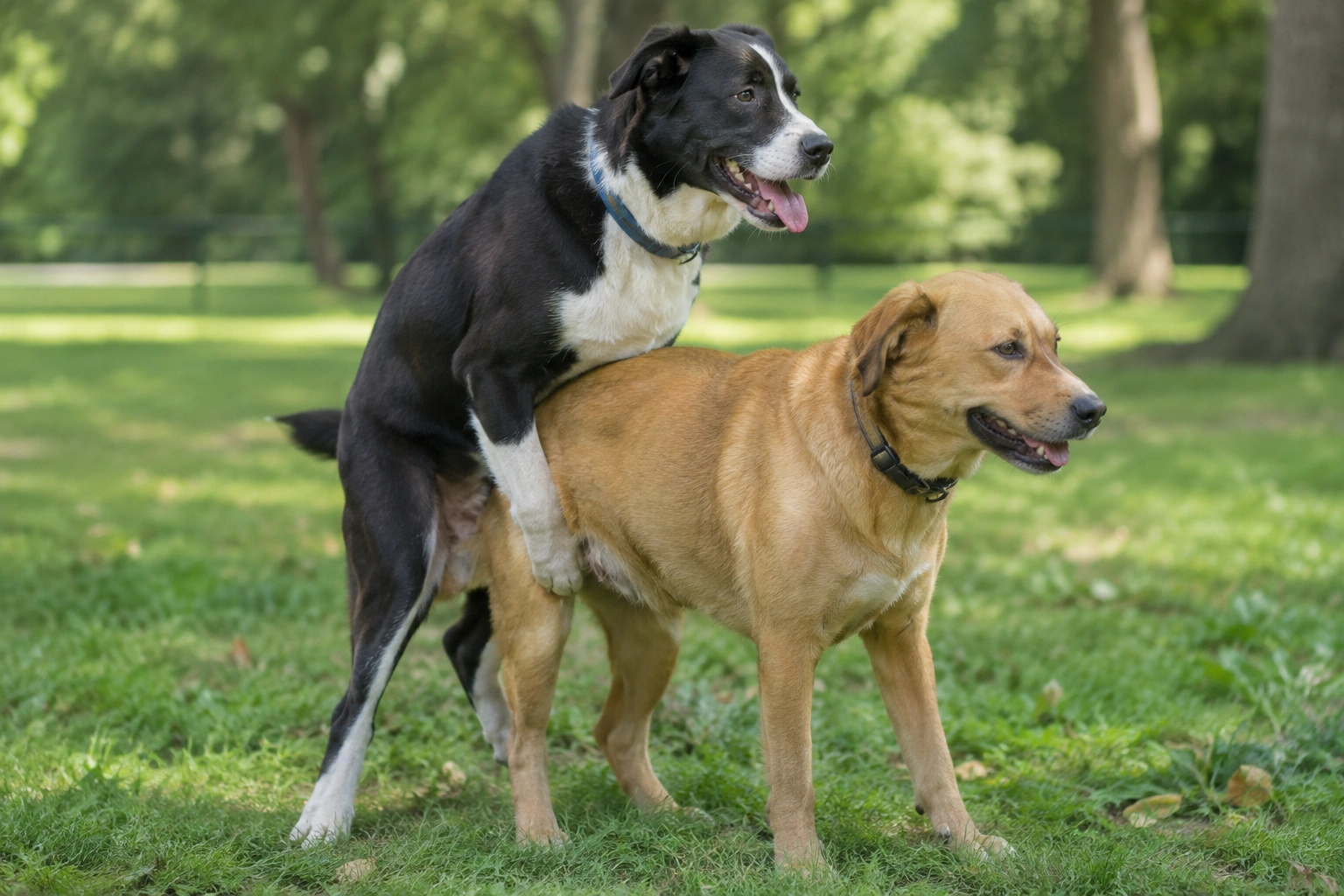
Why a neutered dog may still mount, hump, or court other dogs
Mounting is not always about sex. That surprises a lot of owners, especially when the dog is otherwise calm and well-trained.
1. Leftover hormones after surgery
After neutering, hormone levels do not vanish instantly. Some sexual behaviors may continue for a period after surgery because the body needs time to adjust. That is one reason a recently neutered dog may still act interested in other dogs.
2. Habit and rehearsal
Dogs repeat what has worked before. If mounting became a pattern before neutering, the behavior may continue because it is already in the dog’s behavioral “library.”
3. Excitement and arousal
Many dogs mount when they are overexcited, not when they are trying to reproduce. This is common in busy environments, during greetings, during rough play, or when the dog is over threshold.
For Border Collies, this matters because some individuals run “hot” under stimulation. A dog that is mentally switched on, frustrated, or overworked may use mounting as part of that arousal state.
4. Stress or displacement behavior
A dog that feels uncertain may do something that looks odd but serves as a pressure release. Mounting can appear when a dog is conflicted, overstimulated, or socially uncomfortable.
5. Social tension
Some dogs mount another dog during a scuffle, a status dispute, or when they do not know how else to manage the interaction. In those cases, the behavior is less about mating and more about communication.
6. Play
Young dogs especially may mount during play. It is not always polite play, but it is common enough that owners should not automatically read it as breeding behavior.
How long after neutering can pregnancy risk still exist?
This is the part people most often underestimate.
If a dog was neutered recently, do not assume fertility is gone immediately. The body may still contain residual sperm for a short period after surgery, and hormone-driven interest may also linger.
A practical rule of thumb is to treat the first few weeks after neutering as a caution window, but the exact timing varies by dog and by your veterinarian’s guidance. Owners should follow their vet’s instructions on when sperm are no longer a concern for their individual dog.
That means a recently neutered male should still be supervised around an intact female, especially one in heat, until your veterinarian confirms the post-op timeline for your dog. If there is any chance a mating happened close to the surgery date, contact your vet promptly.
Vet Help Direct notes that if one dog has been neutered but the other has not, a puppy will not be produced once the neutering has fully taken effect; they also advise contacting a veterinary practice quickly if pregnancy or infection is a concern, and they note that a pregnancy scan can be used if pregnancy is suspected. You can read that guidance here: Vet Help Direct on whether neutered dogs can still mate.
Practical rule for owners
Use this rule, not wishful thinking:
- Recently neutered dog + intact female = keep them separated and supervised until your vet says sperm are no longer a concern
- Fully sterile, long-term neutered dog + intact female = pregnancy risk is usually low, but behavior may still need supervision
If the female is in heat and your dog is trying hard to mate, separate them. Even when pregnancy is not possible, the interaction can escalate into frustration, stress, or injury.
Can a neutered male still get a female pregnant?
Usually no, not once he is fully neutered and no sperm remains.
But the timing matters. A dog that was neutered very recently may still have residual sperm for a short time, so pregnancy risk is mainly an immediate post-op concern rather than a long-term one after full sterilization. That is why the phrase “neutered” should not be treated as a magic switch that instantly eliminates all reproductive risk.
So if your question is, “Can my neutered dog still get a female pregnant?” the honest answer is:
- Not if he is fully sterile
- Possibly, if the surgery was recent and sperm are still present
If you are not sure whether the timing is safe, treat it as a veterinary question, not a guess.
When post-neuter mating behavior is normal vs. when it’s a problem
Not every mounting episode needs a medical workup. But not every episode should be brushed off either.
Usually normal enough to monitor
This is often reasonable to watch at home if:
- the behavior is occasional
- it happens during play or excitement
- it is not escalating
- your dog is otherwise normal, comfortable, and social
- there is no intact female in heat involved
A Border Collie that mounts once or twice at the dog park when overexcited is not unusual. In that case, management and training usually matter more than panic.
More concerning patterns
Take the behavior more seriously if:
- the dog suddenly starts mounting when he never did before
- it happens repeatedly in calm settings
- the dog seems restless, uncomfortable, or unable to settle
- the behavior is obsessive or difficult to interrupt
- there are urinary changes, pain, licking, or other physical symptoms
- the dog is persistently fixated on an intact female
A sudden behavior shift is the key warning sign. New mounting behavior is sometimes just arousal, but it can also be a clue that something else is going on.
When to call the vet sooner
Contact your veterinarian promptly if mounting is sudden, persistent, or paired with any of the following:
- straining to urinate or frequent urination
- licking at the penis or groin
- signs of pain, stiffness, or sensitivity when touched
- repeated attempts to mount that are hard to interrupt
- discharge, swelling, or other genital changes
- a recent mating or possible exposure to an intact female in heat
- behavior that seems more compulsive than situational
Persistent mounting can sometimes be linked to pain, urinary issues, or another medical problem, not just stress or arousal.
What to do if your neutered dog keeps trying to mate
The goal is not to shame the behavior. The goal is to reduce rehearsal, lower arousal, and prevent risky situations.
1. Separate from intact females in heat
If an intact female is in heat, do not rely on “he’s neutered” as your safety plan. Use physical separation, leash control, gates, crates, and distance.
2. Interrupt early, before the dog locks in
The earlier you interrupt, the easier it is to redirect. Once a dog is fully aroused, it becomes much harder to break the pattern.
3. Reduce the trigger, not just the symptom
If the dog mounts when play gets too wild, shorten the play session. If it happens at greeting time, slow the greeting down. If it happens when guests arrive, manage the environment before the dog gets overexcited.
4. Reward incompatible behavior
Teach and reward behaviors that cannot happen at the same time as mounting, such as:
- settle on a mat
- sit and look at you
- move away on cue
- go to bed
- disengage and return to you
For a Border Collie, this is especially useful because the breed often learns quickly when the replacement behavior is clear and rewarding.
5. Don’t accidentally reinforce it
If the dog mounts and everyone laughs, pushes, or chases him, the behavior may become more exciting. Calm interruption works better than a big emotional response.
6. Track the pattern
If you notice the behavior only happens in one context, you have useful information. That helps you decide whether the issue is social, environmental, or medical.
When to see a veterinarian or certified trainer
See a veterinarian if the behavior is sudden, intense, or paired with signs that suggest discomfort or illness. That includes:
- straining to urinate
- licking the genitals
- restlessness that looks like distress
- pain when moving or being touched
- repeated mounting that seems compulsive
- any concern about pregnancy after recent mating
- any concern about infection after mating
A vet can help rule out medical causes first. If the dog is physically fine but the behavior is becoming a habit, a certified trainer or behavior professional can help you build a practical plan around arousal control and redirection.
If you are also wondering about age and timing, this related Border Collie Hub guide on whether dogs can be neutered at any age may help you understand how timing can affect expectations after surgery.
FAQ
Can a neutered dog still try to mate?
Yes. Neutering does not always stop mounting, thrusting, or other mating-like behavior right away, and some dogs continue the behavior long term.
How long after neutering can a dog still cause pregnancy?
The exact window varies, but pregnancy risk is mainly a concern in the immediate post-op period while residual sperm may still be present. Follow your veterinarian’s guidance on when sperm are no longer a concern.
Should a recently neutered dog be around an intact female in heat?
Not without supervision. Keep them separated until your veterinarian says the post-neuter fertility window has passed.
Why is my neutered dog still humping?
It may be due to habit, excitement, stress, play, or social tension. If it is sudden or persistent, a veterinary check is wise because pain or urinary issues can also contribute.
Does neutering guarantee the behavior will stop?
No. Neutering usually reduces fertility and may reduce hormone-driven behavior over time, but it does not erase learned habits or all mounting behavior.
Bottom line for owners
Neutering usually prevents puppies, but it does not guarantee that mating behavior disappears right away, or even completely.
A neutered dog may still:
- mount
- hump
- show interest in an intact female
- tie briefly in some situations
- act sexually without being fertile
What matters most is the context. A recently neutered dog around an intact female still deserves supervision until your veterinarian says sperm are no longer a concern. A long-term neutered dog that humps during excitement may need management and training, not breeding advice. And a sudden or persistent change in behavior deserves a veterinary check.
If you remember only one thing, make it this: neutered does not always mean behavior-free, but it usually does mean pregnancy risk is greatly reduced once the dog is fully sterile.
