
How to Make a Border Collie Bath Mat Non Slip

Quick Answer
To make a Border Collie bath mat non slip, first clean the mat’s backing and the surface beneath it. For an in-tub mat with suction cups, install it on a smooth, clean surface, press every cup firmly into place, and test the edges before bathing your dog. For a bathroom floor rug, use a compatible non-slip rug pad on a clean, dry floor. If the mat still shifts, curls, or bunches up, replace it with a properly fitted mat designed for that location.
A bath mat should give your Border Collie stable footing, not slide underneath their paws. Unfortunately, a mat advertised as non-slip can still move when the backing becomes dirty, the floor gets wet, or its grip system does not match the surface.
The right fix depends on whether the mat sits inside the bathtub or on the bathroom floor. These two locations require different types of grip, especially during a wet and soapy dog bath.
First, Find Out Why Your Bath Mat Is Slipping
Before adding anything underneath the mat, identify what is actually moving. Otherwise, a temporary fix may hide the problem without making bathing safer.
- The entire mat slides: Its underside is not gripping the tub or floor adequately.
- The corners lift: The mat may be curled, incorrectly fitted, or losing suction at the edges.
- The mat wrinkles or bunches: It may be too flexible, oversized, or poorly supported.
- Your dog’s paws slide while the mat stays still: The top surface may be too smooth or coated with shampoo residue.
- The mat moves only when wet: Water, soap, or an incompatible backing may be reducing traction.
These problems are not interchangeable. Improving the grip underneath a mat will not necessarily help if your dog’s paws are slipping across its top.
Check both surfaces separately: the connection between the mat and the bathtub or floor, and the contact between your Border Collie’s paws and the mat.
How to Make an In-Tub Border Collie Bath Mat Non Slip
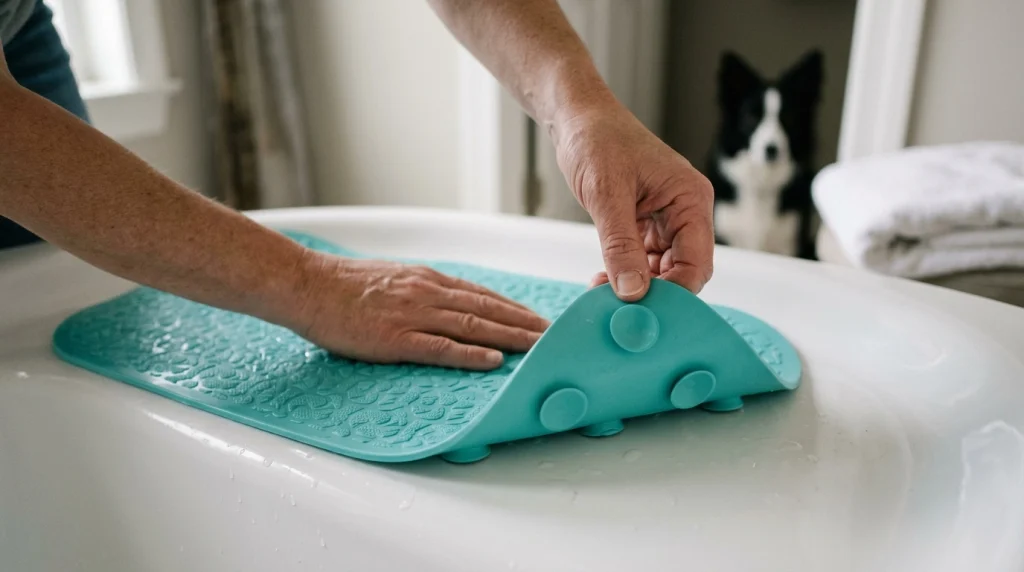
For a bathtub mat with suction cups, proper installation is usually the first practical improvement. Follow the manufacturer’s instructions if they differ from this procedure.
Step 1: Remove Shampoo Residue and Dirt
Take the mat out of the bathtub and inspect its underside. Hair, soap film, oily products, and dirt can interfere with the suction cups.
Clean the mat according to its care instructions. Wash the bathtub floor with a suitable, residue-free cleaner, rinse thoroughly, and remove any remaining cleaning product.
Check around individual suction cups because debris can collect along their edges. Allow the mat to drain while preparing the installation area.
Never mix household cleaning chemicals. Rinse away cleaning products completely before allowing your Border Collie into the tub.
Step 2: Check Whether the Bathtub Surface Is Compatible
Most suction-cup bathtub mats are designed for smooth, nonporous surfaces. They may not attach securely to textured fiberglass, uneven flooring, grout lines, or certain refinished tubs.
Run your hand over the bathtub floor. If it has a noticeable pebbled or raised texture, do not assume the suction cups will hold.
A mat that cannot create a reliable seal is not suitable simply because it feels rubbery.
For more information about the installation process, see Duck Brand’s bath mat installation instructions, which explain cleaning, seating, and checking suction cups.
Step 3: Position and Secure the Mat
- Lightly wet the smooth tub surface as directed by the mat manufacturer.
- Lay the mat flat with the suction cups facing downward.
- Position it where all four of your Border Collie’s paws will normally stand.
- Press firmly over every suction cup, working from one end to the other.
- Smooth out lifted edges, folds, and air pockets.
- Gently pull the corners and edges to check whether the mat moves.
The mat should remain flat when you test it. If several cups immediately release or the entire mat slides, stop and investigate instead of bringing your dog into the tub.
Step 4: Test Stability Before Adding Your Dog
Apply gentle pressure to different areas of the mat with your hands. Check whether an edge lifts when pressure shifts across the surface.
Pay particular attention to the ends of the mat, where your Border Collie may step while turning around. A mat that stays secure in the center but peels up at one end needs attention.
Recheck the attachment before every bathing session, even if the mat worked well previously.
Safety Warning
Do not use loose adhesive tape, household glue, improvised weights, or unsecured fabric underneath a bathtub mat. These materials may create uneven footing, release in water, or leave substances that your dog could contact or ingest. If the mat cannot stay secure through its intended grip system, use a more suitable bathing surface.
How to Stop a Border Collie Bathroom Floor Mat From Sliding
A mat outside the bathtub has a different job. It should give your dog traction while stepping out, standing for towel drying, and walking across the bathroom.
Unlike a wet-area suction mat, an ordinary bathroom rug typically depends on a rubberized backing or separate rug pad. It generally needs a clean, dry floor underneath.
Clean and Dry the Floor
Lift the rug and wipe away water, dust, loose dog hair, and cleaning residue. Dry both the floor and the underside of the mat completely.
Check whether the existing rubber backing has become smooth, cracked, or brittle. Damaged backing may no longer provide enough friction.
Add a Compatible Non-Slip Rug Pad
A purpose-made non-slip rug pad can help stabilize a bathroom mat that lacks adequate backing.
Choose a pad compatible with the flooring material and the rug manufacturer’s instructions. Some backing materials can affect particular floor finishes, so compatibility matters.
Trim the pad to sit beneath the rug without extending beyond its edges. Lay the rug flat and check that it cannot fold over the pad.
Do not put an ordinary dry-floor rug pad inside a wet bathtub. It is not a substitute for a bath-safe grip system.
Keep the Step-Out Area Stable
Position the floor mat where your Border Collie naturally exits the bathtub, without creating a loose edge that catches a paw.
Dry your dog’s paws before allowing them to walk across smooth tile. For additional precautions beyond the bath mat itself, see our guide to wet bathroom floor safety.
What if the Mat Stays Put but Your Border Collie Still Slips?
If the mat does not move but your dog continues losing traction, inspect its upper surface. Suction underneath and paw grip above are two separate safety requirements.
A heavily worn, flattened, or slippery top texture may no longer provide useful traction. Shampoo left on the surface can also make paws slide more easily.
Rinse the mat thoroughly, inspect it for deterioration, and repeat a stability check when it is clean. If the top remains slippery, replacing the mat is safer than trying to modify it with random coatings.
Also look at your dog’s paw condition. Excessive hair covering the paw pads, overgrown nails, or discomfort when standing may contribute to unstable footing. Avoid cutting close to the pads or trimming nails beyond your ability.
If your Border Collie slips on ordinary dry surfaces as well, seems painful, or has new difficulty standing, seek veterinary advice rather than assuming the bath mat is the only problem.
Which Non-Slip Fix Works for Different Bathing Surfaces?
The most suitable approach depends on where you are placing the mat and what material supports it.
| Surface | Practical Approach | Important Limitation |
|---|---|---|
| Smooth bathtub | Compatible suction-cup mat | Requires cleaning and attachment checks |
| Textured bathtub | Manufacturer-approved traction solution | Standard suction cups may not seal |
| Dry bathroom tile | Rubber-backed rug or compatible rug pad | Water underneath can reduce stability |
| Walk-in dog shower | Wet-area mat rated for that shower floor | Slope, texture, and drainage must be considered |
There is no universal backing that grips every surface. Choosing the correct grip mechanism is more useful than repeatedly adding temporary material beneath an incompatible mat.
When Should You Replace the Bath Mat Instead of Fixing It?
Cleaning and repositioning help when the mat is basically sound. They cannot restore badly damaged suction cups or worn-out traction indefinitely.
Consider replacing the mat if:
- Suction cups are torn, flattened, or permanently deformed.
- The backing has cracked or begun separating.
- Several edges lift despite correct installation.
- The mat shifts during gentle stability checks.
- The upper surface becomes slippery even after cleaning.
- The mat is too small for your dog’s natural standing position.
- Its material or grip design is incompatible with the bathing surface.
A Border Collie may shift weight, turn, or step sideways during rinsing. A mat that is barely large enough for stationary paws can leave part of the dog standing on exposed, slippery tub flooring.
When evaluating a replacement, compare its coverage, surface texture, drainage design, backing, and cleaning instructions rather than focusing only on its advertised non-slip label.
Our dog bath mat review illustrates how size, suction cups, and drainage affect suitability for a Border Collie’s bathing area.
Keep the Mat Secure During Every Bath

Even a well-fitted mat cannot compensate for sudden pulling, hurried handling, or a frightened dog scrambling to escape.
Prepare shampoo, towels, and rinsing supplies before bringing your Border Collie into the bathroom. Use comfortably lukewarm water and avoid sudden movements that encourage your dog to turn or jump.
Veterinary-reviewed dog bathing guidance from PetMD also recommends a non-slip bathing surface and a calm, prepared environment.
Support your dog gently when entering and leaving the tub. Never leave them unattended during bathing.
Practical Tip
Make a brief mat check part of every bathing routine: inspect the backing, press down any suction cups, test the edges, and check the step-out floor. After bathing, rinse both sides of the in-tub mat and hang it to dry according to its care instructions.
For the rest of the washing process, our guide to preventing bathtub slipping explains how handling and footing work together.
Related Product: Non-Slip Dog Bathtub Mat
Useful Bathing Accessory
Textured Dog Bathtub Mat With Suction Cups
For a suitable smooth bathtub, consider a bath-safe mat with a textured paw-contact surface, drainage openings, and secure suction cups. Confirm the mat’s dimensions and surface compatibility before choosing one.
Affiliate link: As an Amazon Associate, we may earn from qualifying purchases.
Frequently Asked Questions
Can I put a towel under my Border Collie’s bath mat?
A loose towel is not a dependable way to secure a bathtub mat because it can shift, fold, or become saturated. Use a proper wet-area mat with compatible grip instead. A towel may be useful for drying your dog outside the tub, but it should not create unstable footing.
Why do the suction cups on my dog bath mat keep coming loose?
Soap residue, surface texture, debris, damaged cups, or incomplete installation may prevent a secure seal. Clean the surfaces, check compatibility, press each cup down, and retest. If the cups still release, stop using the mat in that location.
Can I use double-sided tape to stop a bath mat slipping?
Ordinary double-sided tape is not recommended inside a wet bathtub. Water and cleaning products can affect adhesion, and a partially detached strip may create an unreliable surface. Use only a traction product specifically approved for the bathtub material and wet-area application.
Will a rubber-backed bathroom rug work inside the bathtub?
Not unless its manufacturer specifically rates it for use inside a wet bathtub. Most decorative bathroom rugs are intended for floors outside the shower or tub. Their backing may not provide secure traction when continuously exposed to water.
How often should I clean my Border Collie’s non-slip bath mat?
Rinse away hair, shampoo, and debris after each use and let the mat dry thoroughly. Follow the manufacturer’s instructions for deeper cleaning. Inspect suction cups and backing before every bath, especially if the mat has been stored folded or rolled.
What should I do if my Border Collie refuses to stand on the mat?
Do not force your dog onto a surface they find uncomfortable or frightening. First confirm the mat is stable and feels appropriate underfoot. Introduce it gradually with calm encouragement. If your dog seems painful, weak, or unable to stand securely, stop bathing and seek veterinary guidance.
Final Thoughts
Making a Border Collie bath mat non slip starts with the right grip for the right surface. Clean the mat and floor, install suction cups correctly when suitable, and use a compatible rug pad only where it belongs.
Most importantly, never rely on a mat that continues to move after adjustment. Secure footing, a properly sized mat, and careful bathing habits help create a calmer and safer experience for your Border Collie.
