
How to Treat a Dog Eye Infection Safely: What to Do First and When the Vet Is Needed

A red, goopy, or half-closed eye is one of those problems that looks minor until it isn’t. With dogs, especially active Border Collies, eye trouble often starts after a run through brush, a windy walk, or a quick scratch from a paw. The tricky part is that “eye infection” is often the symptom people notice first, not the actual cause.
That matters because a simple irritation, a foreign body, a corneal scratch, dry eye, conjunctivitis, or even glaucoma can all look similar at first glance. Treating the wrong problem at home can delay the right one.
If your dog’s eye is only mildly irritated and your dog is otherwise comfortable, there are a few safe first-aid steps you can take while arranging veterinary advice. But if the eye is painful, cloudy, swollen, or shut, this is not a wait-and-see situation.
How to tell if it’s an infection, irritation, or injury
A useful first step is to look for the pattern, not just the redness.
Quick comparison: infection, allergy, foreign body, or corneal ulcer
- Infection / conjunctivitis: often red with watery or thick discharge; may affect one or both eyes; discomfort is usually mild to moderate, though some cases are more painful.
- Allergy / irritation: often both eyes, watery discharge, and itching or rubbing; pain is usually less prominent than with an ulcer or injury.
- Foreign body: often one eye, sudden blinking or squinting, tearing, and obvious discomfort; discharge may start watery and become thicker if irritation continues.
- Corneal ulcer: often one eye, marked pain, strong squinting, light sensitivity, or the eye being held shut; discharge may be watery or thick, and the surface may look cloudy or blue.
Signs that fit an eye infection or conjunctivitis
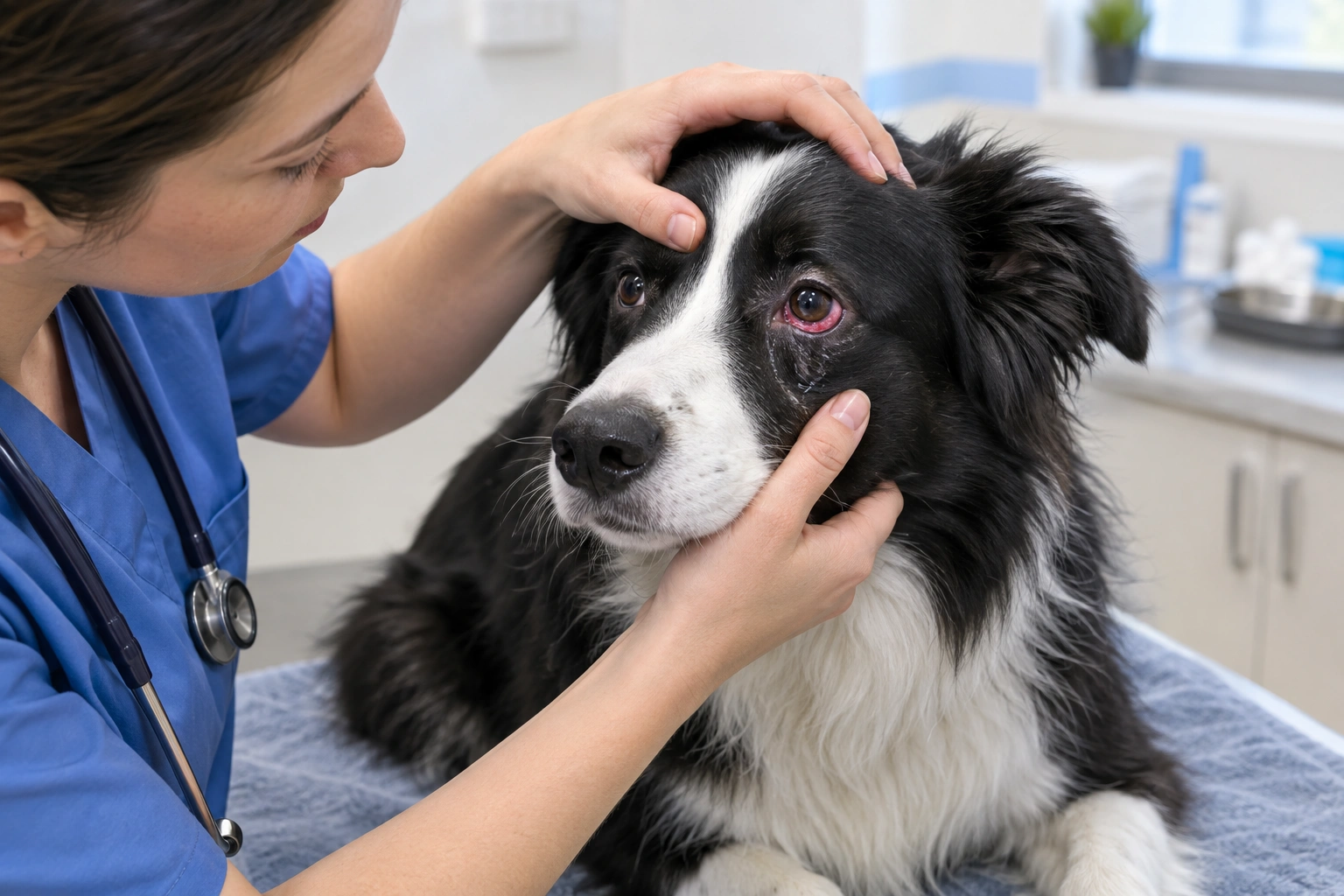
Veterinary sources commonly describe signs such as redness, swelling around the eye, watery discharge, thick smelly discharge, squinting, blinking, holding the eye closed, light sensitivity, and pawing or rubbing at the eye. Those signs can appear with conjunctivitis, but they can also show up with corneal injury or other eye disease. Veterinary Specialty Center of Tucson
Clues it may be irritation or a foreign body
One eye affected more than the other often points toward a local problem: a grass seed, dust, a scratch, or a bit of debris. If your Border Collie was running through hedges, long grass, or dusty ground and then started blinking hard in just one eye, think “foreign body or scratch” before you think “simple infection.”
Clues it may be allergy
Both eyes, watery discharge, and sneezing or itching elsewhere can fit allergy or general irritation. Allergy usually looks more symmetrical. It tends to be more of a watery, itchy problem than a thick, painful one.
Clues it may be a corneal ulcer or more serious injury
A cloudy or bluish spot on the surface of the eye, obvious pain, strong squinting, or keeping the eye shut raises concern for a corneal ulcer or trauma. That is the point where home care stops being enough. A corneal ulcer can worsen quickly and needs a vet exam, usually including fluorescein staining, to rule it in or out before any steroid-containing medication is prescribed.
Here’s the decision rule I use:
– Watery, mild, both eyes, dog otherwise normal = monitor briefly and arrange a routine vet visit if it persists.
– Thick discharge, one eye, squinting, pawing, or pain = vet visit soon.
– Cloudiness, eye held shut, swelling, bleeding, trauma, or sudden vision changes = same-day or emergency care.
What to do right now at home
The goal at home is not to “treat the infection” on your own. The goal is to keep the eye safe until a vet can identify the cause.
1) Stop the rubbing
If your dog is pawing at the eye or face-rubbing on the carpet, use an e-collar or buster collar. That is not overreacting. Rubbing can turn a mild scratch into a deeper ulcer very quickly.
2) Clean only the discharge
Use a clean cotton pad, gauze, or soft cloth moistened with warm water to gently wipe away discharge from the skin around the eye. Do not press on the eyeball.
3) Flush only if debris is suspected and the eye is not painful, cloudy, or held shut
If you suspect dust, pollen, or a small bit of debris, a sterile saline rinse or sterile eyewash can help. Use this only as a temporary comfort measure when the eye looks mildly irritated, not painful.
Do not flush the eye if it is painful, cloudy, or being held shut. In those cases, skip flushing and see a vet promptly.
Use only sterile saline or sterile eyewash. Do not use contact lens solutions, homemade rinses, boric acid solutions, or any other non-sterile liquid.
4) Keep the environment calm and clean
Dust, grass seeds, and wind can keep irritating the eye. Keep your dog indoors or on short leash walks until you know what you’re dealing with. Wash your hands after touching the eye area and clean bedding if there is discharge.
5) Watch for change over the next few hours
If the eye looks noticeably better after removing a small irritant, that is reassuring. If squinting, redness, or discharge worsens, stop home care and get the dog seen.
When a dog eye problem needs same-day or emergency veterinary care
Some eye problems are time-sensitive because vision can be affected.
Get same-day veterinary care if you see any of these:
– the eye is held shut
– strong squinting or obvious pain
– cloudy, blue, or white-looking surface changes
– a visible scratch, spot, or defect on the cornea
– swelling that is increasing
– blood in or around the eye
– a suspected foreign body that won’t wash out
– sudden vision changes
– trauma, such as a branch strike or collision
These signs can point to a corneal ulcer, uveitis, glaucoma, or a deeper injury. Those problems need proper diagnosis before treatment. Using the wrong drop, especially a steroid-containing one, can make a corneal ulcer much worse.
What veterinarians check to find the real cause
A red eye is not a diagnosis. It is a clue.
A veterinarian will usually start with a physical eye exam and then choose tests based on what they see. Common checks include:
– Fluorescein stain to look for a corneal ulcer or scratch
– Tear testing if dry eye is suspected
– Eyelid and eyelash evaluation for entropion, foreign bodies, or hair rubbing the eye
– Pressure checks if glaucoma or uveitis is a concern
That approach matters because treatment changes completely depending on the cause. A bacterial conjunctivitis, a dry eye problem, and a corneal ulcer should not be managed the same way.
How veterinarians typically treat dog eye infections and related eye conditions
Treatment depends on what is actually wrong.
For conjunctivitis
A vet may prescribe antibiotic eye drops or ointment if infection is suspected. In some cases, oral antibiotics are added if the infection is severe or there is a broader systemic issue. MedVet
For dry eye
Dry eye, or keratoconjunctivitis sicca, often needs long-term management, not just a short antibiotic course. Lubricating drops may be part of the plan, and some dogs need medications that support tear production.
For corneal ulcers
Corneal ulcers need prompt treatment based on the depth and cause of the ulcer. Treatment may include pain relief, antibiotic eye medication, and an e-collar to prevent rubbing. Steroid-containing drops are generally avoided unless a veterinarian has specifically ruled out an ulcer and chosen them for a different reason.
For glaucoma or uveitis
These are not routine “eye infections.” They may require pressure-lowering medication, anti-inflammatory treatment, or other prescription drugs depending on the diagnosis. PetMD
For a foreign body
If something is trapped under the lid or lodged in the eye, the vet may flush the eye with saline, sedate the dog for safe removal, or do both. That is one reason not to keep prodding at the eye at home.
For allergy or irritation
Veterinarians may use lubricants or anti-inflammatory eye medication when allergy or irritation is the main driver rather than infection. Blue Cross
The key point: vets do not treat every red eye the same way because the wrong medication can delay healing or make the problem worse.
What not to put in a dog’s eye
This is where well-meaning owners often cause trouble.
Do not use:
– human eye drops unless a vet specifically told you to
– redness-relief drops
– leftover antibiotic eye drops from a previous problem
– steroid eye drops unless a veterinarian has ruled out a corneal ulcer
– homemade rinses or random liquids
A red eye can be caused by an ulcer, and steroids can worsen ulceration. That is the main reason self-medicating is risky.
There are also practical safety issues: old drops may be contaminated, the problem may be the wrong diagnosis, and some medications that help one condition are wrong for another.
How to stop your dog from rubbing or scratching the eye while it heals
If your dog keeps pawing at the face, healing gets harder.
An e-collar is usually the simplest and most effective option. It prevents the dog from turning a scratch into a deeper wound. Veterinary guidance commonly includes a buster collar or similar collar for this reason. Blue Cross
If your dog hates the cone, fit it properly and give a short adjustment period. Most dogs adapt faster than owners expect. The trade-off is simple: a few hours of annoyance now versus a much bigger eye problem later.
Keep nails trimmed too. Short nails reduce damage if the dog does manage a quick rub before you catch it.
Recovery time, follow-up care, and when to expect improvement
How long it takes to heal depends on the cause.
A mild irritation may settle within a day once the irritant is gone. A straightforward bacterial conjunctivitis often improves after treatment begins, but the eye should not be assumed cured just because the discharge is reduced. Corneal ulcers, dry eye, and eyelid problems usually take longer and may need follow-up checks.
Use the vet’s instructions exactly as written. Eye medication often works best when given on schedule, not “when I remember.” If symptoms improve but the eye still looks red or the dog still squints, the problem may not be fully resolved.
A practical warning sign is this: if the eye is not clearly better within the expected window your vet gave you, or if it gets worse after treatment starts, go back. That can mean the diagnosis needs to be rechecked.
If your dog has repeated eye trouble, a referral to a veterinary ophthalmologist may be needed, especially if the problem is recurrent or severe.
Can dog eye infections spread to other pets or people?
Sometimes, but not always.
The bigger everyday concern is contamination from discharge and shared surfaces. Wash your hands after touching the eye, do not let another dog lick the face, and clean bedding if discharge is present. If one eye is affected, avoid touching the other eye with the same cloth or finger.
Hygienic handling is still smart. It lowers the chance of spreading irritation or infectious material to other pets.
Why eye infections happen in dogs and how to reduce recurrence
Eye problems often come from something that keeps irritating the surface of the eye.
Common causes include:
– conjunctivitis
– dry eye
– entropion, where the eyelid rolls inward
– debris or a foreign body
– trauma from running through brush
– underlying inflammatory or immune-mediated disease
For an active Border Collie, the most preventable risks are debris and trauma. If your dog runs in long grass or brush, check the eyes after outdoor work, especially if blinking or tearing starts afterward. Catching a scratch early is much easier than dealing with a full ulcer later.
If your dog has repeated eye trouble, don’t just keep treating each flare as the same problem. Recurrent red eye deserves a proper veterinary workup because an eyelid issue, dry eye, or chronic irritation may be driving it.
When to see a veterinarian or certified trainer
For eye problems, this section is really about the veterinarian. See a vet promptly if the eye is red, painful, cloudy, swollen, or producing thick discharge. Go urgently if the eye is shut, vision seems off, or trauma is involved.
If your dog is resisting eye medication or panicking during handling, a certified trainer can help with cooperative care skills for future treatment sessions. That does not replace medical care, but it can make follow-up treatment much easier.
Final practical takeaway
If the eye is mildly irritated, you can clean it gently, prevent rubbing, and use sterile saline as a short-term measure only when debris is suspected and the eye is not painful, cloudy, or shut, while arranging a vet visit. If there is pain, cloudiness, swelling, or a closed eye, treat it as urgent. The safest path is not guessing the diagnosis at home. It is protecting the eye until the vet can identify the cause and choose the right treatment.
For more on triaging a red eye, see our guide to why a dog’s eye is red, and if you need a step-by-step home-care checklist, read how to treat a dog eye infection at home safely.
FAQs
Can I use human eye drops on my dog?
Not unless your veterinarian specifically tells you to. Some human drops are wrong for canine eye problems, and steroid-containing products can be dangerous if a corneal ulcer is present.
Should I flush my dog’s eye?
Only if you suspect a small irritant or debris and the eye is not painful, cloudy, or held shut. Use only sterile saline or sterile eyewash. If the eye looks injured or very uncomfortable, skip flushing and see a vet.
Is a thick yellow discharge always an infection?
It often suggests infection or significant inflammation, but it does not prove the cause. A scratch, ulcer, or foreign body can also lead to discharge.
How do I keep my dog from scratching the eye?
Use an e-collar as soon as rubbing starts. That is the fastest way to prevent self-trauma while you wait for treatment.
How fast should I expect improvement?
That depends on the cause. Mild irritation may improve quickly, but painful or cloudy eyes need reassessment if they are not clearly better soon after treatment begins.
Are dog eye infections contagious?
Sometimes the discharge or underlying infection can spread to another eye or another dog through contact. Good handwashing and clean bedding help reduce that risk.
When should I ask about a veterinary ophthalmologist?
If the eye problem keeps coming back, is severe, or does not improve as expected, ask your vet whether a referral to a veterinary ophthalmologist makes sense.
