

Quick Answer
Waterless shampoo can be useful for a Border Collie when you need to freshen the coat between full baths. Choose a dog-specific, pH-balanced formula, brush first, work it through the outer coat carefully, and remove any excess product afterward. The AKC’s waterless dog-cleaning guidance also recommends avoiding excessive dry-shampoo use because residue can build up.
What matters most for a Border Collie’s coat
- Dog-only formula: Don’t use human dry shampoo or regular human hair products.
- Low residue: Thick double coats can trap powder or sticky product close to the skin.
- Gentle fragrance: Unscented or lightly scented formulas are usually easier on sensitive dogs.
- Brush first: Remove loose undercoat, dirt, burrs, and tangles before applying shampoo.
- Spot clean first: Use waterless shampoo for paws, legs, belly fur, or mild odor instead of soaking the whole coat unnecessarily.
- Watch the skin: Stop using the product if you notice redness, increased itching, flakes, or discomfort.
My simple rule
- Use waterless shampoo for light cleanup. Use a proper bath when dirt, chemicals, feces, heavy mud, or skin problems require thorough washing.
Border Collies have a talent for finding mud five minutes after I finish grooming them. A waterless shampoo for a Border Collie can save a lot of time when the dog isn’t dirty enough for another full bath.
That doesn’t mean every dry shampoo suits a Border, BC, or working collie. Their dense double coat changes how I choose, apply, and remove these products.
In This Guide
- Is waterless shampoo good for a Border Collie?
- What should you look for in waterless shampoo?
- Which type of waterless shampoo works best?
- How do you use waterless shampoo on a Border Collie?
- How often can you use waterless shampoo?
- When does a Border Collie need a full bath instead?
- Can waterless shampoo help itchy or sensitive skin?
- How do you keep a Border Collie clean between baths?
- Frequently asked questions
- Final takeaway
Is Waterless Shampoo Good for a Border Collie?
Yes. Waterless shampoo is useful for healthy Border Collies when it’s used as a grooming aid between proper baths rather than as a permanent replacement for bathing.
Definition: A waterless dog shampoo is a foam, spray, wipe, or powder designed to loosen dirt, absorb oil, or reduce odor without a traditional rinse-and-water bath.
Why a Border Collie’s coat needs special attention
Border Collies have a double coat. That means a softer insulating undercoat sits beneath protective outer hairs, often called guard hairs.
Both rough-coated and smooth-coated Borders have this double-coat structure. The AKC’s Border Collie breed guidance recommends regular brushing and notes that grooming needs increase during shedding periods.
- Rough coats: Longer feathering can hold foam, debris, and moisture around the chest, rear legs, belly, and tail.
- Smooth coats: They have less feathering, but loose undercoat can still trap grooming residue.
- Working Borders: Herding, hiking, agility, and farm work can leave dust, grass, and mud throughout the coat.
I get the best results when I treat waterless shampoo as a spot-cleaning tool. Muddy lower legs rarely justify coating a clean back and shoulders with more product.
What Should You Look for in Waterless Shampoo for a Border Collie?
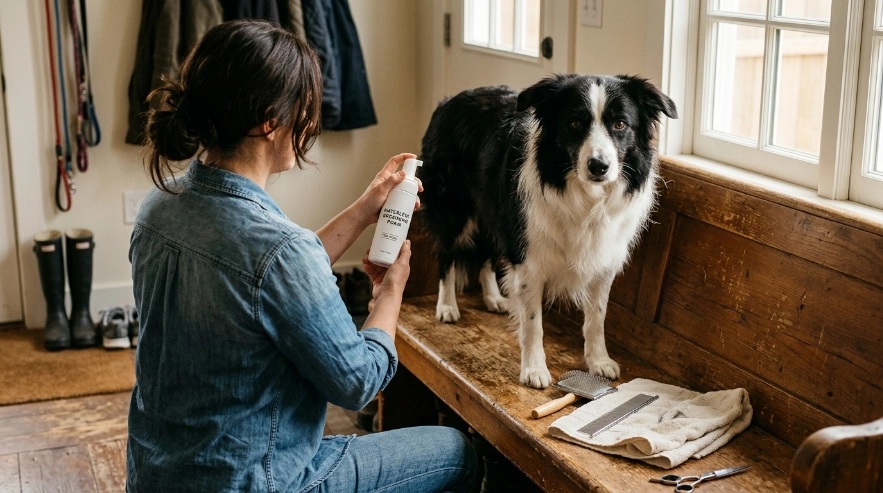
Look for a mild dog-specific formula that leaves little residue and doesn’t depend on heavy perfume to make the dog smell clean. Coat feel after drying matters more to me than fragrance.
My selection checklist
- Made for dogs: The label should clearly state that the product is formulated for canine use.
- pH balanced: Dog skin differs from human skin, so human shampoos aren’t suitable substitutes.
- Low-residue formula: This is especially important beneath a Border Collie’s thick undercoat.
- Mild scent: I prefer unscented or lightly scented products over intense perfumes.
- Simple application: A foam or controlled pump spray makes it easier to keep product away from the face.
- Clear directions: The label should explain application, drying, brushing, and age restrictions.
The VCA grooming and coat-care guidance recommends shampoos formulated specifically for dogs rather than human shampoo. That’s a rule I follow for both wet and waterless products.
Ingredients aren’t the whole story
Terms like “natural” or “botanical” don’t automatically tell you whether a formula suits your dog. I pay more attention to species labeling, fragrance level, residue, and my dog’s skin response.
For a dog with normal skin, gentle conditioning ingredients can be useful. If your Border already has irritated skin, choosing a medicated or therapeutic product becomes a veterinary decision.
Which Type of Waterless Shampoo Works Best for a Border Collie?
A foam is my first choice for broader cleaning because I can control where it goes and work it through the outer coat. Wipes are easier for paws and small dirty patches.
| Type | Rinse Needed? | Best Border Collie Use | Double-Coat Consideration | My Preference |
|---|---|---|---|---|
| Foam | No | Legs, belly, chest, larger dirty areas | Easy to massage through longer rough coats | Best all-round option |
| Pump spray | No | Light odor, dusty coat, spot cleaning | Can land mostly on topcoat unless worked in | Good with careful application |
| Grooming wipes | No | Paws, lower legs, belly, small stains | Doesn’t reach deeply into dense coat | Excellent for quick cleanup |
| Powder | Usually brushed out | Oil and mild odor | Powder can remain beneath dense undercoat | Not my first choice |
Owners of Australian Shepherds face a similar issue because Aussies also carry substantial double coats. A short-coated Kelpie may be easier to wipe clean because there’s less coat for residue to hide in.
How Do You Use Waterless Shampoo on a Border Collie?
Brush first, apply a small amount, work it through the dirty hair, let the product perform as directed, and then remove loose residue. Starting with less product is easier than fixing an overloaded coat.
My step-by-step method
- Check the skin. Look for redness, open sores, moist patches, scabs, ticks, or painful areas before applying anything.
- Brush the coat. Remove loose undercoat, grass, burrs, dry mud, and small tangles first.
- Read the label. Follow the manufacturer’s instructions for quantity, drying time, puppy age, and brushing.
- Apply away from the face. I put foam into my hands first rather than squirting it near the eyes, nose, mouth, or ears.
- Work with the coat. Massage gently through the dirty hair instead of soaking the entire double coat.
- Prevent licking. Keep the dog occupied until the product has been worked in and dried as directed.
- Brush again. Once appropriate for the formula, brushing lifts loose dirt and helps remove remaining product.
- Check the finish. The coat should feel clean and normal, not sticky, chalky, damp, or heavily perfumed.
Don’t forget the undercoat
One mistake I made early with double-coated dogs was cleaning only what I could see. The top looked fresh, while product and loose fur were still sitting underneath.
Part the coat with your fingers after it dries. Check the skin and undercoat in the armpits, chest, groin, rear feathering, and behind the ears.
Use grooming as training
Border Collies learn routines fast, including bad ones. Chasing a dog around the room with a spray bottle can turn grooming into a game you don’t want.
- Use a grooming station: A nonslip mat can become a clear place to stand.
- Reward short sessions: Start with 30–60 seconds if your dog dislikes handling.
- Pair touch with food: Reward calm handling of paws, chest, belly, and tail.
- Stop before frustration: Two calm minutes beat ten minutes of wrestling.
How Often Can You Use Waterless Shampoo on a Border Collie?
For routine dry or waterless shampoo, I wouldn’t make frequent whole-body application the default. The AKC advises limiting dry shampoo use to about once a week because product can build up on the coat.
Your Border may need much less than that. I often find brushing and a damp cloth handle ordinary dust without adding another grooming product.
Let the dog’s lifestyle decide
- Mostly indoor Border: Use waterless shampoo only when odor or a dirty patch makes it useful.
- Agility dog: Wipe feet and legs after dirty training sessions before reaching for shampoo.
- Farm or herding dog: Brush out dry soil and vegetation before deciding whether shampoo is needed.
- Heavy shedder: Increase brushing rather than trying to manage loose coat with shampoo.
Regular brushing matters more than deodorizing. The AKC recommends brushing Border Collies about once or twice weekly and more often during heavy shedding.
When Does a Border Collie Need a Full Bath Instead?
Waterless shampoo is for light cleaning. A full rinse is the better choice when something needs to be physically removed from the coat rather than disguised or partially loosened.
I skip waterless shampoo in these situations
- Heavy wet mud: Thick mud can dry beneath feathering and around the feet.
- Feces or urine: Contaminated coat needs proper cleaning.
- Unknown chemicals: Don’t cover chemical residue with another product.
- Road salt or deicer: Paws and lower legs should be rinsed thoroughly.
- Greasy contamination: Waterless products may not remove heavy oils effectively.
- Strong organic odor: Rolling in manure or decomposing material normally calls for washing.
- Dense matting: Shampoo isn’t a substitute for safely resolving mats and checking the skin underneath.
When I do give a full bath, I brush the coat first. Wetting existing tangles can make some knots tighter and harder to work through.
The PetMD dog-shampoo guidance also emphasizes choosing products made for dogs and matching the shampoo to the dog’s needs.
Can Waterless Shampoo Help an Itchy or Sensitive Border Collie?
Waterless shampoo may clean a mildly dirty coat, but it shouldn’t be treated as a cure for persistent itching. Repeated scratching can have causes that grooming alone won’t solve.
Signs I wouldn’t try to cover with grooming products
- Persistent scratching or chewing
- Red or inflamed skin
- Hair loss
- Crusts or scabs
- Greasy skin or an unusual odor
- Moist or painful patches
- Recurring ear irritation
- Sudden widespread dandruff
These signs can occur with allergies, parasites, bacterial problems, yeast overgrowth, or other skin conditions. A veterinarian can identify the cause and recommend an appropriate treatment plan.
Vet note: If your Border Collie has ongoing itching, sores, infection, significant hair loss, or a reaction after shampoo use, stop the product and contact your veterinarian.
Medicated products are different
A medicated shampoo is a treatment product, not simply a stronger grooming shampoo. Contact time, frequency, concentration, and rinsing instructions can matter.
The Merck Veterinary Manual’s topical-treatment guidance explains how veterinary shampoo therapy is used for several skin conditions. I wouldn’t replace a prescribed bathing plan with an ordinary waterless cleaner.
How Do You Keep a Border Collie Clean Between Baths?
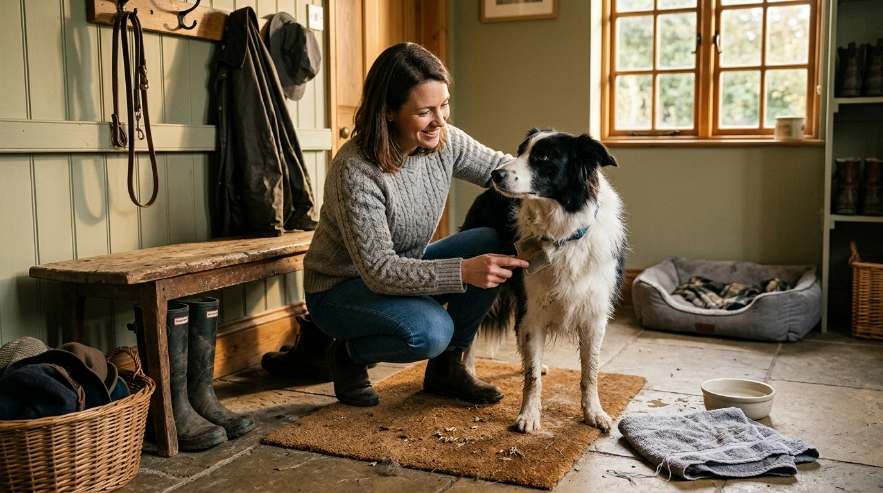
The best between-bath routine starts with mechanical cleaning, not shampoo. Brushes, towels, paw rinses, and quick coat checks solve many everyday messes.
A practical Border Collie grooming routine
- Brush weekly: Work through the coat to remove loose hair, dust, and early tangles.
- Brush more during shedding: Heavy undercoat release may justify daily attention for a period.
- Rinse muddy paws: Plain lukewarm water is often enough after a wet walk.
- Dry the feathering: Pay attention to the belly, armpits, chest, and rear legs.
- Check for burrs: Working and hiking Borders collect seeds and vegetation quickly.
- Inspect behind the ears: Longer rough coats can knot here before the mat becomes obvious.
- Wash bedding: A clean dog quickly picks up odor again from a dirty bed.
One of my favorite habits is letting light dirt dry before brushing it out. Trying to scrub wet mud from a long coat often spreads the mess farther.
A good pin brush and comb usually do more for a Border’s natural coat than repeated fragrance products. The goal is clean skin and free-moving hair, not a perfume smell.
Protect the natural double coat
A Border Collie’s topcoat and undercoat work together as insulation and protection. I avoid shaving a healthy double coat just to make grooming quicker.
The same applies to excessive degreasing. Removing dirt is useful, but constantly stripping the coat isn’t the goal.
Frequently Asked Questions About Waterless Shampoo for Border Collies
Can I use human dry shampoo on my Border Collie?
No. Use a shampoo or waterless cleanser specifically formulated for dogs because canine skin differs from human skin, and dogs can lick products from their coat.
Is waterless shampoo safe for Border Collie puppies?
It depends on the product’s age directions. Check the label for a minimum puppy age, use as little as necessary, keep it away from the face, and ask your veterinarian before using grooming products on a very young puppy.
Does waterless shampoo replace bathing?
No. It works best for mild dirt, light odor, or targeted cleaning between baths. Heavy mud, feces, chemicals, greasy contamination, and some skin treatments require proper washing or veterinary guidance.
Can I use waterless shampoo on a rough-coated Border Collie?
Yes. Rough coats just require extra care because long feathering and dense undercoat can retain product, so brush before application and check the coat for residue afterward.
Is foam or spray better for a Border Collie?
I prefer foam for larger areas because it’s easier to control and massage through the coat. A pump spray can work well for light cleaning, while wipes are convenient for paws and small patches.
Why does my Border Collie still smell after dry shampoo?
A returning odor may mean the coat wasn’t fully cleaned, the bedding smells, or there’s a skin or ear problem. Persistent unusual odor deserves closer inspection rather than repeated layers of fragrance.
Should I brush before or after waterless shampoo?
Usually both. Brush first to remove loose hair and debris, then follow the product instructions and brush again when appropriate to distribute the coat oils and remove remaining residue.
Final Takeaway: Keep Waterless Shampoo Simple
Waterless shampoo for a Border Collie is most useful as a convenient cleanup tool between baths. I choose a dog-specific, low-residue product and use it only where the coat needs help.
For most Borders, brushing, paw rinsing, and quick spot cleaning should do most of the work. Save waterless shampoo for mild dirt and odor, and use a proper bath or veterinary care when the situation calls for more.
Start with the coat, not the smell. If your Border’s skin looks healthy and the fur feels clean after grooming, you’ve done the important part.
