
What Animals Are Dogs Afraid Of? A Practical Guide for Border Collie Owners

Dogs can be wary of many animals, but fear is rarely about the species alone. It usually comes down to size, movement, sound, smell, past experience, and how close the encounter happens. For Border Collie owners, that matters because a sensitive, fast-thinking dog can look “reactive” when he is really overwhelmed.
The useful question is not just “What animals are dogs afraid of?” It is “Which animals trigger caution, fear, chase behavior, or defensive barking in my dog, and what should I do about it?”
Which Animals Dogs Commonly Fear — and Which Reactions Are Actually Normal
Dogs most often react strongly to animals that are larger than they are, move unpredictably, or have a history of startling them. In real life, that often means other dogs, cats, horses, cows, birds, and wildlife such as deer, raccoons, foxes, or coyotes.
Some of those reactions are normal caution. A dog backing away from a horse, freezing at a barking dog behind a fence, or staring at a large bird overhead may simply be gathering information. Fear becomes a problem when the dog cannot recover, cannot eat treats, or escalates into frantic barking, lunging, or panic.
A useful rule: if your dog can notice the animal, orient to you, and respond to simple cues, that is caution. If he cannot redirect, take food, or recover, that is fear.
| Animal | Common dog reaction | Usually dangerous or mainly intimidating? | Best management approach |
|---|---|---|---|
| Other dogs | Alerting, barking, avoidance, or leash tension | Can be both intimidating and risky | Keep distance, avoid forced greetings, use controlled exposure |
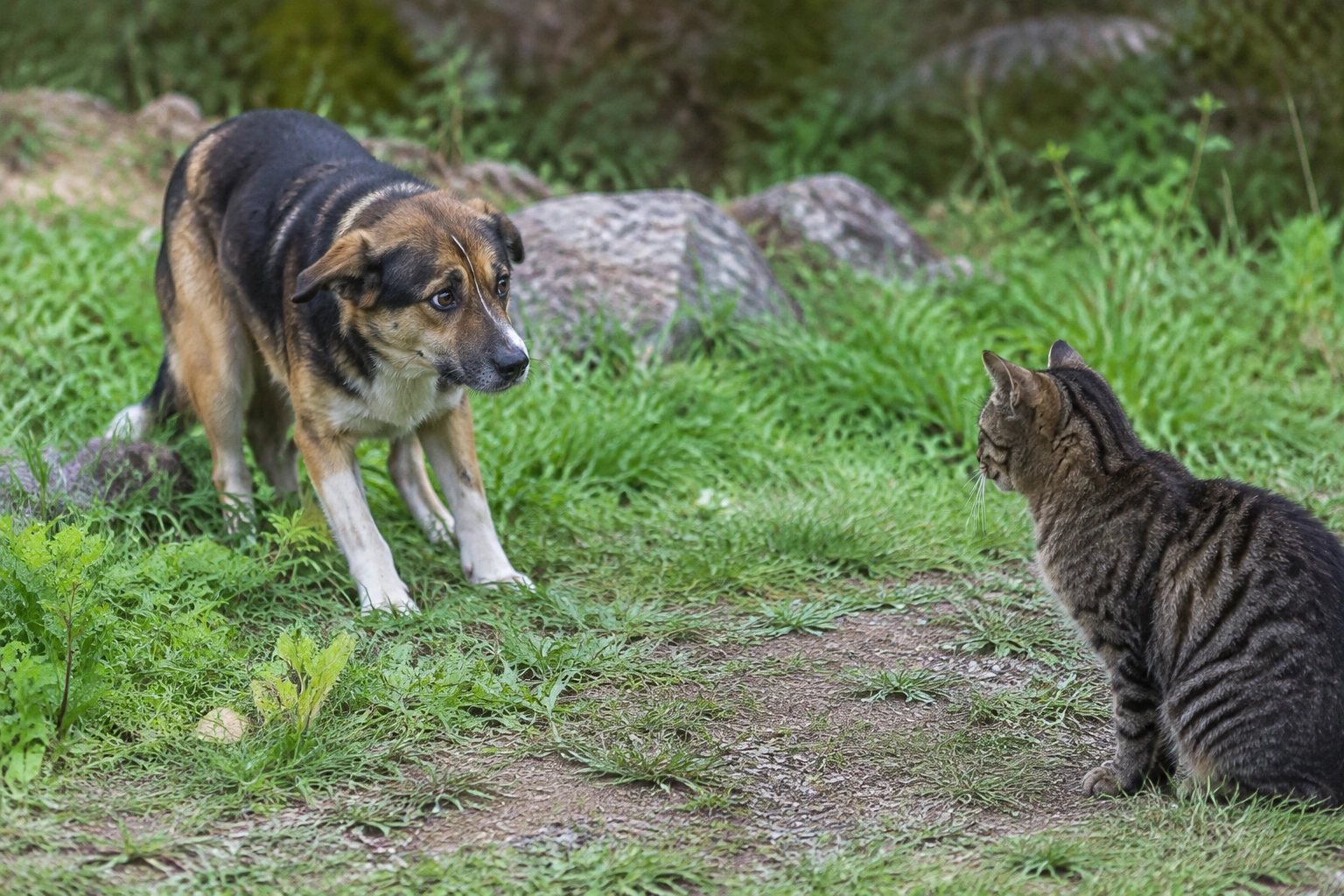
| Cats | Staring, backing away, chase behavior, or defensive barking | Usually intimidating; risk depends on the cat’s behavior and the dog’s size/temperament | Separate if needed, prevent rehearsal of chase |
| Horses | Freezing, barking, retreating, or overfocus | Often intimidating; can be dangerous if kicked or crowded | Stay wide, use leash control, reward calm observation |
| Cows | Hesitation, barking, or circling | Mainly intimidating; risk depends on herd movement and proximity | Give space, move calmly, avoid crowding livestock |
| Birds | Staring upward, barking, or sudden chase | Usually intimidating; some birds can peck or strike | Leash near waterfowl or ground-nesting birds |
| Wildlife | Barking, tracking, lunging, or pursuit | Often both intimidating and risky | Use leash and barriers; do not allow chase |
If you want a broader look at fear signals, AKC’s guidance on canine body language is a useful companion resource. For a veterinary view of fear and phobias in dogs, VCA’s article on fears and phobias is also worth reading.
Why Dogs Fear Certain Animals: Size, Movement, Sound, Smell, and Past Experience
Dogs do not evaluate animals the way people do. They react to patterns.
A large animal can feel threatening simply because it fills the dog’s visual field. Fast movement can trigger alarm because the dog cannot predict what happens next. Loud breathing, hoof strikes, hissing, growling, wing flapping, or a sudden rush toward the dog can all sharpen the fear response.
Past experience matters just as much. A dog who was chased by a cat, pinned by another dog, or kicked at by livestock may connect that animal with danger for a long time. VCA notes that dogs can develop fear-based responses toward people or other animals after a frightening or traumatic experience, and that single event can shape later behavior.
Socialization gaps matter too. If a puppy never learned that horses, cattle, or busy dogs are part of normal life, the first meeting can feel overwhelming. That does not mean the dog is stubborn. It means the dog lacks a usable template.
The practical takeaway: fear often grows from unpredictability. The more the dog can predict distance, movement, and outcome, the easier the situation becomes.
Fear vs Prey Drive vs Aggression: How to Tell the Difference
This distinction saves a lot of trouble.
Fear looks like distance-seeking
A fearful dog usually wants to increase space. You may see:
– tucked tail
– lowered body posture
– lip licking or yawning
– freezing
– backing away
– trying to hide behind you
– barking from a distance
– refusal of food
Fear says, “I do not feel safe.”
Prey drive looks like pursuit
A dog with prey drive may lock on, stalk, chase, or pounce. The body often becomes forward and intense rather than shrinking away. Cats, birds, squirrels, and moving wildlife are common triggers.
Prey drive says, “I want to chase that.”
Aggression is usually defensive or territorial
A dog that feels cornered may lunge, growl, or snap to make the other animal go away. The dog may look “big,” but the motive is often protection of space, not confidence.
Aggression says, “Back off.”
The same dog can show more than one of these in the same encounter. A Border Collie might stare at a cat with intense prey drive, then bark and retreat if the cat swipes. That is not a contradiction; it is a sequence.
A simple decision rule: if the dog is trying to get farther away, think fear. If the dog is trying to get closer and faster, think prey drive. If the dog is trying to make the other animal leave, think defensive reactivity.
Border Collies and Other Sensitive Herding Dogs: Are They More Reactive Around Animals?
Often, yes — not because they are weak, but because they are tuned in.
Border Collies notice movement, posture, and distance very quickly. That makes them excellent working dogs, but it also means they can become overfocused on animals that move unpredictably. A horse stepping sideways, a cow turning its head, or a flock of birds lifting off can create a strong arousal spike.
That spike can look like fear, but it may actually be a blend of alertness, herding instinct, and uncertainty. Some Border Collies bark because they are worried; others bark because the moving animal activates their motor pattern.
The difference matters because the response is different:
– fear needs distance and confidence-building
– prey/herding drive needs management and impulse control
– both need structure
If your Border Collie fixates on livestock, do not assume he is “being naughty.” He may be too close to threshold to learn. In that state, more exposure usually makes the pattern stronger, not weaker.
Common Animal-by-Animal Scenarios: Cats, Dogs, Horses, Cows, Birds, and Wildlife
Cats
Cats are one of the most confusing triggers because they can provoke both fear and chase behavior.
A dog may back away from a cat that hisses, arches, or swats. That is plain self-protection. Another dog may chase a cat that runs. That is more likely prey drive than fear.
In a multi-pet home, the safest move is management first: baby gates, leashes indoors if needed, and no unsupervised access until the dog has shown calm, repeatable behavior. A single chase rehearsal can make the pattern much harder to change.
Other dogs
Other dogs are a very common trigger. In the Finnish pet-dog study published in Scientific Reports, fear of other dogs was reported in roughly 15% of the dogs in that sample, fear of strangers in roughly 15%, and fear of novel situations in roughly 11%. Those figures are useful as a snapshot from one study, not a universal prevalence rate.
The most common problem is not “my dog hates all dogs.” It is “my dog dislikes certain types of dogs”: fast, rude, staring, bouncy, or crowding dogs. That is why off-leash greetings with unfamiliar dogs are not a good test of social skills.
Horses
Horses are often intimidating because they are large, fast, and capable of injuring a dog with a kick. Even a calm horse can worry a dog if it suddenly turns, stamps, or snorts.
Keep a wide berth on trails. Do not let a dog rush up to a horse because “he just wants to say hi.” For a fearful dog, even a calm horse at close range may be too much. For a prey-driven dog, the risk is even higher.
Cows
Cows are usually more intimidating than inherently “scary,” but they deserve respect. Their size, herd movement, and unpredictable shifts can unsettle dogs. A dog that barks at cows on a farm may be saying, “This is too much pressure.”
Do not let a dog weave between cattle or approach from behind. Give the herd room and move steadily.
Birds
Birds are easy to underestimate. A flock of geese, a sudden wing-flap, or a low-flying bird can trigger barking, chasing, or startle responses. Ground-nesting birds can also react aggressively if cornered.
For dogs with strong chase instincts, birds are a management issue, not just a fear issue. Leash control is the simplest prevention.
Wildlife
Wildlife is a mixed category. Deer, raccoons, foxes, coyotes, and similar animals can scare dogs, trigger chase behavior, or both. Some wildlife can also bite, scratch, or carry disease, so this is not just a behavior question.
If your dog is reacting to wildlife in the yard, the priority is not training in the moment. It is preventing access, removing attractants, and avoiding rehearsal of the chase.
What Fear Looks Like in Dogs: Body Language, Thresholds, and Escalation Signals

Fear usually starts before barking or lunging.
Early signs include:
– looking away from the animal
– slowing down
– closing the mouth tightly
– licking lips
– lifting a paw
– yawning when not tired
– leaning away
– ears pinned back
– scanning for escape routes
As the dog gets closer to threshold, you may see:
– freezing
– hard staring
– hackles up
– trembling
– barking
– pulling hard on the leash
– refusal to take food
– frantic attempts to get away
Threshold is the point where the dog can no longer learn well. If your dog can still sniff, eat, and respond to you, you are probably below threshold. If he cannot, you are too close.
That one distinction should guide your choices. Training happens below threshold. Panic happens above it.
How to Respond in the Moment: Safe Distance, Leash Handling, and Environmental Management
When your dog sees a scary animal, your first job is not obedience. It is space.
Use distance as your main tool
If your dog is tense, increase space immediately. Cross the street, step behind a car, turn around, or create a visual barrier. The goal is to bring the dog back into a thinking state.
Keep leash handling boring and steady
A tight, jerky leash can add pressure and make the encounter worse. Hold the leash securely, but avoid repeated corrections. Short, calm movement away from the trigger is usually more effective than talking the dog through it.
Do not force a meeting
Forced exposure can backfire. If a dog is fearful of horses, for example, pushing closer because “nothing bad is happening” may simply teach the dog that you ignore his discomfort.
Use the environment before the behavior
On trails, choose wider paths and better sight lines. On farms, keep the dog at a distance where he can still think. In multi-pet homes, use barriers and separate zones. These are not shortcuts around training; they are what make training possible.
A practical trade-off: avoiding the animal entirely can prevent panic, but it can also limit learning. Controlled distance gives you the middle ground — enough safety for the dog to stay under threshold, enough exposure for calm behavior to be reinforced.
Can You Train a Dog Not to Be Afraid? Desensitization, Counterconditioning, and Realistic Expectations
Yes, sometimes — but only if the plan matches the dog’s actual state.
Desensitization means tiny steps
Expose the dog to the animal at a distance or intensity that does not trigger panic. For example, if your dog notices horses at 100 feet and can still take treats, start there. The instant he looks at the horse, feed a treat; when the horse disappears or the dog relaxes, stop feeding. Over several sessions, you might move 10 to 20 feet closer only if the dog stays loose, can orient to you, and continues taking food. If he stiffens, stops eating, or cannot respond to cues, you moved too fast.
Counterconditioning changes the emotional association
Pair the animal with something the dog values, usually food. The goal is not to bribe the dog into tolerating fear; it is to help the dog predict something good when the animal appears.
Progress should look boring
Good progress is often subtle:
– the dog notices the animal and looks back at you
– the dog can eat
– the dog recovers faster after seeing the animal
– the dog needs less distance than before
What does not work well is flooding — putting the dog in close contact and hoping he “gets used to it.” If the dog is already panicked, the lesson is usually that the animal is even more dangerous than he thought.
For a Border Collie, success often comes from combining calm observation with clear structure. The dog does not need to love every animal. He needs to stay under threshold and recover quickly.
When Fear Is Normal vs When It Becomes a Behavior Problem
Normal caution is situational. A dog may dislike one horse, one cat, or one noisy dog and still function well.
Fear starts to look like a behavior problem when the reaction is frequent, hard to interrupt, or out of proportion to the actual encounter. In practice, that often means the dog is not just wary in the moment — he is anticipating danger, avoiding places, or staying wound up long after the animal is gone.
Fear becomes a behavior problem when you see one or more of these:
– reactions are getting stronger over time
– the dog cannot recover after the encounter
– the dog refuses food or cannot focus
– fear spreads to more animals or more places
– walks, hikes, or daily routines become difficult
– the dog starts anticipating the animal before it appears
That last point matters. If your dog panics at the sight of a farm gate because he expects cows beyond it, the fear has become generalized. At that stage, management alone is rarely enough.
When to See a Veterinarian or Certified Trainer
Seek help sooner rather than later if your dog:
– panics around animals
– cannot take treats during the encounter
– grows more reactive instead of less reactive
– has snapped, bitten, or tried to escape dangerously
– is afraid of multiple animals or many everyday situations
– seems unable to settle after the trigger is gone
A veterinarian can help rule out medical contributors that make fear worse or recovery slower. A certified dog trainer or behavior professional can build a plan around distance, thresholds, and controlled exposure.
If the dog’s fear is severe, do not wait for it to “work itself out.” Fear rehearsed often becomes fear practiced.
Practical Takeaway for Border Collie Owners
If your Border Collie is afraid of an animal, your job is to identify which part of the encounter is the problem: size, movement, sound, unpredictability, or past experience. Then manage distance first, read body language early, and train only when the dog is calm enough to learn.
That approach is slower than forcing the issue, but it is also safer, clearer, and far more likely to create lasting confidence.
If you are also working on other stress-related behavior issues, you may find our guide on whether dogs can get sick of their food useful when you are sorting out appetite changes during anxiety. For seasonal comfort concerns, see can dogs get heat rash, since discomfort can sometimes make fear responses look worse.
FAQs
Are dogs more afraid of other dogs than cats?
Not always, but other dogs are a common trigger. In the Finnish study cited above, fear of other dogs and fear of strangers were both reported at roughly 15% in that sample. Cats can be scary too, especially if the cat has swatted or the dog has a strong chase instinct.
Why does my dog bark at horses but ignore cows?
Horses move differently. Their size, speed, and sudden shifts can be more alarming to some dogs than the slower, steadier movement of cows. Individual experience also matters.
Is my dog scared of the animal or just trying to chase it?
If your dog backs away, freezes, or tries to escape, think fear. If he leans forward, stalks, or chases, think prey drive. Some dogs switch between both.
Can Border Collies be more sensitive around animals?
Yes. Border Collies often notice movement and pressure very quickly, so they may react more intensely to animals that move unpredictably. That can look like fear, herding drive, or overfocus.
Should I let my dog “work it out” with another animal?
Not if the dog is panicking or the animal can injure him. Controlled distance and gradual exposure are safer than forcing contact.
When is fear around animals a serious problem?
When it is getting worse, spreading to more situations, or interfering with normal life. If your dog cannot recover, cannot eat, or is at risk of injury, get professional help.
