
What to Feed a Dog With Diarrhea: A Practical Guide for Fast, Safe Recovery

When a dog has diarrhea, the goal is not to “fix” the stool with a random home remedy. The goal is to keep the dog hydrated, reduce gut irritation, and choose food that the digestive system can handle while it settles down.
For a healthy adult dog with mild diarrhea and no vomiting, a short-term bland diet is often the most practical next step. Cornell’s veterinary guidance notes that mild cases may be managed at home with bland foods such as boiled chicken or low-fat hamburger with white rice, and cooked pasta can also be an option in some cases because it is easy to digest. Cornell University Veterinary Medicine
If your dog is vomiting, very lethargic, refusing water, or showing blood in the stool, stop thinking in terms of “what should I feed?” and move to “does this need a vet today?” Feeding advice changes fast once dehydration or systemic illness enters the picture.
First decision: feed now, or pause food briefly?
For uncomplicated diarrhea, many healthy adult dogs do not need a long fast. Some do fine with no food pause at all and can go straight to a bland diet in small amounts. If you do choose to withhold food, keep it very short and only for a stable adult dog.
Feed right away if your dog:
- Is bright and alert
- Is not vomiting
- Can keep water down
- Has mild stool looseness rather than repeated large-volume diarrhea
Pause food briefly and call your vet sooner if your dog:
- Is vomiting
- Won’t drink
- Seems weak, painful, or unusually quiet
- Has a puppy’s low body reserves, a senior dog’s reduced reserve, or a chronic condition like diabetes, kidney disease, or pancreatitis
A healthy adult dog with mild diarrhea may only need a brief food break, if any. Puppies, seniors, and dogs with health issues should not be fasted casually because they can dehydrate or destabilize faster than a healthy adult dog. If you are unsure, feed a tiny bland meal or contact your veterinarian first.
The bland diet that usually works best
For most mild cases, the safest short-term approach is a bland, low-fat meal made from one protein and one carbohydrate.
The most common combination is:
– Boiled, skinless chicken breast or another lean, unseasoned protein
– Plain white rice
That basic pairing works because it is simple, low in fat, and easy to portion. If chicken does not agree with your dog, lean turkey is a reasonable swap. Cornell also includes low-fat hamburger as an option, and some veterinary clinics recommend extra-lean ground beef if the fat is fully drained after cooking.
A practical rule: keep the food plain enough that you would never want to eat it yourself. No oil, butter, salt, garlic, onion, spice blends, or gravy.
How chicken and rice compares with other options
| Option | Best for | Trade-off |
|---|---|---|
| Boiled chicken and white rice | Most mild, uncomplicated diarrhea | Needs home cooking and portion control |
| Plain pumpkin puree | Stool support when diarrhea is mild and the dog is otherwise stable | Not a full meal; fiber may help some dogs and not others |
| Commercial gastrointestinal diet | Dogs that need a more balanced, ready-to-feed option | Costs more, but is often easier and more consistent |

A commercial GI diet can be the better choice if you want something nutritionally complete and easier to use than home cooking. These diets are formulated to be highly digestible, which matters when you need to feed small meals for more than a day or two.
Where pumpkin fits — and where it doesn’t
Plain canned pumpkin is often recommended in pet care circles, but it is not magic. It can help some dogs because it contains fiber, but it is not the right answer for every stool problem.
Use only plain canned pumpkin, not pumpkin pie filling. Pumpkin pie filling may contain added sugar and spices that are not appropriate for dogs. AnimalBiome also notes that pumpkin contains fiber and may be useful for some dogs, but it should be treated as a support ingredient rather than a guaranteed fix. AnimalBiome
My practical take: use pumpkin as a support tool, not the whole plan. It is most useful when the diarrhea is mild, the dog is eating, and you want to add a little stool-forming fiber without making the meal rich.
How much to feed and how often
When a dog has diarrhea, large meals are the wrong move. A full bowl can overwhelm an irritated gut and trigger another loose stool.
A better pattern is small, frequent meals. One veterinary clinic recommends starting refeeding at about 1 tablespoon per 10 pounds of body weight per meal, then increasing gradually as tolerated, with meals spread across the day. That is a useful starting point for a dog that is recovering and can keep food down. Scottsdale Veterinary Clinic
A simple feeding structure
- Feed 4 to 6 small meals per day
- Keep each meal plain and low fat
- Increase the amount only if the stool is improving and the dog is acting normal
For example, a 40-pound dog might start with a very small portion at each meal, then get several more small meals instead of one or two large ones. If the dog acts hungry but stool worsens after each meal, the issue may be that the portions are too large or the food is still too rich.
If the dog is nauseated, reduce the size of each meal rather than skipping to a big serving later. If the dog is ravenous and the stools are improving, increase gradually over a day or two rather than giving a full normal meal.
Hydration matters more than most owners realize
Diarrhea can drain water quickly. The University of Guelph’s OVC Pet Nutrition guidance notes that acute diarrhea can cause a large loss of water, so encouraging water intake is important. It also says adding water to dry food or using a high-moisture food can help maintain hydration during a bout of diarrhea. OVC Pet Nutrition
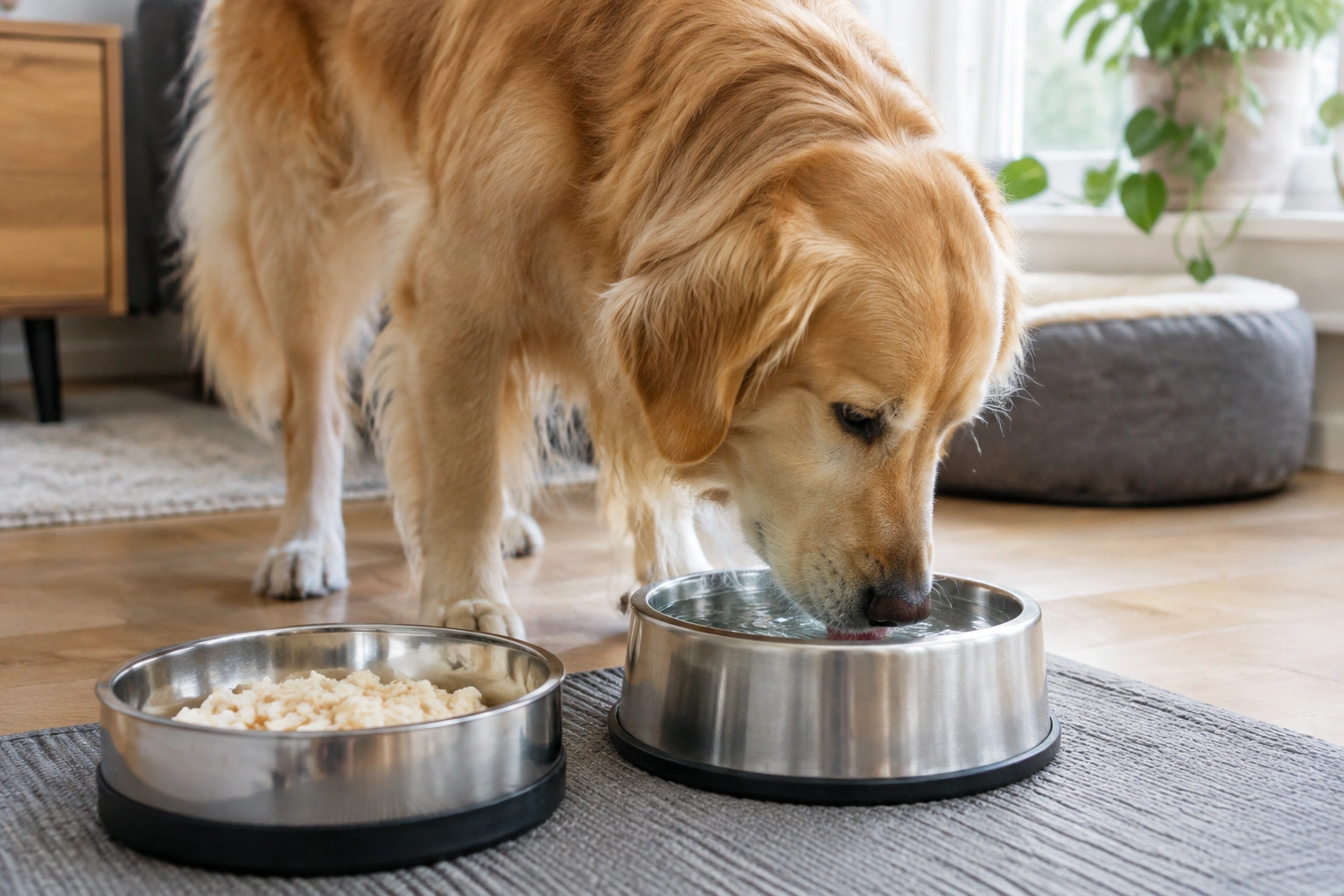
That means the hydration plan is part of the feeding plan.
What to do at home
- Keep fresh water available at all times
- Offer water frequently rather than waiting for the dog to drink a lot at once
- If your dog is hesitant, try adding a little water to food
- Wet food or fresh food with high moisture content can help some dogs maintain intake
Some clinics also suggest low-sodium broth for picky drinkers, or small amounts of unflavored Pedialyte with veterinary guidance on dosage. Use that cautiously and only if your vet says it is appropriate for your dog.
Signs of dehydration to watch for
- Dry gums
- Sunken eyes
- Lethargy
- Dark yellow urine
If dehydration is showing up, home feeding alone is not enough.
Foods, treats, and chews to avoid
The fastest way to make diarrhea worse is to keep feeding the things that irritated the gut in the first place.
Avoid:
– Fatty or greasy foods
– Seasoned meats
– Table scraps
– Rich treats
– Chews with a lot of fat
– Leftover sauces, butter, or oils
– Human anti-diarrheal medicines unless your veterinarian specifically tells you to use them
Fat is a common problem because it is harder on the GI tract during recovery. Even “healthy” foods can be wrong if they are too rich. A dog with diarrhea needs simplicity more than variety.
This is also the time to stop the extras. No new chews, no training treats, no flavored toppers, and no “just a little bit” of whatever you are eating.
Probiotics: helpful for some dogs, unnecessary for others
A dog-safe probiotic can be a reasonable add-on when diarrhea is mild and the dog is otherwise stable. Some veterinary sources suggest probiotics as a supportive option alongside diet changes because diarrhea can disrupt the balance of bacteria in the gut.
That said, probiotics are support, not a substitute for the right food and hydration. If the dog is vomiting, dehydrated, or worsening, probiotics will not solve the problem.
If you do use one, choose a product made for dogs and follow the label or your veterinarian’s instructions. Common veterinary formulations include products such as Purina FortiFlora, Nutramax Proviable, and Visbiome Vet, but the best choice depends on your dog’s situation and your vet’s preference.
When commercial GI diets beat homemade food
Homemade bland diets are useful because they are easy to prepare quickly. Commercial gastrointestinal diets are useful because they are balanced, consistent, and often easier to keep using if recovery takes longer than expected.
Choose a commercial GI diet when:
– You need a complete diet for more than a day or two
– Your dog is picky and refuses plain chicken and rice
– You want less guesswork about nutrient balance
– Your vet recommends it after repeated GI upset
Choose homemade bland food when:
– You need something immediately
– Your dog usually tolerates chicken, turkey, or lean beef well
– You are using it as a short bridge back to normal food
The trade-off is simple: homemade is flexible, commercial GI diets are more complete.
How to transition back to regular food
Once stools begin to normalize, do not jump straight back to the full usual diet. That is a common reason diarrhea returns.
A veterinary clinic recommends mixing regular food back in slowly over 5 to 7 days once stools improve. That gradual transition gives the gut time to adjust without another flare-up.
A practical approach:
– Day 1: mostly bland food, a small amount of regular food
– Day 2–3: increase the regular food if stools stay formed
– Day 4–7: move toward the normal diet only if the stool remains stable
If stool is improving but not fully normal yet, stay at the current step a little longer instead of rushing the transition. If diarrhea returns, step back to the bland diet and slow down.
When to call the veterinarian
This is a medical issue, not a training problem, but the decision point matters.
Call your veterinarian promptly if:
– Diarrhea lasts more than a short period without improvement
– There is blood in the stool
– Your dog is vomiting
– Your dog is lethargic or painful
– Your dog shows dehydration
– Your dog is a puppy, senior, or has diabetes, kidney disease, pancreatitis, or another chronic condition
– The diarrhea keeps returning
Seek urgent care sooner rather than later if the dog cannot keep water down or seems weak. A dog that looks “just a bit off” can actually be farther along than you think.
Puppies deserve especially early veterinary attention because they have smaller reserves and can dehydrate quickly.
Quick decision checklist for home care
Use this as a simple filter:
Home feeding may be reasonable if:
- The dog is alert
- There is no vomiting
- Water stays down
- Diarrhea is mild
- Energy is mostly normal
- Stools begin improving within a short window
Vet care is the better choice if:
- The dog is vomiting
- There is blood in the stool
- The dog is dehydrated
- The dog is weak, painful, or depressed
- The dog is a puppy, senior, or medically fragile
- Diarrhea persists or worsens
A practical example from the real world
Say your adult dog has one day of loose stool after a food change, but is still bright, drinking, and interested in food. That is the kind of case where a short-term bland diet, small meals, and close monitoring may be reasonable.
Now compare that with a puppy that has diarrhea and is eating less. That puppy should not be managed the same way. Puppies dehydrate quickly and can go downhill fast, so the threshold for veterinary help is much lower.
That difference is the whole decision-making process in one sentence: stable adult dog, mild signs, brief home support; puppy or sick dog, earlier vet involvement.
If you want to reduce the chance of another flare-up, also read our guide on Border Collie food transition diarrhea so you can switch foods more safely next time. For new puppy owners, our article on how much to feed a Border Collie puppy can help you keep portions and meal timing on track when the stomach is healthy again.
The best feeding plan for diarrhea is usually the simplest one that the dog can tolerate, followed by a careful return to normal food. If the dog is not improving, the answer is not a fancier home remedy — it is a veterinary exam.
FAQ
Should I withhold food if my dog has diarrhea?
Sometimes, briefly. But if your dog is a puppy, senior, has a chronic health issue, or is vomiting, do not make that call on your own. A healthy adult with mild diarrhea and no vomiting may do well with a very short pause or immediate bland feeding.
Is chicken and rice always the best choice?
No. It is a common, practical choice, but some dogs do better with turkey, lean beef, or a commercial GI diet. The best option is the one your dog will tolerate without making the stool worse.
Can I give pumpkin every time my dog has diarrhea?
Not necessarily. Plain canned pumpkin can help some dogs, but it is not always useful and should never replace a proper meal plan or veterinary care when symptoms are more serious.
How long should diarrhea last before I worry?
If it is not improving within a short period, or if it is accompanied by vomiting, blood, weakness, or dehydration, call your veterinarian. Persistent or repeated diarrhea should not be managed at home indefinitely.
Are probiotics worth trying?
They can be, especially for mild diarrhea in a stable dog. They are not a fix for dehydration, vomiting, or serious illness, and they should be dog-specific.
Can I give my dog broth or Pedialyte?
Plain, low-sodium broth may help a picky drinker. Unflavored Pedialyte is sometimes suggested, but dosage should be checked with a veterinarian first.
