
When to Switch a Border Collie Puppy to Adult Food: A Practical Feeding Guide

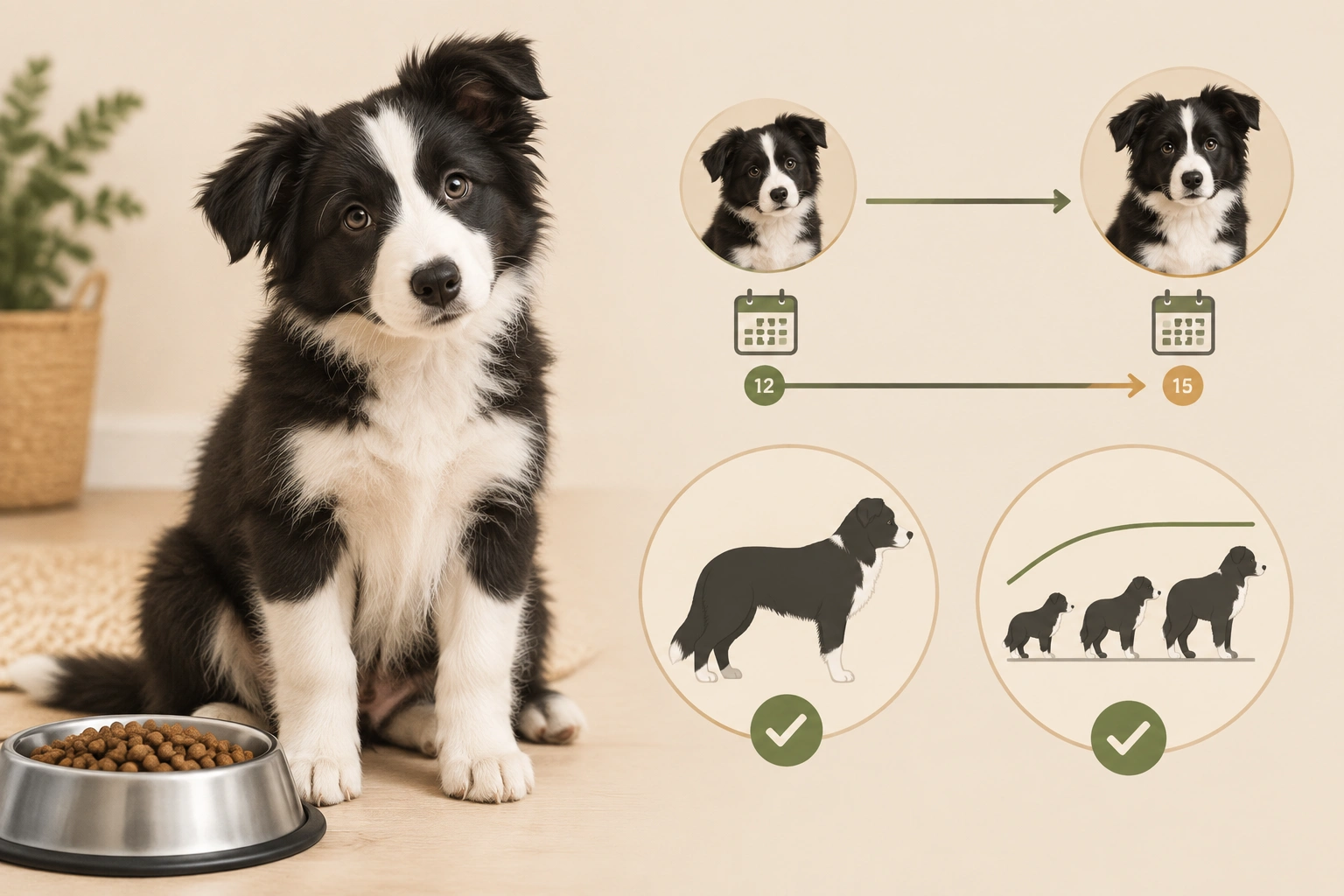
If you want the short version: most Border Collie puppies are ready to move from puppy food to adult food somewhere around 12 to 15 months of age, but age alone should not make the decision. Border Collies are typically a medium-sized breed, and medium dogs often reach adult size around 12 to 15 months and are commonly ready for adult food in roughly that same window. That broad timing is a useful starting point, not a hard rule. PetMD
Quick decision rule: if your Border Collie has mostly stopped growing, looks close to adult proportions, and is holding a steady, lean body condition, it is usually time to consider the switch. If the dog is still gaining height or filling out, keep puppy food a bit longer and reassess in a few weeks.
A Border Collie that is still filling out, growing quickly, or working hard in sport or herding may need puppy food a little longer. A puppy that has clearly plateaued in growth, has adult-like proportions, and is maintaining a steady body condition is often close to the switch. The goal is simple: keep the puppy on a growth diet long enough to support development, but not so long that you keep feeding a puppy formula after growth has mostly finished.
Why Border Collie timing is based on growth, not just age
Border Collies sit in that middle ground where “puppy” and “adult” feeding timelines overlap. They are not tiny dogs that finish growing early, and they are not giant breeds that need a long puppy stage. In practice, Border Collies usually follow the timing of other medium-breed dogs, which is why a fixed birthday is less useful than watching the dog’s actual development.
Puppy food is built to support growth. It usually provides more calories per cup and is formulated to supply nutrients needed for bone, muscle, and tissue development. Adult food is designed for maintenance. If you switch too early, you may cut back on calories and nutrients before your puppy is truly done growing. If you switch too late, you may keep feeding a richer diet after the dog no longer needs that level of support.
Activity level matters too. A Border Collie that spends the day on the couch has very different needs from one that is hiking, training, or doing herding work. The more active dog may need a more calorie-dense adult formula after the switch, while a lower-activity family pet may do better on a more moderate adult recipe.
Signs your Border Collie puppy is ready to switch
Use these signs together instead of relying on just one.
1. Your puppy is near adult size
For many Border Collies, the body will look less “puppy-round” and more balanced. The legs and torso stop looking disproportionate, and the dog begins to resemble its adult frame. PetMD notes that medium-sized breeds like Border Collies typically reach adult size at 12 to 15 months.
2. Growth has slowed or plateaued
A puppy that used to gain weight or size quickly may start leveling off. That plateau is one of the most useful clues that the growth phase is winding down. It does not mean the dog is finished maturing in every way, but it often means the biggest nutritional demands of puppyhood are easing.
3. Body condition is stable
You should be able to feel ribs without pressing hard, but not see them sharply. The waist should be visible from above, and the belly should tuck up from the side. If your puppy is staying lean and steady on the current food, that is a good sign the feeding plan is working and the dog may be nearing the adult stage.
4. Stools are normal and appetite is predictable
A puppy ready for a diet change usually has a fairly stable digestive pattern already. If stool quality is already inconsistent, it is better to solve that first rather than layering in a food switch.
5. Your veterinarian agrees growth is on track
This matters most if your puppy is unusually small, unusually large, very active, or seems behind or ahead of peers in development. A quick vet check can help confirm whether the switch timing makes sense.
When to keep a Border Collie on puppy food a little longer
There are a few situations where I would hesitate to move a Border Collie to adult food right away.
Your puppy is still clearly growing
If the dog still looks lanky, is adding height, or is changing shape quickly, puppy food usually still has a job to do. Border Collies can look “almost grown” before they are actually done.
Your puppy is underweight or hard to keep in condition
A lean, busy Border Collie puppy may need the extra calorie density of puppy food a bit longer. That is especially true if meals disappear quickly and the dog still seems to be burning through energy faster than expected.
Your puppy is highly active
Young Border Collies in training, agility foundations, or farm work may need more energy than a typical family pet. In those cases, the switch should be based on growth stage and condition, not just the calendar. After the switch, the adult formula still needs to match the dog’s workload.
Your puppy is a slower developer
Some dogs mature at the slower end of the range. If the body still looks immature and the dog has not settled into a stable size, waiting is usually safer than rushing.
For most owners, the more useful guidance is to rely on growth plateau, body condition, and veterinary advice rather than any one offhand recommendation from a breeder or forum. A single anecdote is not a reliable feeding rule.
Puppy food vs adult food vs all-life-stage formulas

Here is the practical difference between the main label types.
| Formula type | Main purpose | When it fits best | Main trade-off |
|---|---|---|---|
| Puppy food | Supports growth and development | Puppies still gaining size and muscle | Can be richer than an adult dog needs once growth slows |
| Adult food | Maintenance for mature dogs | Border Collies nearing or at adult size | May not support ongoing growth if used too early |
| All-life-stage food | Can be fed across life stages if complete and balanced | Homes that want one food for multiple dogs or life stages | Less tailored than a dedicated puppy or adult formula |
An all-life-stage food can be convenient, but it does not remove the need to judge readiness. If your Border Collie is still growing, the food still has to be appropriate for that stage. If your dog is nearly mature, an adult formula may be the cleaner choice.
How to transition from puppy food to adult food safely
A food change should be gradual. Abrupt switches are one of the most common reasons dogs get soft stools or vomiting during a diet change.
Use a simple transition over about 7 to 10 days. If your puppy has a sensitive stomach, stretch it longer.
- Days 1–2: 75% puppy food, 25% adult food
- Days 3–4: 50% puppy food, 50% adult food
- Days 5–6: 25% puppy food, 75% adult food
- Days 7–10: 100% adult food
If stools loosen, hold at the current ratio for a few extra days before moving forward. If vomiting happens, pause the transition and contact your veterinarian if it continues or the dog seems unwell.
One practical point gets missed often: adult food may have a different calorie density than puppy food. That means the amount in the bowl may need to change even if the dog seems to be eating “the same” volume. Watch body condition, not just the scoop.
What to look for in an adult food for an active Border Collie
Once your Border Collie is ready for adult food, choose a formula that fits the dog’s workload, not just the breed name on the bag.
Choose a complete and balanced adult maintenance formula
Look for a diet labeled for adult maintenance and complete and balanced for adult dogs. That gives you a clearer starting point than a puppy formula or a recipe that is not clearly intended for maintenance feeding.
Match calories to activity
A working or highly active Border Collie may need a more energy-dense adult recipe than a family pet with moderate exercise. A couch-loving adult Border Collie can gain weight quickly on a rich food that was designed for a hard-working dog. If the dog’s workload changes, the calorie level may need to change too.
Pay attention to calorie density, not just the ingredient list
For active dogs, the key question is whether the food provides enough energy to maintain lean condition without overfeeding. If your Border Collie is very active, a denser adult food can help. If the dog is only moderately active, a less calorie-dense formula may be easier to keep in balance.
Keep the food easy to feed consistently
The best adult food is one your dog can stay on without digestive drama. Consistency usually beats novelty. If your dog does well on a formula, there is no need to keep changing it just to chase trends.
When to ask your veterinarian
Ask your veterinarian before switching if any of these apply:
- Your puppy is much smaller or larger than expected for age
- Growth seems unusually slow or uneven
- Your puppy has recurring loose stools, vomiting, or poor appetite
- Your Border Collie is in intense training or working daily
- Your puppy is underweight, overly thin, or hard to keep in condition
- You are unsure whether the current food is puppy, adult, or all-life-stage
A veterinarian can help you decide whether to switch now, wait a bit longer, or adjust the feeding plan before changing formulas. That is especially useful if your dog’s body condition and growth pattern do not match the usual timeline.
What to watch for after the switch
The first two weeks after the change tell you a lot.
Signs the transition is going well
- Normal, formed stools
- Steady appetite
- Stable energy
- No sudden weight loss
- No vomiting or repeated digestive upset
Signs you should slow down or reassess
- Loose stools that last more than a day or two
- Refusing meals
- Excessive gas
- Vomiting after meals
- Noticeable weight loss
- A dog that seems hungrier than usual but is losing condition
If the dog seems hungry but is losing weight, the issue may be that the adult food is not calorie-dense enough for the dog’s activity level. If the dog is gaining weight too quickly, the portions may be too large. Either way, the answer is usually to adjust the feeding plan, not to switch foods again immediately.
For a deeper look at portions and age-based feeding, see How Much to Feed a Border Collie Puppy. If you are feeding a very young pup, Border Collie Puppy Feeding Schedule at 8 Weeks is a useful companion guide.
The practical takeaway
For most Border Collie owners, the switch from puppy food to adult food happens around 12 to 15 months, with 12 to 14 months being a common window for medium-sized dogs. But the better decision rule is this: wait until growth has slowed, body condition is steady, and your puppy looks physically close to adult proportions. Then transition gradually and watch stools, appetite, and weight closely.
If you want one final rule to remember, use this: switch when your Border Collie has plateaued in growth and is holding a lean, stable body condition — not just when the calendar says so. If your dog is unusually active, slow-growing, underweight, or having digestive trouble, get your veterinarian involved before making the change. That small step can save you a lot of guesswork.