

Quick Answer
The best dog towel for a Border Collie is a large, absorbent microfiber towel that lets you press and squeeze water from the dense double coat without aggressive rubbing. Border Collies have rough or smooth weather-resistant double coats, so I prefer a towel that absorbs quickly, covers most of the dog, and stays manageable when wet.
What I Look For
- Microfiber material: It picks up water efficiently without requiring hard back-and-forth rubbing.
- Large coverage: I prefer roughly 30 × 50 inches or larger for an adult Border Collie.
- Soft texture: The towel should move across feathering without constantly catching or pulling hair.
- Fast drying: A towel that dries between uses is more convenient after wet walks and baths.
- Easy washing: Machine-washable construction makes muddy-day cleanup much simpler.
My Simple Choice
- Choose one large microfiber towel for normal drying and keep a second dry towel ready for rough-coated or heavily soaked dogs.
Finding the best dog towel for a Border Collie sounds simple until you try drying that thick coat after a proper bath. The outer hair may look almost dry while the softer undercoat still holds plenty of moisture.
I’ve had the best results with a simple towel-first routine rather than trying to scrub the coat dry. This guide explains the towel materials, sizes, features, and drying methods I find most useful for Border Collies in 2026.
In This Guide
- What Is the Best Dog Towel for a Border Collie?
- Why Does a Border Collie Need a Good Drying Towel?
- Which Towel Material Works Best?
- What Size Dog Towel Should You Buy?
- How Should You Towel-Dry a Border Collie?
- Which Towel Is Best for Baths, Mud, and Travel?
- What Should You Avoid When Choosing a Dog Towel?
- Frequently Asked Questions
- Final Takeaway
What Is the Best Dog Towel for a Border Collie?
The best all-around choice is a large microfiber drying towel with enough surface area to wrap around your Border Collie. I prefer a short-pile, waffle-style, or smooth microfiber surface that I can press into the coat.
Definition: A Border Collie drying towel is an absorbent towel used to remove surface and undercoat moisture after bathing, swimming, rain, or muddy walks without aggressively rubbing the double coat.
My three priorities
- Absorption: It needs to keep pulling water from the coat through several towel passes.
- Coverage: It should handle the body, chest, legs, and tail without feeling like a hand towel.
- Low friction: I want to press and squeeze the hair rather than scrub the feathering into knots.
Fancy features matter less to me than those basics. A simple microfiber towel that does them well can outperform a bulky towel that looks impressive but becomes difficult to handle once soaked.
Why Does a Border Collie Need a Good Drying Towel?
A Border Collie needs an effective towel because water can remain beneath the visible outer coat. Both rough- and smooth-coated Border Collies have a dense double coat, although rough dogs have more obvious feathering.
The outer coat consists of coarser guard hairs, while the softer undercoat sits closer to the skin. This structure is useful outdoors, but it changes how I approach drying.
The surface can fool you
I never judge dryness by running my hand across the dog’s back. I part the hair and check closer to the skin around the chest, neck, belly, rear legs, and tail base.
- Rough-coated dogs may hold extra water through the chest, rear feathering, and tail.
- Smooth-coated dogs have less long feathering but still have a dense undercoat.
- Dogs in a heavy shedding period may take longer because loose undercoat affects airflow and handling.
The ASPCA’s dog grooming guidance recommends brushing before bathing and drying dogs thoroughly afterward. That matches the routine I find easiest with this breed.
Which Towel Material Works Best for a Border Collie?
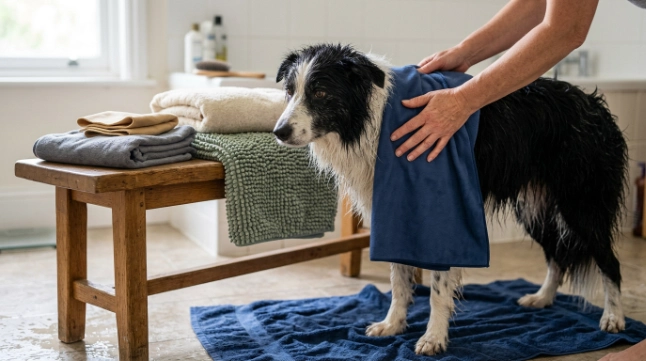
Microfiber is my first choice for most Border Collies, but it is not the only useful material. Cotton, chenille microfiber, absorbent shammies, and wearable drying robes can each serve different jobs.
| Towel Type | Useful Size Target | Best Use | My Verdict |
|---|---|---|---|
| Flat or short-pile microfiber | 30 × 50 to 35 × 60 in. | Baths, swimming, general drying | Best overall |
| Chenille microfiber | 30 × 50 in. or larger | Wet legs, belly, muddy coat | Highly absorbent option |
| Cotton terry bath sheet | 35 × 60 in. or larger | Backup towel at home | Useful but bulky when soaked |
| Absorbent shammy | About 17 × 27 in. or larger | First water-removal pass | Good companion towel |
| Drying robe | Dog-specific fit | Post-bath or post-swim rest | Helpful after towel drying |
Microfiber: my best overall choice
Microfiber gives me the best balance of absorption, low bulk, and easy handling. I can fold it over thick sections and squeeze instead of dragging it repeatedly across the hair.
It is also convenient when I need several towels. Two microfiber towels take up less storage space than several thick household bath sheets.
Chenille microfiber: useful for dirty outdoor dogs
Chenille towels use thicker finger-like strands that can pull moisture and loose surface grime from paws and legs. I like this style near an entrance after wet field walks.
For long rough-coat feathering, I still use a gentle pressing motion. I avoid working any textured towel aggressively through tangles.
Cotton: reliable but not my first pick
A large cotton bath sheet works, and I always keep old clean ones as backups. The downside is that thick cotton can become heavy and soggy before a saturated Border Collie is finished.
I find cotton most useful for the floor, the first shake, or a second towel pass when my main microfiber towel is already wet.
Shammy towels and drying robes
A compact shammy is handy for squeezing water from the body before the final towel. However, I would not rely on one small shammy as the only drying tool for a soaked adult Border Collie.
A drying robe can keep collecting leftover surface moisture after the main towel pass. It should complement proper drying rather than hide an undercoat that is still wet.
Section Takeaway: For most Border Collies, I would buy a large microfiber towel first. Add a second towel, shammy, or robe only when your routine makes it useful.
What Size Dog Towel Should You Buy?
For an adult Border Collie, I usually look for a towel around 30 × 50 inches or larger. A bath-sheet-sized option around 35 × 60 inches gives me even more room for wrapping and pressing the body.
Those measurements are practical targets rather than breed rules. Your dog’s build, coat length, and the towel’s thickness all change what feels manageable.
When a larger towel helps
- You have a large adult near the upper end of the breed’s size range.
- Your Border Collie has a full rough coat with long chest and rear feathering.
- Your dog swims frequently or comes home completely soaked.
- You prefer wrapping the body before drying each area separately.
I would rather own two medium-large towels than one enormous towel that becomes hard to control. The first removes most water, while the second finishes areas where the undercoat still feels damp.
How Should You Towel-Dry a Border Collie?
The best technique is to let your dog shake, then press, blot, and gently squeeze water from the coat. Avoid rapid scrubbing because it can work longer hair and feathering into tangles.
PetMD’s home dog-bathing guidance also recommends gently patting dogs dry and notes that thick-coated dogs may need multiple towels or cool pet-safe airflow.
1. Brush before the bath
Remove loose undercoat, dirt, burrs, and obvious tangles while the coat is dry. Wetting an already tangled coat makes the rest of the grooming session harder.
2. Let your dog shake first
Move your Border Collie onto a secure, non-slip surface and give them a chance to shake. This removes loose water before the towel has to do the harder work.
3. Start with the back and sides
Lay the towel over the body and press it into the coat with both hands. Lift it, move to a drier section, and repeat.
4. Squeeze thicker areas
Wrap sections of chest, rear feathering, legs, and tail loosely inside the towel. Apply gentle pressure without twisting the hair.
5. Switch towels when needed
A fully saturated towel stops being efficient. This is why I keep a second towel within reach before the dog ever enters the bath.
6. Check the undercoat
Part the hair and feel near the skin. Focus on the chest, armpits, belly, neck, behind the ears, hindquarters, and tail base.
7. Finish with gentle airflow when necessary
A towel does not always remove every bit of moisture from a dense coat. If needed, finish with pet-appropriate cool or low-heat airflow while keeping your dog comfortable.
The VCA coat-care guidance also emphasizes grooming according to coat type and thoroughly managing thick coats. I use that same coat-first mindset rather than relying on a fixed drying time.
Section Takeaway: Press and squeeze instead of scrubbing. Use a second towel when the first becomes saturated, then check dryness close to the skin rather than judging only the outer coat.
Which Towel Is Best for Baths, Mud, and Travel?
The best towel can change with the job. I use a different approach for a full bath than I do for muddy paws after a quick walk.
For a full bath
Choose a large flat or short-pile microfiber towel and keep a second one ready. This setup gives you enough dry fabric to handle the body and undercoat.
For muddy walks
A chenille microfiber towel works well near the door for paws, legs, belly, and chest. I brush off dried debris first when possible instead of grinding dirt deeper into wet fur.
For swimming
Bring a large microfiber towel plus a spare if your Border Collie loves repeated trips into the water. A compact towel that packs easily is useful in the car.
For road trips
I value quick drying and compact storage more than plush thickness. One towel stays ready for the dog, while another can protect the seat or cargo area.
For puppies
A smaller soft microfiber towel is usually easier to handle. Keep drying sessions short and calm so towel handling becomes normal rather than a wrestling match.
What Should You Avoid When Choosing a Dog Towel?
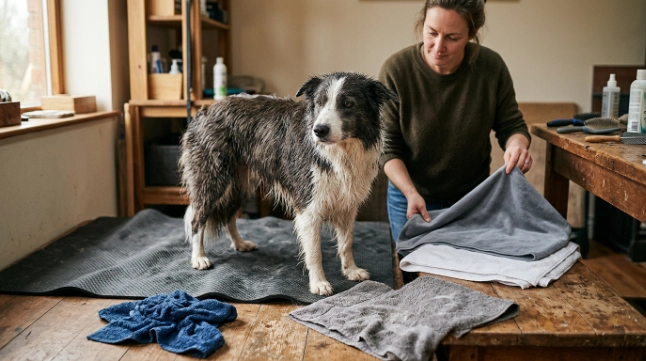
Avoid choosing a towel only because it feels thick or luxurious. For a Border Collie, usability when the towel is wet matters much more.
- Tiny towels: They saturate quickly and make drying an adult dog frustrating.
- Rough textures: Skip anything that repeatedly snags longer feathering or pulls the coat.
- Excessive rubbing: Even a good towel performs poorly when used like a scrub brush.
- Hard-to-wash designs: Mud, hair, and outdoor grime make easy laundering important.
- One-towel expectations: A fully soaked rough-coated Border Collie may simply need a fresh second towel.
Also inspect the skin while drying. Redness, sores, persistent odor, pain, excessive itching, or unusual hair loss should not be treated as ordinary towel problems.
Vet note: If your Border Collie has ongoing skin irritation, unusual odor, sores, or painful areas, ask your veterinarian before changing bathing products or repeatedly washing the coat.
Frequently Asked Questions
Is microfiber or cotton better for a Border Collie?
I prefer microfiber because it is absorbent, relatively lightweight, and easy to press through a thick coat. Cotton towels still work well as backups, especially when your first towel becomes saturated.
How many towels do I need to dry a Border Collie?
One large towel may handle a lightly wet smooth-coated dog. For a full bath, swimming session, or heavy rough coat, I keep two large absorbent towels ready so I can switch when the first becomes wet.
Can I use a normal human bath towel?
Yes. A clean bath towel can dry a Border Collie, but large cotton towels often become bulky when soaked. A dedicated microfiber dog towel is more convenient for my regular bathing and muddy-walk routine.
Should I rub my Border Collie dry with a towel?
No aggressive rubbing is needed. I press, blot, and gently squeeze sections of coat because fast back-and-forth rubbing can encourage tangles, especially around the chest, tail, and rear feathering.
What size microfiber towel is best for an adult Border Collie?
I use roughly 30 × 50 inches as a practical minimum target for most adults. A 35 × 60-inch bath-sheet-sized towel gives more wrapping room for larger or heavily coated dogs.
Can a towel completely dry a Border Collie’s undercoat?
Sometimes, but not always. After towel drying, part the hair and feel near the skin; if thick areas remain damp, gentle pet-safe cool airflow can help finish drying the coat.
Is a dog drying robe worth buying?
A robe can be useful for dogs that stay damp after the main towel pass, especially after swimming or wet walks. I still remove as much water as possible with a towel first and check the undercoat afterward.
Final Takeaway
The best dog towel for a Border Collie is not necessarily the thickest or most expensive option. I would choose a large, machine-washable microfiber towel that absorbs well, stays manageable when wet, and lets you press rather than scrub the coat.
- Start with a large microfiber towel around 30 × 50 inches or bigger.
- Keep a second towel ready for full baths and rough coats.
- Use gentle pressing, blotting, and squeezing motions.
- Check moisture close to the skin, not just across the topcoat.
- Use cool pet-safe airflow if the dense undercoat remains damp.
- Wash and fully dry the towel between grooming sessions.
That simple setup has been the most practical approach in my Border Collie grooming routine. A good towel cannot replace careful brushing or complete drying, but it makes both bath day and wet-weather cleanup much easier.
