
Apple Cider Vinegar Border Collie Bath: Is It Safe and How Should You Use It?

Quick Answer
An apple cider vinegar Border Collie bath is not a replacement for dog shampoo or veterinary treatment. If your veterinarian agrees that your dog’s healthy, unbroken skin can tolerate it, heavily diluted apple cider vinegar may be used as an occasional rinse, but it should never go on raw, inflamed, scratched, or infected skin. For dogs already prone to irritation, follow a gentle Border Collie sensitive-skin bath routine instead.
Before trying apple cider vinegar
- Check the skin: Skip vinegar if you see redness, sores, scratches, hot spots, or broken skin.
- Dilute it: Never pour undiluted apple cider vinegar directly onto your Border Collie’s skin.
- Avoid sensitive areas: Keep the mixture away from the eyes, nose, mouth, genital area, and ear canals.
- Watch the reaction: Rinse immediately if your dog shows discomfort, redness, or increased scratching.
- Use proper shampoo: Dirt, oil, allergens, and skin disease may require dog shampoo or veterinary treatment instead.
Safest approach
- Ask your veterinarian before using ACV when your Border Collie already has itching, allergies, recurring odor, or another skin problem.
Apple cider vinegar shows up in countless homemade dog-grooming recipes. As a longtime Border Collie owner, I understand why the idea is appealing when a muddy double coat starts smelling less than fresh.
But “natural” does not automatically mean gentle. This guide explains where apple cider vinegar may fit into a Border Collie bath, where it does not, and how to protect that dense double coat and the skin underneath.
In This Guide
- What Is an Apple Cider Vinegar Border Collie Bath?
- Is Apple Cider Vinegar Safe for a Border Collie’s Skin?
- What Can Apple Cider Vinegar Actually Do in a Dog Bath?
- How Do You Give a Border Collie an Apple Cider Vinegar Rinse?
- When Should You Avoid Apple Cider Vinegar?
- Apple Cider Vinegar vs Dog Shampoo: Which Is Better?
- How Do You Protect a Border Collie’s Double Coat?
- When Does Your Border Collie Need a Vet Instead?
- Frequently Asked Questions
- Final Takeaway
What Is an Apple Cider Vinegar Border Collie Bath?
An apple cider vinegar Border Collie bath usually means applying diluted apple cider vinegar to the coat during or after ordinary bathing. Some owners use it as a final rinse rather than as the main cleanser.
An apple cider vinegar rinse is a diluted acidic solution applied briefly to the coat and skin. It is not the same thing as a veterinary shampoo, medicated treatment, or regular dog cleanser.
Why Border Collie owners consider it
Border Collies are active dogs. Mine have managed to collect mud, pond water, wet grass, and barnyard smells during a single energetic afternoon.
The breed’s double coat makes those messes more challenging. Both rough-coated and smooth-coated Border Collies have an outer coat plus a softer undercoat.
- Outdoor odor: Owners may look for a simple rinse after muddy adventures.
- Coat residue: Homemade rinses are sometimes promoted for removing leftover product or mineral deposits.
- Itching: Online advice often recommends vinegar for itchy dogs, although itching has many possible medical causes.
- Yeast concerns: ACV is frequently promoted online for yeast, but suspected skin infections need veterinary diagnosis.
That last point matters most. A sour-smelling or itchy Border Collie does not automatically have a problem that vinegar can solve.
Is Apple Cider Vinegar Safe for a Border Collie’s Skin?
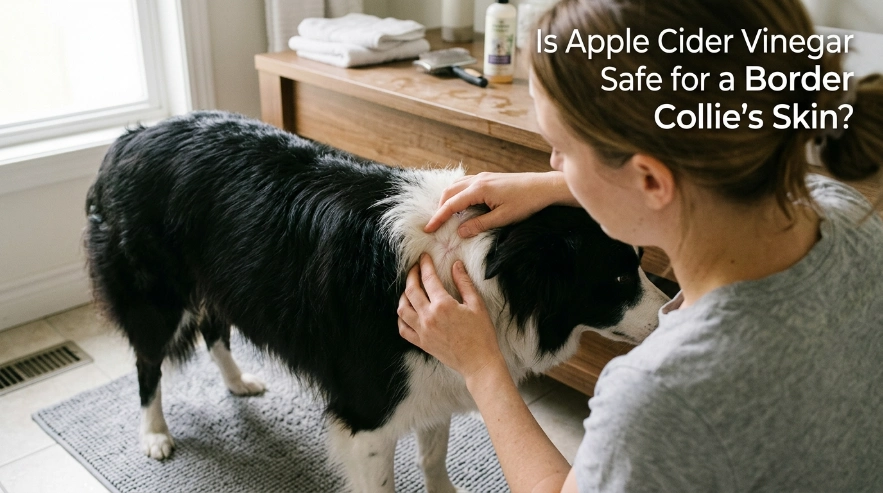
Apple cider vinegar should be treated cautiously on dogs because it is acidic. Undiluted vinegar can sting irritated skin, and even diluted vinegar may bother an individual dog.
The safest rule is simple: don’t use it on unhealthy skin. A Border Collie’s thick coat can hide scratches and inflammation until you part the fur and look closely.
Inspect the skin before using anything
Before a bath, run your fingers through the coat and examine several areas. I pay special attention to the belly, armpits, paws, neck, groin, and base of the tail.
- Open scratches or cuts
- Raw spots from licking or chewing
- Red or unusually warm skin
- Moist sores or hot spots
- Scabs or bleeding
- Swelling
- Patchy hair loss
- Strong or unusual skin odor
- Heavy flaking or greasy buildup
If you find these signs, skip the homemade rinse. A routine designed for a Border Collie with dry skin may be more appropriate for simple dryness, while persistent irritation deserves veterinary attention.
Vet note: Ask your veterinarian before applying vinegar, essential oils, medicated products, or other home remedies to irritated or abnormal skin.
What Can Apple Cider Vinegar Actually Do in a Dog Bath?
Apple cider vinegar is best viewed as an optional grooming rinse, not a proven treatment for canine skin disease. Claims about treating allergies, fleas, bacterial infections, or yeast go beyond what a basic home rinse should promise.
As of 2026, veterinary skin care still centers on identifying the cause of persistent itching and using appropriate canine products. The American Kennel Club’s dog shampoo guidance also emphasizes choosing products suited to a dog’s skin needs.
It may help with temporary coat odor
A diluted rinse has a sharp smell when wet. That smell usually fades as the coat dries.
However, recurring foul odor is different. Yeast, bacterial skin problems, ear disease, or other conditions can produce odor that bathing alone will not fix.
It is not a substitute for shampoo
Apple cider vinegar does not perform the same job as a well-formulated dog shampoo. Shampoo contains cleansing ingredients designed to lift dirt, oil, and debris so water can carry them away.
If your dog simply needs a proper cleaning, use a dog-specific product. For dogs that react easily, a hypoallergenic shampoo for a Border Collie may be a better starting point.
It should not be presented as an infection treatment
Itching does not identify its own cause. Fleas, environmental allergies, parasites, bacterial infections, yeast, contact irritation, and other conditions can look similar at home.
Using stronger homemade mixtures can make the skin more uncomfortable. It may also delay the diagnosis your dog needs.
Vet note: Persistent itching, recurrent odor, greasy skin, sores, or hair loss should be assessed by your veterinarian rather than treated repeatedly with ACV.
How Do You Give a Border Collie an Apple Cider Vinegar Rinse?
If your veterinarian approves an ACV rinse for healthy skin, keep the method conservative. The goal is brief exposure to a diluted solution, not soaking the dog in concentrated vinegar.
Step 1: Brush before bathing
Brush out loose undercoat, debris, and manageable tangles first. Water can tighten existing mats and make them harder to remove.
A slicker brush and metal comb work well for many Border Collies. Be gentle around feathering behind the ears, legs, chest, and tail.
Step 2: Inspect the skin
Part the fur down to the skin before preparing the rinse. Do not proceed if you find abrasions, sores, inflamed areas, or obvious infection.
Step 3: Use a conservative dilution
Don’t use straight apple cider vinegar. For an occasional rinse on healthy skin, a cautious starting mixture is about one part apple cider vinegar to three or four parts water.
There is no universal veterinary dilution for routine ACV bathing. Your veterinarian may recommend avoiding it entirely for your individual dog.
Step 4: Wash with dog shampoo when cleaning is needed
Wet the double coat thoroughly with lukewarm water. Work dog-specific shampoo through the coat using your fingertips rather than your nails.
Rinse until the coat no longer feels slippery. Border Collie undercoat holds product surprisingly well.
Step 5: Apply the diluted rinse carefully
- Keep the mixture below the neck.
- Apply a small amount through the body coat.
- Avoid eyes, muzzle, mouth, genitals, and ear canals.
- Massage lightly without scratching the skin.
- Stop immediately if your dog shows discomfort.
Step 6: Rinse with clean water
I prefer rinsing the solution away rather than leaving an acidic homemade mixture trapped inside a dense undercoat. Flush the coat thoroughly with lukewarm water.
This approach also reduces the chance that your Border Collie will lick concentrated residue while drying.
Step 7: Dry the double coat fully
Press towels into the coat instead of rubbing aggressively. Rubbing can create tangles in longer feathering.
If you use a pet dryer, choose comfortable airflow and low heat. Keep the dryer moving and avoid the face and ear canals.
Once the coat is mostly dry, gently comb through it. Proper drying also supports the general goal of improving a Border Collie’s coat through bathing without leaving the undercoat damp.
Section Takeaway: Use ACV only as an optional, diluted rinse on healthy skin. Proper brushing, canine shampoo, thorough rinsing, and complete drying matter far more.
When Should You Avoid Apple Cider Vinegar?
Skip apple cider vinegar whenever the skin barrier is damaged or the cause of irritation is unclear. Acidic liquid can sting exposed tissue.
Do not use ACV on these areas
- Open wounds
- Hot spots
- Fresh scratches
- Raw skin from chewing
- Eyes or eyelids
- Inside the ears
- Nose or mouth
- Genital areas
- Recently irritated or inflamed skin
Be especially careful with a dog that has a history of sensitive skin. Products that seem harmless on one Border Collie may bother another.
Do not pour vinegar into the ears
A Border Collie’s ear problem should not be treated by guessing at homemade ear cleaners. Ear redness, discharge, odor, scratching, or repeated head shaking can have several causes.
A veterinarian needs to check the ear canal and eardrum when disease is suspected. Putting an inappropriate solution into a painful ear can make matters worse.
Vet note: Contact your veterinarian when your dog’s skin or ears are painful, swollen, bleeding, producing discharge, or getting worse quickly.
Apple Cider Vinegar vs Dog Shampoo: Which Is Better?

Dog shampoo is the better choice for routine cleaning. Apple cider vinegar is an optional rinse with limited grooming uses, not a replacement cleanser.
| Option | Best Role | Main Advantage | Main Caution |
|---|---|---|---|
| Dog-specific shampoo | Routine cleaning | Designed to remove coat dirt and oil | Must be rinsed thoroughly |
| Hypoallergenic shampoo | Sensitive dogs | Often uses simpler, mild formulations | Cannot diagnose the cause of itching |
| Dog-specific oatmeal shampoo | Some dry or sensitive coats | Designed for canine bathing | Not suitable for every skin condition |
| Diluted apple cider vinegar | Optional occasional rinse | Simple and inexpensive | Can sting or irritate damaged skin |
| Medicated shampoo | Diagnosed skin disease | Targets a specific veterinary problem | Use according to veterinary directions |
If dryness is your main concern, consider whether a dog-specific oatmeal shampoo for a Border Collie fits the situation better.
The key difference is purpose. A grooming product should match the actual problem rather than whichever home remedy happens to be popular online.
How Do You Protect a Border Collie’s Double Coat?
A good bath routine protects both skin and coat. Border Collies don’t need complicated homemade mixtures to maintain healthy-looking fur.
Brush before getting the coat wet
Remove loose undercoat and tangles first. Wet mats become dense and can hold moisture close to the skin.
Use lukewarm water
Hot water adds unnecessary discomfort and can be unpleasant for sensitive skin. Comfortable lukewarm water is enough for routine bathing.
Rinse deeper than the surface coat
Slide your fingers through the fur while rinsing. A rough-coated Border Collie can look completely rinsed while shampoo still sits near the skin.
- Check behind the front legs.
- Flush the chest feathering.
- Rinse underneath the belly.
- Separate thick tail hair.
- Check the rear leg feathering.
Don’t automatically add oil afterward
A dry-looking coat does not always need more products. Oils can make some coats greasy and can encourage licking.
If you’re considering another home-care product, read the guide to using coconut oil after a Border Collie bath before layering products onto the coat.
When Does Your Border Collie Need a Vet Instead?
Repeated itching is a medical clue, not simply a grooming inconvenience. Bathing can remove surface dirt or allergens, but it cannot tell you why the skin keeps reacting.
The American Veterinary Medical Association’s pet-owner resources are a useful starting point when deciding when professional veterinary care is appropriate.
Make an appointment if you notice:
- Persistent scratching or chewing
- Redness that keeps returning
- Raw or bleeding skin
- Patchy hair loss
- Strong skin odor
- Greasy or crusty areas
- Pustules or draining sores
- Repeated ear problems
- Sudden facial swelling
- A major reaction after a grooming product
The ASPCA pet-care resources also emphasize safe, pet-appropriate care rather than assuming household products are automatically suitable for animals.
Keep notes if the problem comes and goes. Record bathing products, outdoor exposure, swimming, diet changes, flea prevention, and where the itching appears.
That information can help your veterinarian understand the pattern. It is more useful than repeatedly trying stronger vinegar mixtures.
Vet note: Severe swelling, breathing difficulty, collapse, extensive wounds, or rapidly worsening illness warrants urgent veterinary attention.
Frequently Asked Questions
Can I wash my Border Collie with apple cider vinegar?
You can discuss an occasional diluted ACV rinse with your veterinarian if your Border Collie has healthy, intact skin. Do not use undiluted vinegar, and avoid raw, scratched, inflamed, or infected areas because acidic vinegar can cause significant stinging.
What is a safe apple cider vinegar dilution for a dog bath?
There is no universally prescribed veterinary ACV bath ratio. If your veterinarian approves its use on healthy skin, a conservative mixture such as one part ACV to three or four parts water reduces concentration, but individual dogs can still react.
Can apple cider vinegar stop my Border Collie from itching?
Do not rely on ACV to treat persistent itching. Allergies, fleas, mites, bacterial disease, yeast, contact irritation, and other conditions can cause similar symptoms, so recurring or intense itching needs proper diagnosis.
Does apple cider vinegar kill fleas on Border Collies?
Apple cider vinegar should not replace proven flea prevention or veterinary treatment. If you find fleas or flea dirt, ask your veterinarian which parasite-control product fits your dog’s age, weight, health, and lifestyle.
Can I put apple cider vinegar in my Border Collie’s ears?
Don’t pour homemade vinegar mixtures into a dog’s ears without veterinary guidance. Ear odor, discharge, redness, pain, or head shaking may signal disease, and an inappropriate liquid can irritate an already painful ear.
Should I rinse apple cider vinegar off my Border Collie?
For a dense Border Collie double coat, rinsing an optional ACV mixture away with clean lukewarm water is a cautious approach. It prevents acidic residue from staying against the skin or being licked from the coat during drying.
How often can I use apple cider vinegar on my Border Collie?
There is no standard schedule that every Border Collie needs. ACV should not become an automatic part of every bath, especially if your dog develops dryness, redness, scratching, or other signs of skin irritation afterward.
Final Takeaway
An apple cider vinegar Border Collie bath is optional, not essential. Good coat care still comes down to brushing, dog-specific shampoo when needed, complete rinsing, gentle drying, and watching the skin closely.
If you choose to try ACV, use a well-diluted mixture only on healthy skin and keep it away from sensitive areas. Stop immediately if your Border Collie appears uncomfortable.
Most importantly, don’t use vinegar to chase a recurring skin problem. When itching, odor, redness, sores, or hair loss keeps returning, your veterinarian can help identify the cause and choose a treatment that addresses the real problem.
