

Quick Answer
The best slicker brush for a Border Collie is one with long, flexible pins that can reach through the outer coat without scraping the skin. For most rough-coated Border Collies, my premium pick is the Chris Christensen Big G, while the Safari Self-Cleaning Slicker is a practical lower-cost choice. Border Collies have double coats, and PetMD’s Border Collie grooming guidance also recommends regular slicker brushing.
What to look for
- Long pins: Longer pins work better through rough-coat feathering and a dense undercoat.
- Flexible cushion: A forgiving pad reduces harsh pulling when you use light pressure.
- Comfortable handle: A secure grip gives you better control during longer shedding-season sessions.
- Correct head size: Medium heads offer good control, while large heads cover the torso faster.
- Comb follow-up: A metal comb helps confirm that hidden tangles are gone after slicker brushing.
My quick rule
- If the brush repeatedly catches or your dog flinches, stop and inspect that section instead of adding pressure.
Border Collies can have rough or smooth coats, but both varieties carry a weather-resistant double coat. That makes choosing the right grooming tool more important than simply buying the stiffest brush.
This guide looks at the best slicker brush for Border Collie coats in 2026. I’ll also explain brush size, pin length, shedding-season use, and safe brushing technique.
In This Guide
- What Is the Best Slicker Brush for a Border Collie?
- Why Does a Border Collie Need a Slicker Brush?
- Best Slicker Brushes for Border Collies Compared
- Which Slicker Brush Is Best for Rough vs Smooth Coats?
- How Do You Use a Slicker Brush Safely?
- How Often Should You Slicker Brush a Border Collie?
- Slicker Brush vs Pin Brush, Comb, and Undercoat Rake
- Frequently Asked Questions
- Final Takeaway
What Is the Best Slicker Brush for a Border Collie?
For a typical adult rough-coated Border Collie, I would choose the Chris Christensen Big G Slicker Brush. Its 27 mm stainless-steel pins are long enough to work into dense, longer coats without relying on heavy pressure.
The flexible cushion and curved brush head also make controlled line brushing easier. The manufacturer offers large, medium, and smaller Baby G versions.
Why the Big G is my premium pick
- 27 mm pins: They reach farther into long feathering and dense coat than short-pin slickers.
- Flexible cushion: The pin bed has some give instead of feeling rigid against the coat.
- Multiple sizes: The large version covers the body, while medium offers more control.
- Dense pin pattern: It can collect loose coat while separating longer hair.
- Ergonomic handle: The extended grip is useful during long seasonal grooming sessions.
You can review the current specifications on the Chris Christensen Big G product page. As of August 2026, the manufacturer lists 27 mm pins and a $55.50 starting price for the professional version.
It is expensive for a dog brush. However, owners managing a full rough coat may value the longer pins and larger working area.
Best value option: Safari Self-Cleaning Slicker
The Safari Self-Cleaning Slicker is my value choice for routine home grooming. Its stainless-steel pins retract when you press the cleaning button.
That feature is useful during shedding season because a Border Collie’s loose undercoat can fill a slicker quickly. The grip is also easy to control with light strokes.
- Best for: Regular maintenance and moderate shedding.
- Main advantage: Fast hair removal from the brush head.
- Sizes: Small, medium, and large versions are available.
- Limitation: It may not reach through a heavy rough coat as efficiently as a long-pin professional slicker.
Section Takeaway: For a dense rough Border Collie coat, the Big G is my strongest overall choice. For everyday brushing on a tighter budget, the Safari Self-Cleaning Slicker is easier to justify.
Why Does a Border Collie Need a Slicker Brush?
A Border Collie’s coat has two layers. The softer undercoat sits beneath tougher guard hairs that form the outer coat.
Definition: A slicker brush is a grooming brush with many fine wire pins set into a flat or curved pad. It helps separate hair, collect loose coat, and work through small tangles.
The American Kennel Club’s Border Collie guidance describes both rough and smooth Border Collies as double-coated dogs. The AKC recommends regular brushing and increased grooming during shedding periods.
Where Border Collies commonly tangle
Rough-coated Border Collies can develop tangles where longer hair rubs against itself. These areas deserve a quick check before you begin brushing.
- Behind the ears
- Under the front legs
- Along the rear feathering
- Around the tail
- Under collars and harnesses
- Where burrs or grass collect after outdoor work
A slicker is useful because it can separate this hair in small sections. It should not be treated as a tool for ripping through hard mats.
A slicker brush is not a complete grooming kit
I never consider the slicker the final check. A stainless-steel comb tells you whether a tangle remains beneath the surface.
If the comb stops at the same spot repeatedly, return to a smaller section. Work gently rather than forcing either tool through.
Best Slicker Brushes for Border Collies Compared
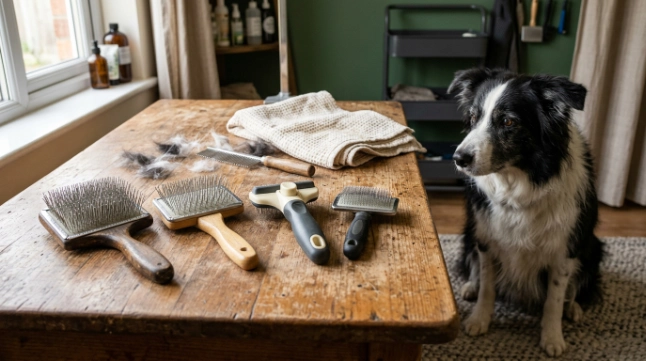
The best choice depends on coat density, length, your dog’s tolerance, and how much cleanup convenience matters. Here is a practical comparison based on current 2026 specifications.
| Brush | Pin Design | Best Border Collie Use | Main Tradeoff |
|---|---|---|---|
| Chris Christensen Big G | 27 mm, dense stainless-steel pins | Rough coats, feathering, dense coat maintenance | Premium price |
| Chris Christensen Big K | 27 mm, more widely spaced pins | Exceptionally dense or difficult undercoat | Can be more brush than a typical coat needs |
| Safari Self-Cleaning | Retractable stainless-steel pins | Routine maintenance and convenient cleanup | Less specialized for deep, long rough coats |
| Chris Christensen Mark | 12 mm pins | Smooth coats and shorter surface coat work | Pins are short for heavy rough coats |
What size slicker brush should you buy?
For many adult Border Collies, a medium slicker provides the best balance between speed and control. It fits the torso while remaining manageable around shoulders and rear feathering.
A large brush makes sense when you have a big rough-coated dog and mostly work broad body sections. A smaller brush is easier around the ears, chest, legs, and other tight areas.
- Large head: Faster across the back, sides, and torso.
- Medium head: Best all-round size for many Border Collies.
- Small head: Better control around sensitive or narrow areas.
Which Slicker Brush Is Best for Rough vs Smooth Coats?
Rough and smooth Border Collies share the same double-coat structure, but their outer coats create different grooming needs. Rough coats usually benefit more from longer pins.
Rough-coated Border Collies
Rough Borders have longer hair and more obvious feathering around the chest, legs, belly, and tail. That extra length can hide tangles below the visible surface.
Choose a slicker with a flexible pad and enough pin length to enter the coat. The goal is to separate layers, not scratch the skin.
- Favor medium or long pins.
- Work the feathering in small sections.
- Check behind the ears carefully.
- Finish each section with a metal comb.
Smooth-coated Border Collies
Smooth Border Collies usually need less detangling because their outer coat sits closer to the body. A huge long-pin brush may feel awkward for routine maintenance.
A medium or softer slicker can remove loose surface coat. A pin brush, comb, or other coat-appropriate tool may also play a larger role.
The AKC’s double-coat grooming guidance recommends gentle brushing and emphasizes brushing the hair rather than scraping the skin.
Section Takeaway: Match pin length to coat length. Long rough coats benefit from deeper reach, while smooth Border Collies usually need a lighter, more controlled setup.
How Do You Use a Slicker Brush Safely on a Border Collie?
Use a slicker with light pressure and short, controlled strokes. You should feel the brush moving through hair rather than dragging across skin.
My rule is simple: resistance tells me to inspect the coat. It does not tell me to push harder.
Step-by-step Border Collie slicker-brushing method
- Inspect first: Feel behind the ears, under the legs, around the tail, and through feathering.
- Remove debris: Pick out twigs, grass, and loose burrs that could catch the pins.
- Start in sections: Lift a small layer of coat so you can see what you are brushing.
- Use light strokes: Brush away from the skin and generally follow the direction of coat growth.
- Support tangled hair: Hold the coat near the base so pulling does not transfer directly to the skin.
- Check with a comb: The comb should pass through the finished section without repeatedly catching.
- Stop at tight mats: Do not keep scraping or pulling when a mat sits close to the skin.
This section-by-section technique is often called line brushing. It prevents the common mistake of making the surface look smooth while leaving compacted hair underneath.
How much pressure should you use?
Less than many new owners expect. Fine slicker pins can irritate skin when someone presses the brush down like a rake.
Run the brush lightly across your own forearm before grooming. If the pins feel harsh with mild pressure, they may also feel harsh on sensitive areas of your dog.
The VCA dog grooming guide likewise recommends gentle brushing and warns against excessive pulling on tangles.
Vet note: Stop grooming and contact your veterinarian if you find persistent redness, sores, unusual hair loss, swelling, discharge, or painful skin.
How Often Should You Slicker Brush a Border Collie?
Most Border Collies benefit from brushing several times each week, with more frequent grooming when the undercoat is shedding heavily. Coat length, activity, climate, and time outdoors can change that schedule.
A practical weekly schedule
| Situation | Suggested Check | Main Focus |
|---|---|---|
| Normal maintenance | 2–3 times weekly | Loose coat and small tangles |
| Heavy shedding | Daily or near-daily quick sessions | Releasing loose undercoat gently |
| After fields or trails | Same day | Burrs, grass, twigs, and tangles |
| Before bathing | Before getting coat wet | Loose fur and existing knots |
Short sessions usually work better than turning grooming into a long wrestling match. Five to ten focused minutes can be enough for a maintenance check.
During a major coat blow, divide the dog into sections over several sessions if needed. Comfort matters more than finishing the entire dog at once.
Slicker Brush vs Pin Brush, Comb, and Undercoat Rake
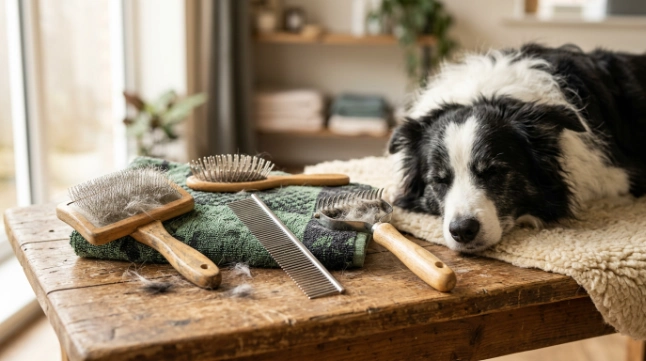
A slicker is useful, but it should not replace every grooming tool. Border Collie coats are easier to manage when each tool has a specific job.
- Slicker brush: Separates coat, collects loose hair, and works through small tangles.
- Pin brush: Useful for general coat maintenance and longer feathering with less aggressive penetration.
- Metal comb: Checks whether hidden knots remain after brushing.
- Undercoat rake: Helps manage heavy loose undercoat during seasonal shedding.
Should you use a deshedding blade every day?
No. A bladed deshedding tool is different from an ordinary slicker and can remove more coat than you intend when overused.
For everyday maintenance, I prefer controlled brushing and combing. Reserve stronger shedding tools for times when the coat genuinely needs them.
Common slicker-brush mistakes
- Pressing too hard: Fine wire pins do not need heavy downward pressure.
- Only brushing the surface: A smooth top layer can hide tangles beneath it.
- Dragging through mats: Tight mats can pull painfully on the skin.
- Ignoring sensitive areas: Armpits, ears, belly, and rear feathering need slower work.
- Skipping the comb check: A comb reveals tangles the slicker may pass over.
- Brushing irritated skin: Red, sore, or painful areas need investigation first.
Grooming should become a predictable routine rather than a battle. Start puppies with short sessions and reward calm behavior before their patience runs out.
Vet note: Sudden coat loss, severe itching, skin lesions, or unusual sensitivity can have medical causes. Ask your veterinarian to examine those changes instead of treating them as normal shedding.
Section Takeaway: Think of the slicker as one part of a Border Collie grooming system. The slicker loosens and separates, while a comb confirms that the coat is truly tangle-free.
Frequently Asked Questions
Can I use a slicker brush on a Border Collie every day?
Yes, gentle daily brushing can be appropriate during heavy shedding or after outdoor activity. Keep sessions short and use light pressure, especially over bony or sensitive areas.
What size slicker brush is best for a Border Collie?
A medium slicker is the safest all-round choice for many adult Border Collies. Large heads cover the torso faster, while smaller heads provide better control behind the ears and around the legs.
Are slicker brushes good for Border Collie undercoats?
They can collect loose undercoat, especially when the pins are long enough to reach through the outer coat. During heavy shedding, an appropriate undercoat rake may work more efficiently alongside the slicker.
Can a slicker brush hurt a Border Collie?
Yes, if you press too hard, repeatedly scrape the skin, or force the pins through a tight mat. Use gentle strokes and stop when your dog shows discomfort.
Should I brush my Border Collie before or after a bath?
Brush before bathing to remove loose coat, debris, and ordinary tangles. Water can make existing tangles harder to manage, so starting with a separated coat usually makes bathing easier.
Is the Chris Christensen Big G worth it for a Border Collie?
It makes the most sense for a rough-coated Border Collie with longer, dense hair and frequent grooming needs. Owners of smooth-coated Borders may not need its long 27 mm pins or premium price.
Do I need both a slicker brush and a metal comb?
For a rough-coated Border Collie, I recommend both. The slicker does most of the brushing, while the comb checks whether small tangles remain near the skin or inside feathering.
Final Takeaway
The Chris Christensen Big G is my best overall slicker brush for a rough-coated Border Collie in 2026. Its 27 mm pins, flexible cushion, and multiple sizes suit the breed’s longer double coat particularly well.
The Safari Self-Cleaning Slicker is a sensible alternative when convenience and price matter more. It is easy to clear when loose hair starts filling the brush.
Whichever brush you choose, technique matters more than force. Work in small sections, use light pressure, check your work with a comb, and never fight through painful matting.
Make those short coat checks part of your normal routine. Your Border Collie will stay cleaner, more comfortable, and much easier to groom when small tangles never get the chance to become large ones.
