
Home Bath vs Professional Grooming Border Collie: Which Is Better?

Quick Answer
For most healthy Border Collies, a home bath is perfectly suitable for routine cleaning if you can brush, rinse, and dry the double coat properly. Professional grooming becomes the better choice for heavy shedding, stubborn mats, difficult nail trims, skin concerns, or when you need a thorough coat blowout. If bath-day tangles are your main concern, follow a careful post-bath mat prevention routine.
Home Bath vs Professional Grooming
- Home bath: Best for normal dirt, mud, odor, and routine coat maintenance.
- Professional groomer: Better for impacted undercoat, difficult tangles, nail trimming, and extensive deshedding.
- Cost: Home grooming costs less after you own the basic tools.
- Convenience: Home bathing avoids travel but requires drying time and cleanup.
- Coat safety: Either option works when the Border Collie’s double coat is handled gently and never aggressively stripped.
- Best approach: Many owners combine regular home care with occasional professional appointments.
When I compare a home bath vs professional grooming for a Border Collie, I don’t think one option always wins. The right choice depends on your dog’s coat, temperament, shedding level, and how comfortable you are handling grooming tools.
I’ve found that ordinary mud and everyday coat care rarely require a salon visit. Heavy undercoat, tight mats, nervous nail trims, and skin problems are different.
In This Guide
- What Is the Difference Between Home Bathing and Professional Grooming?
- When Is a Home Bath Enough for a Border Collie?
- When Should a Border Collie See a Professional Groomer?
- Home Bath vs Professional Grooming: Side-by-Side Comparison
- Does Border Collie Coat Type Change the Best Choice?
- How Do You Groom a Border Collie Properly at Home?
- Can You Combine Home Grooming With Professional Grooming?
- Frequently Asked Questions
- Final Takeaway
What Is the Difference Between Home Bathing and Professional Grooming?
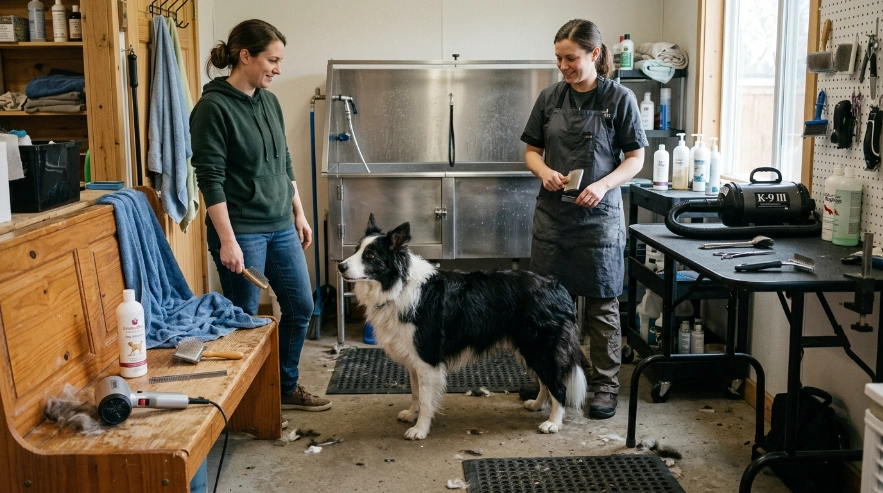
A home bath handles basic cleaning, brushing, drying, and simple maintenance. Professional grooming adds specialized equipment, coat handling experience, intensive deshedding, nail care, and help with difficult coats.
The key difference isn’t simply who applies the shampoo. It is the depth of coat work that happens before, during, and after the bath.
A Border Collie grooming session is the full process of maintaining the dog’s skin, double coat, nails, paws, ears, and overall cleanliness. Bathing is only one part of that process.
Why the double coat matters
Border Collies have rough or smooth coat varieties, but both can carry a dense double coat. The softer undercoat sits beneath protective outer hairs.
The American Kennel Club’s Border Collie guide recommends regular brushing and notes that more frequent grooming may be needed during shedding periods.
- Outer coat: Helps protect the dog from dirt, moisture, and outdoor conditions.
- Undercoat: Provides insulation and produces much of the loose hair you see during shedding.
- Feathering: Longer hair around the chest, legs, belly, and tail can tangle more easily.
A groomer with a high-velocity pet dryer can move water and loose undercoat much faster than most home setups. That can make a major difference during seasonal shedding.
However, professional equipment isn’t necessary every time your Border Collie steps in a muddy puddle. A simple home bath often handles that job perfectly well.
Section Takeaway: Home bathing focuses on routine cleaning, while professional grooming offers deeper coat work and specialized handling. Neither option automatically suits every grooming session.
When Is a Home Bath Enough for a Border Collie?
A home bath is usually enough when your Border Collie is healthy, reasonably cooperative, and free from serious mats. Routine dirt and odor don’t normally require professional grooming.
This is where I handle most of my own Border Collie grooming. A muddy underside after a wet walk is far easier to deal with at home than booking an appointment.
Home grooming works well for routine maintenance
- Muddy paws and belly: Normal outdoor dirt is easy to rinse and shampoo at home.
- General dog odor: An occasional bath can freshen a healthy coat.
- Light shedding: Regular brushing can remove ordinary loose hair.
- Small tangles: Loose tangles can often be gently combed before bathing.
- Cooperative nails: Experienced owners may handle routine nail maintenance themselves.
The ASPCA’s dog grooming guidance recommends brushing away dead hair and mats before bathing. It also recommends products formulated specifically for pets.
Home bathing is also easier for some nervous dogs
A Border Collie that dislikes unfamiliar environments may relax more in its own bathroom. Familiar flooring, towels, and handlers can reduce excitement.
That benefit disappears if bath time becomes a wrestling match. Fearful dogs shouldn’t be physically forced through grooming procedures.
What equipment do you need?
You don’t need a salon in your house. A small, practical kit covers most routine Border Collie grooming.
- Dog-specific shampoo
- Absorbent towels
- Non-slip bath surface
- Slicker or pin brush
- Metal grooming comb
- Optional undercoat rake for active shedding
- Pet dryer or safe low-temperature drying method
Your brush matters almost as much as your shampoo. My guide to the best brush after a Border Collie bath explains which tools suit the coat after washing.
Section Takeaway: Choose a home bath when the coat is manageable, the dog is comfortable, and you’re dealing with normal dirt or routine maintenance rather than a difficult grooming problem.
When Should a Border Collie See a Professional Groomer?
A professional groomer makes sense when the job exceeds your tools, confidence, or ability to keep the dog comfortable. Severe tangles and impacted undercoat are two common examples.
Professional help can also prevent a small grooming issue from becoming a painful home experiment.
Choose professional grooming for difficult matting
Don’t attack a tight skin-level mat with household scissors. Dog skin can sit surprisingly close to tangled hair.
VCA’s grooming and coat-care guidance recommends professional grooming or veterinary help when tangles are severe or extensive. Skin irritation associated with matting also deserves veterinary attention.
- Tight mats: Especially those sitting close to the skin.
- Large burr clusters: Removing them can become difficult without pulling the coat.
- Impacted undercoat: Dense dead coat may require extensive section-by-section removal.
- Painful areas: Stop grooming if touching the coat causes a strong pain response.
Professional deshedding can save substantial work
During a heavy coat blow, my floor can tell me what’s happening before I even brush the dog. Loose undercoat seems to appear everywhere.
Bathing can help loosen hair that was already ready to shed. For a deeper seasonal routine, see my Border Collie bath during shedding season guide.
A groomer’s bathing system and pet dryer can remove an impressive amount of loose undercoat. That doesn’t mean the coat should be aggressively stripped.
Difficult nails may justify the appointment alone
Nail trimming becomes risky when a dog panics, snaps, or violently pulls its feet away. A trained groomer may have better handling experience and equipment.
Some dogs still need veterinary assistance rather than grooming assistance. Severe fear or pain should never be treated as simple stubbornness.
Skin disease changes the situation
Itching, open sores, unusual hair loss, strong skin odor, persistent redness, and recurring infections aren’t ordinary cosmetic problems. A veterinarian should guide treatment.
Vet note: If your Border Collie has painful skin, open sores, infection, persistent itching, or unexplained hair loss, ask your veterinarian before changing bathing products or frequency.
If your dog’s skin is easily irritated, my guide on bathing a Border Collie with sensitive skin covers gentler bath-day decisions.
Section Takeaway: Professional grooming is most valuable when coat condition, behavior, equipment needs, or safety makes home grooming difficult. Medical skin problems belong with a veterinarian, not simply a groomer.
Home Bath vs Professional Grooming: Side-by-Side Comparison
For a healthy Border Collie, the choice usually comes down to coat condition, workload, and your own grooming skills. This table shows where each option has an advantage.
| Factor | Home Bath | Professional Grooming |
|---|---|---|
| Routine dirt | Excellent choice | Usually unnecessary |
| Heavy seasonal shedding | Possible but time-consuming | Excellent for thorough blowout |
| Loose tangles | Usually manageable | Also suitable |
| Severe matting | Higher risk | Safer choice |
| Drying speed | Often slower | Usually faster with pet dryers |
| Owner effort | High | Low after drop-off |
| Ongoing cost | Lower after buying tools | Higher per appointment |
| Nervous dog | May prefer familiar surroundings | Useful with skilled handling |
| Skin disease | Only with veterinary guidance | Vet guidance still needed |
As of 2026, I still see the hybrid approach as the most practical choice for many Border Collie households. Owners handle routine maintenance and book professional help when the coat becomes more demanding.
Does Border Collie Coat Type Change the Best Choice?
Yes, but not as dramatically as some owners expect. Rough and smooth Border Collies both need coat care, even though the rough coat usually demands more detangling.
Rough-coated Border Collies
A rough coat has longer hair and feathering around the chest, legs, belly, and tail. These areas create more opportunities for friction and tangling.
- Check behind the ears.
- Comb the armpits carefully.
- Inspect chest feathering.
- Work through rear feathering.
- Check the base of the tail.
A rough coat doesn’t automatically require professional grooming. It simply rewards owners who groom in sections instead of brushing only the visible surface.
Smooth-coated Border Collies
Smooth Border Collies have shorter outer hair, so obvious tangling is usually less demanding. The undercoat can still shed substantially.
That means a smooth-coated dog may still benefit from professional deshedding. Short hair doesn’t equal a maintenance-free coat.
Should a groomer shave a Border Collie?
Routine shaving isn’t part of normal Border Collie coat maintenance. Their natural coat should generally be preserved unless a medical or severe matting situation requires a different approach.
Discuss any major coat removal with a qualified groomer and veterinarian first. Cosmetic convenience alone isn’t a good reason to radically alter the coat.
How Do You Groom a Border Collie Properly at Home?
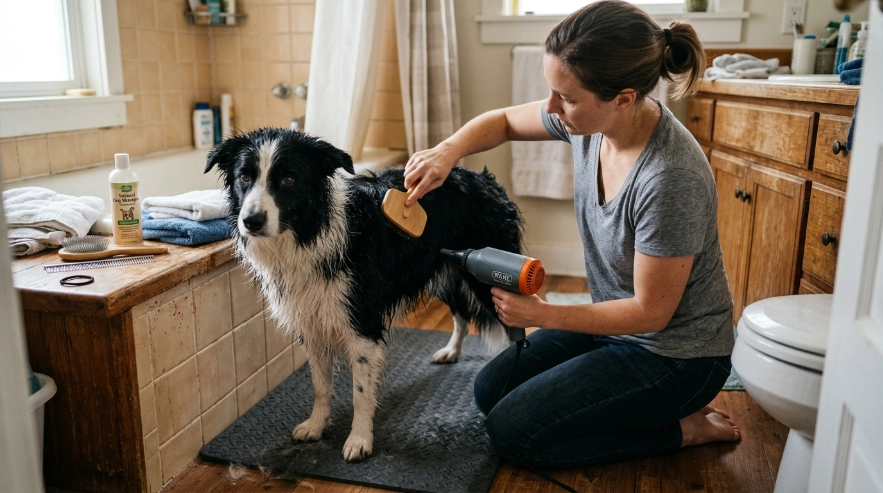
The safest home routine begins before the bath. Removing loose hair and tangles first makes washing, rinsing, and drying much easier.
1. Inspect the coat with your hands
Feel behind the ears, under the collar, beneath the front legs, around the hindquarters, and through the tail. Your fingers can locate compacted areas that surface brushing misses.
2. Brush before adding water
Work through loose hair and minor tangles using a suitable brush. Follow with a comb in longer feathering.
Don’t force a tool through a tight knot. Stop when resistance becomes significant.
3. Use lukewarm water and dog shampoo
Wet the coat thoroughly instead of washing only the outer surface. A dense undercoat can take longer to saturate than it appears.
Massage shampoo through the coat without aggressively twisting the hair. Keep shampoo and direct water away from the eyes and ear canals.
4. Rinse longer than you think
Dense coats can trap product near the skin. Separate the hair with your fingers as you rinse.
- Rinse the shoulders.
- Check the chest.
- Check beneath the belly.
- Rinse the hindquarters carefully.
- Recheck any especially dense areas.
5. Blot instead of scrubbing
Press towels into the coat and gently squeeze long sections. Vigorous circular rubbing can twist longer hair together.
6. Dry the undercoat, not just the surface
A coat can feel dry across the back while remaining damp close to the skin. Check dense areas with your fingers during drying.
Keep dryer temperature comfortable and airflow moving. Never concentrate hot air against one patch of skin.
7. Finish with brushing and a comb check
Once the coat has separated during drying, brush in small sections. Finish by passing a metal comb gently through common trouble spots.
Bathing can also make a healthy coat look cleaner and more separated when the whole routine is done correctly. I explain those limits in whether bathing can improve a Border Collie’s coat.
Section Takeaway: A successful home bath isn’t simply shampoo and water. Pre-brushing, thorough rinsing, gentle drying, and a final comb check are what make the routine work.
Can You Combine Home Grooming With Professional Grooming?
Yes. In my experience, combining both methods gives many Border Collie owners the best balance of cost, convenience, and coat maintenance.
You don’t need to choose one method forever. Grooming needs change with weather, shedding, age, activity, and coat condition.
A practical routine for many healthy adults
- Several times weekly: Brush according to coat density, outdoor activity, and shedding.
- After outdoor adventures: Check paws, feathering, ears, and coat for mud, burrs, seeds, and tangles.
- When dirty: Give a home bath when the coat genuinely needs washing.
- During coat blow: Increase brushing and consider a professional deshedding session if the undercoat becomes difficult.
- As needed: Use a groomer for difficult nails, extensive tangling, or tasks beyond your skill level.
Don’t follow the calendar blindly
Bathing frequency should respond to the individual dog. An active farm Border Collie working around mud may need cleaning sooner than a suburban dog walking mostly on pavement.
Skin condition matters too. More shampoo isn’t automatically better grooming.
Vet note: Ask your veterinarian before starting frequent bathing or medicated shampoo if your Border Collie has allergies, recurring skin irritation, infections, or another diagnosed skin condition.
My decision rule
I use a simple question: Can I complete this grooming job calmly, thoroughly, and without risking pain or injury? If the answer is yes, I usually handle it at home.
If I’m fighting the coat or the dog, I stop. That’s usually the point where professional skill becomes more valuable than persistence.
Section Takeaway: Home grooming and professional grooming work best as complementary tools. Routine maintenance belongs at home for many dogs, while harder jobs can be handed to an experienced professional.
Frequently Asked Questions
Does a Border Collie need professional grooming?
No. Most healthy Border Collies don’t require professional grooming for every bath. Owners can often manage routine brushing and bathing at home, while professional grooming is especially useful for heavy deshedding, difficult mats, challenging nail trims, or grooming tasks beyond the owner’s experience.
How often should a Border Collie go to a groomer?
There isn’t one mandatory salon schedule for every Border Collie. Some dogs may only need occasional professional appointments during major shedding periods, while others never require routine salon grooming because their owners successfully maintain the coat at home.
Is professional grooming better than bathing a Border Collie at home?
Professional grooming is better for difficult or labor-intensive coat work, but it isn’t automatically better for ordinary cleaning. A well-executed home bath can keep a healthy Border Collie clean and comfortable without the expense of a salon visit.
Can I completely groom my Border Collie myself?
Many owners can handle brushing, bathing, drying, coat checks, and basic nail care themselves. You should still seek professional help for severe mats, unsafe nail trimming, painful skin, difficult behavior, or any task you can’t complete comfortably and safely.
Should I brush my Border Collie before or after a bath?
Do both. Brush before bathing to remove loose hair, debris, and tangles, then brush again after towel drying and partial drying. The post-bath session removes loosened coat and lets you check that the undercoat is separated and tangle-free.
Is a professional groomer useful during Border Collie shedding season?
Yes. Professional bathing and drying equipment can make a heavy seasonal coat blow easier to manage. A groomer can remove substantial loose undercoat, but you’ll still need regular brushing at home because one appointment doesn’t stop normal shedding.
What if my Border Collie hates both home baths and groomers?
Start with short, reward-based grooming sessions and teach handling gradually rather than forcing a full procedure. If fear is intense, involves aggression, or suddenly appears alongside pain, discuss the behavior with your veterinarian and an appropriately qualified behavior professional.
Final Takeaway
For most healthy Border Collies, home bathing wins for everyday maintenance. It’s convenient, economical, and completely capable of handling ordinary dirt when you brush and dry the coat properly.
Professional grooming wins when the job becomes difficult. Heavy coat blow, impacted undercoat, severe mats, unsafe nail trimming, or challenging handling are good reasons to get experienced help.
- Choose home grooming for ordinary brushing, mud, odor, and manageable coat care.
- Choose a groomer for difficult mats, intensive deshedding, and tasks you can’t perform safely.
- Choose your veterinarian when grooming reveals pain, infection, sores, persistent itching, or other medical concerns.
The best Border Collie grooming routine doesn’t depend on proving you can do everything yourself. It depends on keeping the dog clean, comfortable, tangle-free, and relaxed throughout the process.
