

Quick Answer
The best dog dryer for a Border Collie is a variable-speed, high-velocity canine dryer that can push water from the dense undercoat without relying on strong heat. My top overall choice for serious home grooming is the K-9 III Variable, while the Flying One and MetroVac Commander are strong alternatives. The American Kennel Club dog-drying guide also recommends using a dryer designed specifically for dogs rather than a human hair dryer.
What I look for in a Border Collie dryer
- Variable airflow: Start gently around sensitive areas, then increase power through the body coat.
- High-velocity air: Strong airflow pushes moisture and loose undercoat outward instead of only warming the surface.
- Low heat: Cool or mildly warm airflow gives you more control around canine skin.
- Long flexible hose: A useful hose lets you work around the dog without moving the motor constantly.
- Useful nozzles: Flat and round nozzles make it easier to switch between broad drying and dense coat areas.
- Manageable noise: Speed control helps nervous Borders become comfortable before full-power drying.
My quick pick
- For most owners who groom regularly at home, I would prioritize variable speed over maximum advertised horsepower.
Finding the best dog dryer for a Border Collie is different from choosing one for a thin-coated dog. Borders, sometimes called working sheepdogs, have a weather-resistant double coat that can hold surprising amounts of water close to the skin.
I care more about controlled airflow than flashy heat settings. This guide covers the dryers I would shortlist, the specifications that matter, and how I use a force dryer without turning bath day into a noisy battle.
In This Guide
- Which Dog Dryer Is Best for a Border Collie?
- Why Does a Border Collie Need a Special Dryer?
- My Top Border Collie Dog Dryer Picks
- What Should You Look for in a Border Collie Dryer?
- High-Velocity vs Other Dog Dryers
- How Do You Dry a Border Collie Safely?
- What Dog Dryer Mistakes Should You Avoid?
- Frequently Asked Questions
- Final Takeaway
Which Dog Dryer Is Best for a Border Collie?
A variable-speed high-velocity dryer is the best overall dryer type for most Border Collies. It uses concentrated airflow to push water through both coat layers while also helping release loose undercoat.
My first choice is the K-9 III Variable when power, durability, and heavy-coat performance matter most. Its manufacturer lists adjustable airflow up to about 245 cubic feet per minute, two motors, a 10-foot hose, and no dedicated heating element.
| Dryer | Best for | Listed airflow | Speed control | Weight |
|---|---|---|---|---|
| K-9 III Variable | Best overall heavy-coat performance | 20–245 cfm | Variable | 25 lb |
| Flying One | Strong home-grooming value | 240 cfm | Variable | Portable canister |
| MetroVac Commander Variable | Compact premium option | 126 cfm | Variable | 8 lb |
| SHELANDY 1902 | Lower-cost home use | 84.7 cfm | Variable | Compact canister |
| MetroVac Quick Draw Variable | Travel and easy storage | 101 cfm | Variable | 3 lb |
Specifications do not tell the whole story. A nervous Border may do better with a quieter, controllable dryer than a stronger machine that jumps immediately to maximum airflow.
For a rough-coated Border Collie with thick feathering, I lean toward the stronger K-9 or Flying One options. Smooth-coated Borders can often dry well with a smaller variable-speed unit.
Why Does a Border Collie Need a Special Dryer?
A Border Collie’s double coat consists of a protective outer coat plus a softer, dense undercoat. The American Kennel Club’s double-coat guidance identifies Border Collies among medium double-coated breeds.
This structure is why the surface can feel almost dry while moisture remains underneath. I always check near the skin around the chest, neck, rump, legs, and tail base before putting the dryer away.
Definition: A high-velocity dog dryer, also called a force dryer, uses a concentrated stream of moving air to push water from the coat. Its main drying tool is airflow rather than intense heat.
- Rough coat: Longer hair and feathering can trap more water and develop tangles if left damp.
- Smooth coat: The outer coat is shorter, but the dog still has an undercoat that needs proper drying.
- Seasonal shedding: Force drying can help move already-loose undercoat after a bath.
- Wet-weather dogs: Working and active Borders may need drying after rain, swimming, or muddy outings even without a full shampoo bath.
A towel helps, but it usually removes surface water rather than drying every layer. I use towels first because every ounce of water removed before the dryer reduces noise exposure and drying time.
Thorough drying also gives me a chance to inspect the skin. Persistent redness, sores, strong odor, or painful areas are reasons to stop routine grooming and contact a veterinarian.
Vet note: Skin irritation, recurring odor, hair loss, sores, or unusual sensitivity should be assessed by your veterinarian rather than treated with extra bathing or heat.
My Top Border Collie Dog Dryer Picks
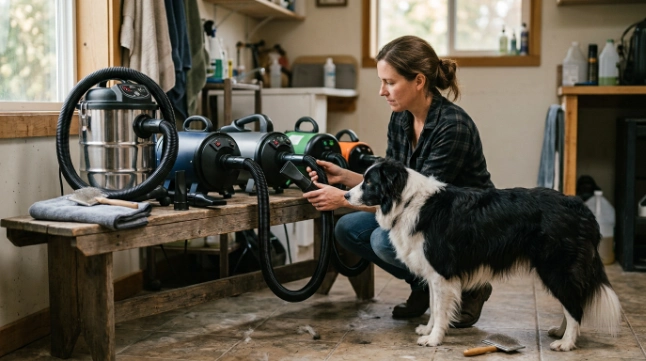
These five machines cover different budgets and grooming styles. As of 2026, I would choose among them based on airflow control, portability, coat density, and how comfortable the dog is with noise.
1. K-9 III Variable — Best Overall
The K-9 III Variable is my pick for owners who want salon-level airflow at home. Its manufacturer lists a variable range of roughly 20 to 245 cubic feet per minute and a 10-foot hose.
- Two motors: Designed for demanding coat-drying work.
- Variable control: More useful for sensitive Borders than a simple high-low switch.
- No heating element: Heat comes from normal motor operation rather than a dedicated heater.
- Heavy construction: The steel housing weighs about 25 pounds.
The downside is size and electrical demand. I would check the outlet and circuit requirements before buying rather than assuming every grooming area is suitable.
2. Flying One High Velocity Dryer — Best Balance of Power and Value
The Flying One is easier to justify for many home groomers. The manufacturer lists variable airflow, up to 240 cubic feet per minute, a 10-foot hose, and no-heat, low-heat, and high-heat choices.
I like the speed adjustment more than the heater. For a Border Collie, I would normally begin with the lowest comfortable airflow and avoid chasing faster drying with excessive temperature.
3. MetroVac Air Force Commander Variable — Best Compact Premium Pick
The MetroVac Commander Variable combines a compact eight-pound steel body with adjustable airflow. MetroVac lists a 4.0 peak-horsepower motor, 1,200 watts, 126 cubic feet per minute, and a six-foot hose.
It is easier to move and store than the K-9 III. That makes it attractive if you groom one or two dogs rather than running long salon sessions.
4. SHELANDY 1902 — Best Lower-Cost Home Option
The SHELANDY 1902 gives occasional home groomers variable airflow without moving into large professional equipment. The manufacturer lists 2,400 watts, 84.7 cubic feet per minute, and airflow between 65 and 135 miles per hour.
It also includes multiple nozzles and warm or cool operation. I would still use the lowest practical temperature and let airflow do most of the work.
5. MetroVac Quick Draw Variable — Best Portable Dryer
The Quick Draw Variable weighs about three pounds, which makes it useful for travel, shows, camping, or small grooming spaces. MetroVac lists 1,000 watts, 101 cubic feet per minute, and a six-foot hose.
It gives up some heavy-coat output compared with larger machines. In return, it is much easier to carry and store.
Section Takeaway: I would choose the K-9 III Variable for maximum heavy-coat performance, the Flying One for balanced home use, and the Quick Draw when portability matters most.
What Should You Look for in a Border Collie Dryer?
Buy for your dog’s coat and temperament, not the largest horsepower number on the box. Air control affects daily usability more than impressive marketing figures.
Variable speed
Variable speed is the first feature I look for. It lets me introduce the dryer gently around the legs and body before increasing airflow through dense areas.
That matters with sound-sensitive dogs. The PetMD guide on getting dogs comfortable with dryers also recommends gradual exposure and beginning on a low setting.
High airflow without aggressive heat
Strong moving air separates wet coat and pushes moisture away. High temperature is not the goal.
If the air feels uncomfortable against my own hand, I consider it too warm to direct at a dog’s skin. I also keep the nozzle moving rather than holding it against one spot.
A flexible hose
A six-foot hose works in a compact bathroom. A 10-foot hose gives me more freedom when the dryer motor needs to sit farther from the grooming area.
Useful nozzles
- Flat nozzle: Useful for pushing water across larger body areas.
- Round nozzle: More concentrated airflow for dense coat sections.
- No nozzle: A broader, gentler stream can help while introducing a nervous dog to the dryer.
Noise and vibration
No force dryer is silent. Variable speed, a stable housing, clean filters, and placing the motor farther away can make the experience easier.
I never use more power than I need. A calmer 15-minute session is better than five stressful minutes at full blast.
Replaceable filters and serviceable parts
Dog hair collects around air intakes quickly. A dryer with an accessible filter is easier to keep working efficiently.
For frequent grooming, I also look at replacement hoses, brushes, switches, and manufacturer warranty support. Long-term serviceability matters more than an extra nozzle.
Section Takeaway: Prioritize variable airflow, cool operation, hose reach, manageable noise, and easy maintenance before chasing maximum power.
High-Velocity vs Other Dog Dryers
A high-velocity dryer is usually the most useful type for a Border Collie. Stand dryers, cage dryers, towels, and human hair dryers solve different problems.
| Drying method | Border Collie fit | Main advantage | Main drawback |
|---|---|---|---|
| High-velocity dryer | Excellent | Pushes water through dense undercoat | Noise requires acclimation |
| Stand dryer | Useful for finishing | Hands-free controlled airflow | Slower for removing heavy water |
| Microfiber towels | Essential first step | Quiet and simple | May leave undercoat damp |
| Human hair dryer | Poor choice | Already available in many homes | Heat and airflow are not designed for canine coats |
I always towel-blot before force drying. That combination gives me the fastest practical routine without depending on high heat.
How Do You Dry a Border Collie Safely?
Start with towels, introduce airflow slowly, and dry in sections until the undercoat feels dry near the skin. Never point concentrated airflow directly into the eyes, ears, nose, or other sensitive areas.
- Brush before bathing. Remove loose coat, small tangles, burrs, and debris before adding water.
- Rinse thoroughly. Shampoo residue can hide beneath a thick outer coat.
- Let your dog shake. This removes a surprising amount of free water.
- Press with towels. Blot and squeeze instead of aggressively rubbing longer feathering.
- Start the dryer low. Let your Border hear and feel the machine before increasing airflow.
- Begin on the body. Work across the shoulders, back, sides, and hindquarters first.
- Keep the nozzle moving. Separate the coat while watching the skin underneath.
- Reduce power near sensitive areas. Use gentle airflow around the neck, legs, belly, and rear.
- Check for hidden moisture. Feel down to the skin before finishing.
The PetMD dog-bathing guide recommends gently towel-drying first and using a pet-safe dryer on a low, cool setting for thicker coats. That matches the routine I find easiest to control at home.
Watch your dog’s body language throughout the process. Repeated escape attempts, trembling, freezing, or escalating distress mean I lower the intensity or stop the session.
Vet note: Stop drying and seek veterinary guidance if you discover painful skin, open sores, significant redness, unusual discharge, or another concerning skin problem.
What Dog Dryer Mistakes Should You Avoid?
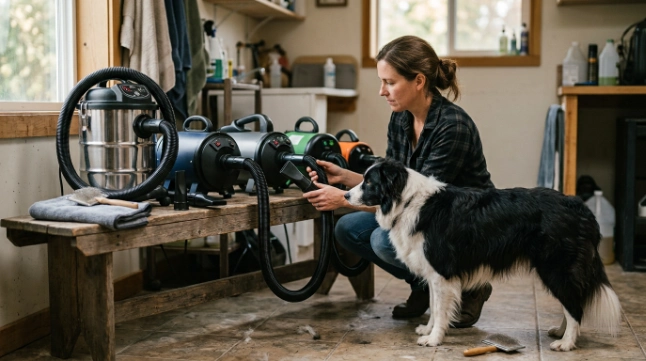
The biggest mistake is assuming faster always means better. Border Collies need thorough drying, but the experience should stay controlled and comfortable.
- Starting at full power: Sudden strong airflow can frighten a dog before the session begins.
- Using excessive heat: More temperature does not automatically create safer or better drying.
- Holding one spot too long: Keep the nozzle moving and monitor the skin.
- Blowing directly into ears: Work around the head gently rather than forcing air toward openings.
- Drying a tangled coat: Deal with loose tangles before bathing whenever possible.
- Stopping when the top looks dry: Feel through the coat and check the undercoat near the skin.
- Ignoring filters: Hair buildup can reduce airflow and increase strain on the machine.
- Forcing a frightened dog: Short desensitization sessions can be more productive than one stressful bath day.
I also avoid using drying as an excuse to skip normal brushing. Force air can move loose coat, but it does not replace careful coat inspection and routine grooming.
Frequently Asked Questions
Can I use a human hair dryer on my Border Collie?
A dog-specific dryer is a better choice for routine Border Collie grooming. Human dryers tend to focus more on heat and are not designed to move water efficiently through a dense canine undercoat.
Do Border Collies need a high-velocity dryer?
They do not absolutely need one, but it can make drying a double coat much faster and more thorough. It is especially useful for rough-coated Borders, frequent swimmers, working dogs, and dogs with dense seasonal undercoat.
How powerful should a Border Collie dryer be?
There is no single required horsepower or airflow figure. I prefer adjustable power because a useful low setting for sensitive areas is just as important as strong airflow for the body.
Is heat safe when drying a Border Collie?
Mild warmth may be available on some canine dryers, but high heat is unnecessary for normal force drying. Use the lowest comfortable temperature, keep air moving, and check the skin frequently with your hand.
Does a dog dryer help with Border Collie shedding?
High-velocity airflow can loosen and move undercoat that is already ready to shed, especially after bathing. It does not stop the natural shedding cycle, so regular brushing remains important.
How do I get my Border Collie used to dryer noise?
Begin with short sessions while the dryer is several feet away, reward calm behavior, and start at the lowest setting. Increase proximity and airflow gradually instead of introducing full power during the first bath.
Should I buy a dryer with a heater?
A heater is optional rather than essential. For a Border Collie’s dense coat, I would prioritize controllable high-velocity airflow, a useful hose, suitable nozzles, and easy maintenance before paying extra for stronger heating.
Final Takeaway
The best dog dryer for a Border Collie is a controllable high-velocity model that reaches the undercoat without depending on excessive heat. For maximum performance, my first choice is the K-9 III Variable.
The Flying One offers a strong balance for home grooming, while the MetroVac Commander is easier to store. The SHELANDY 1902 suits more budget-conscious owners, and the MetroVac Quick Draw Variable is my portability pick.
Whichever dryer you choose, introduce it slowly and let airflow do the work. A calm dog, a thoroughly dry undercoat, and intact healthy skin matter more than shaving a few minutes off bath day.
